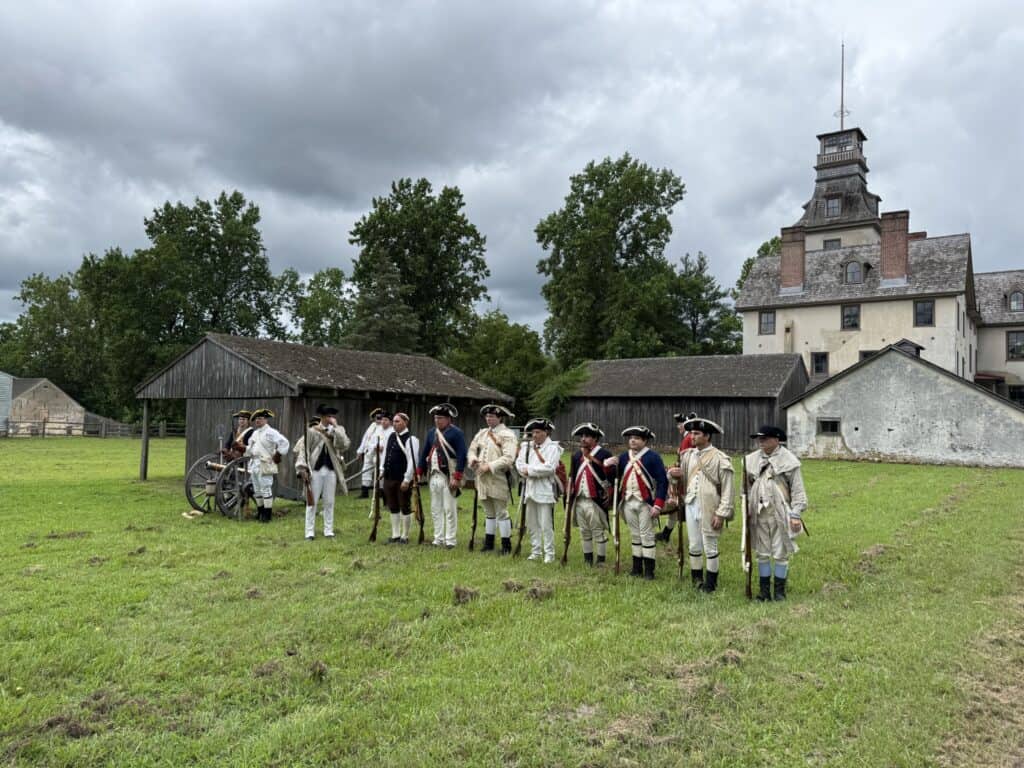
Re-enactors of the Second Pennsylvania Second Regimental Line–Continental Army make ready to advance their ranks to fire upon the British. Each soldier is dressed in a uniform that denotes the state he is from. Batsto Mansion is the backdrop in this photos. Photos by the Author
Batsto Village is an apt addition to our coverage of the Pinelands and its history in shaping the region.
Recently a comrade and I took a trip to Batsto Village, a New Jersey State historic site, as a follow up to our previous two articles on the Pinelands and in the interest of exploring how such a visit might help round out your knowledge about this unique and special region.
We arrived at a full parking lot and a cannon’s deafening salvo. It turns out that the Pennsylvania Line Second Pennsylvania Regiment of the Continental Army was in residence. We were magically transported to the 1775–1783 Revolutionary War as the appointed Regimental Commander described how the line of men advanced and fired at the enemy.
The uniforms varied greatly, each denoting the region that the soldier represented. Buff was worn by New Jersey and New York soldiers; Pennsylvania, Delaware, Virginia, and Maryland regiments had red facings on blue uniforms while Georgia, North, and South Carolina wore blue facings. These reenactors represented the various regions.
A tent and provisions had been set up for the soldiers. There we met two young men who had been tackling the Batona Trail. This track goes through Batsto, traversing 50 miles through the Pine Barrens, and is known for its varied terrain, unique flora and fauna, and a smattering of historic sites. The men, who hailed from Hopatcong in northern New Jersey, had planned a two-day hike. They estimated they had thus far traversed 20 miles of trail, having started at Bass River, when they stumbled upon the regiment’s maneuvers.
When I inquired about what they had seen, they laughed and said, “No Jersey Devil.”
“Oh, he’s out there; you seem disappointed,” I said. “ So what did you see?”
Their list included reptiles, toads, turtles, frogs, lots of flora, wild berries, huge mushrooms, and plenty of ticks. Unlike the Continental Army we saw, they had spent the prior night in tents and shared photos of their adventures.
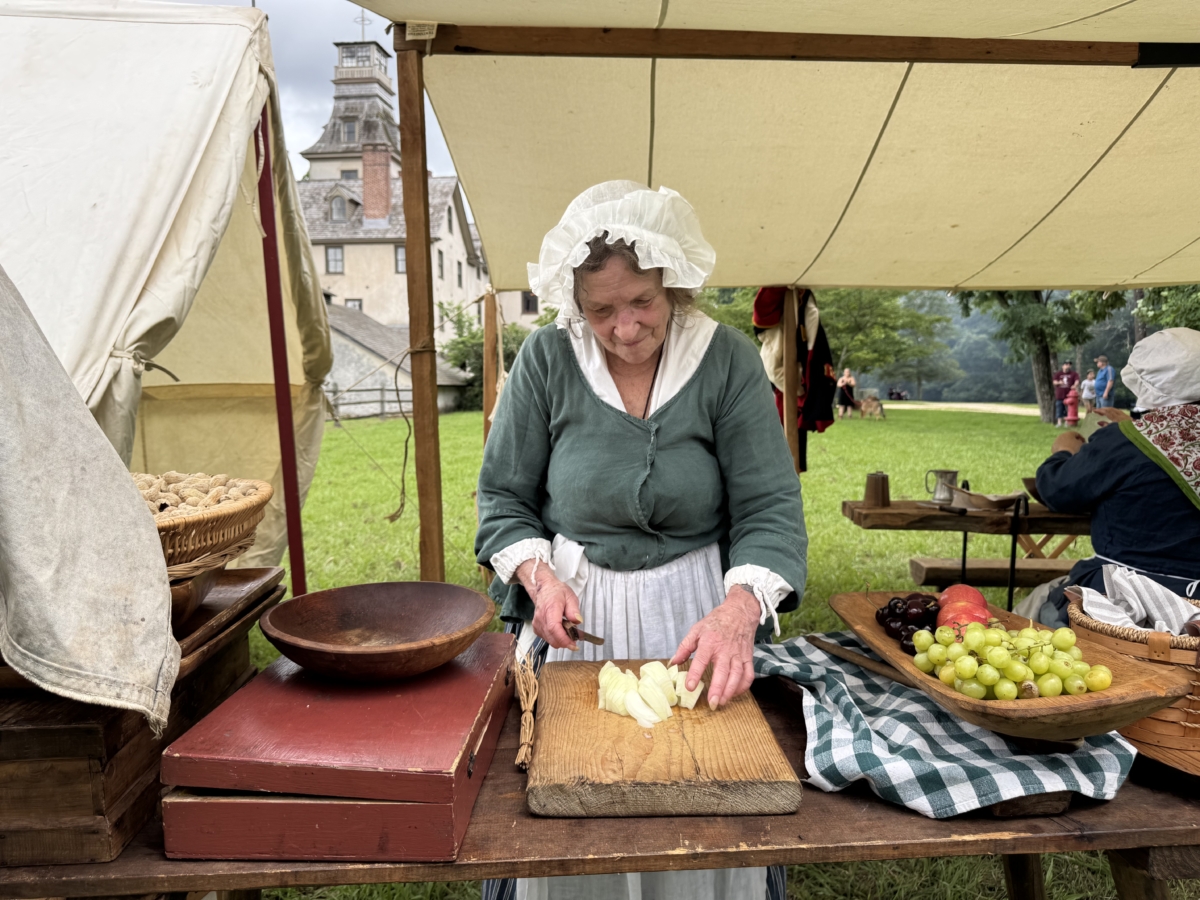
Women in period garb made provisions for the Second Pennsylvania Second Regimental Line of the Continental Army re-enactors. Photo: J. MORTON GALETTO
We excused ourselves to head to the Batsto Village Visitor Center’s interpretative displays and further tour some of the 1,200-acre grounds.
The welcoming display board offered a quick summary of what we would experience: “A Journey Through Time – Welcome to Batsto Village. This once-bustling company town is now quiet (evidently whoever wrote the sign didn’t know about the cannon). The iron furnace that gave it purpose has been cold for more than 150 years … if you look closely and listen carefully as you journey through the village, you will find that the restored homes and buildings now scattered across the ground have many fascinating stories to tell.”
Indeed they do.
Batsto is in Wharton State Forest, representing about one-tenth of the Pine Barrens’ million-acre area that comprises the Pinelands National Reserve. It is the largest remaining wilderness tract on the mid-Atlantic seaboard.
Entering a narrow hall to the left of the visitor’s welcome desk, the halls were decorated with interpretative displays. An explanation is given to European settlers calling the region the “Pine Barrens.” They had found nutrient-poor soil that did not support traditional crops, even though there was an ample water supply. The museum begins its story by discussing soil types and the abundance of water; in fact the word Batsto comes from the Swedish word “Batstu,” meaning bathing place.
The signage also explains key aspects of the Pine Barrens denoting that they are anything but barren. Flora and fauna of the pines are pictured on kiosks—pine and rattlesnakes, rufous-sided towhees, fence lizards, whitetail deer, blue and hackberries, post and blackjack oaks, and pitch pines.
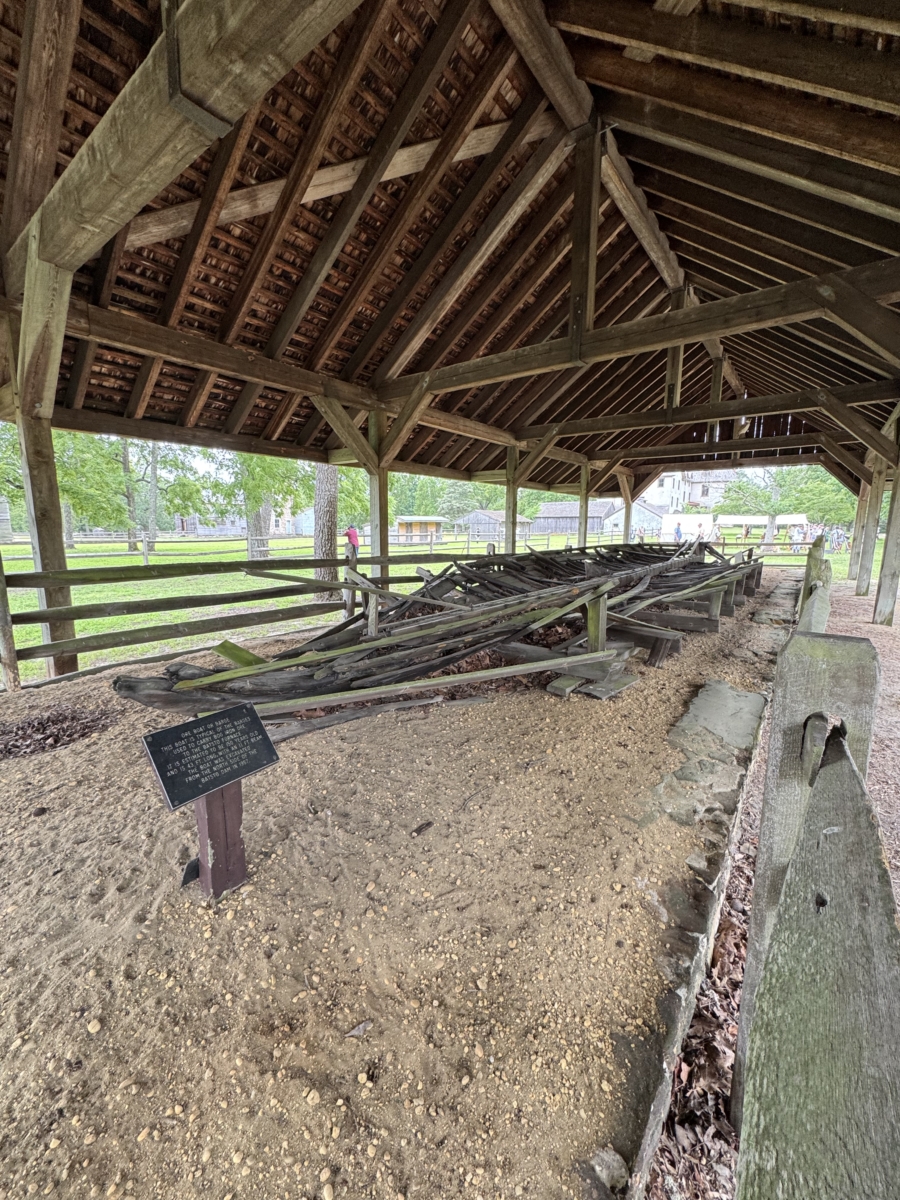
In the 1800s ore boats like this example, 4-foot long with a 11-foot beam, transported materials to and from Batsto’s furnace. Bog ore was fired and then melted to make bars of iron. This boat was excavated from the bottom of Batsto Lake in 1957. Photo: J. MORTON GALETTO
Iron ore was top loaded into a furnace c. 1820 to make iron bars called pigs. Molten material flowed into a main channel and then into side troughs resulting in a form resembling suckling pigs – thus pig iron. Display Batsto Village museum
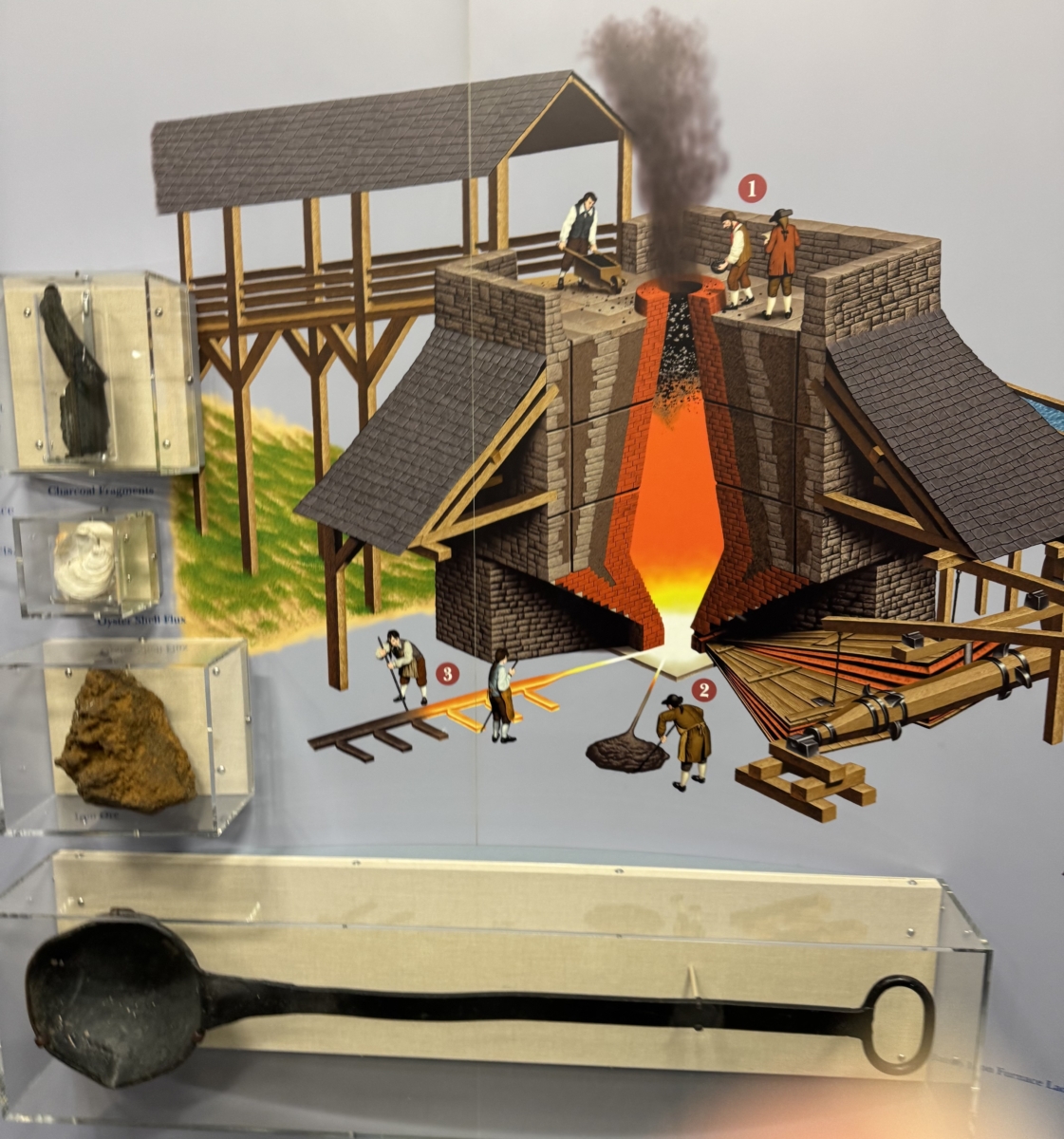
The remainder of the displays delve into the industrial history of the tract and those who prospered and toiled there, initially with the bog iron ore of the region, and the region’s evolution into glass production, lumbering, and agriculture. It explores the families and men who industrialized the property and how they used the resources to manufacture their products.
The pre-Revolutionary War years began in Batsto in 1766, when Charles Reed constructed an iron furnace. Visitors are introduced to Colonel John Cox of the 1773 -1784 era, well-known for the development of iron products, such as cast iron pots, firebacks, Franklin stoves, tombstones, and mortar and pestles. Initially he partnered with Charles Petit and Joseph Ball. During the Revolutionary war munitions became increasingly important and cannon balls were fashioned. The manufacture of armaments was considered enough of a threat that the British navigated the Mullica River in an attempt to destroy the iron works.
In 1784, William Richards took over the property and his family ran the estate for 92 years. They manufactured miles of cast iron pipe for New York City and also the products that Colonel Cox had made famous. They too made munitions, but this time for the War of 1812. His son Jessie further developed products on the property with the introduction of a grist mill, blacksmith shop, and saw mill in 1852.
However, in 1867 the furnace went dark; cheaper, higher quality iron came out of Pennsylvania, and iron sales fell at the Batsto site.
At its height, some 1,000 people were employed in Batsto Village. In 1846, their efforts focused on blowing window glass. Large sausage-like cylinders were cut and flattened to make the window stock. The resources of the pines were critical to glassmaking—sand, shells, wood/charcoal, soda, and lime. However their glass had quality issues that were further complicated by broken shipments. In 1854 Jessie died, leaving his eldest son Thomas to carry on at Batsto.
Glass houses were always plagued by fire and in 1874 the seven glass manufacturing buildings were destroyed by an inferno. Workers’ houses were also casualties. In 1867 the glassworks closed. By 1868, the property was in receivership and in 1874–76 the Richards had to sell their property to pay debts and taxes.
Then began the Wharton era of 1876–1954. Joseph Wharton carried on his business there from the 1880s until his death in 1911. Wharton envisioned that he could collectively channel surface waters of the pines and supply water to Philadelphia. He purchased some 40,000 acres for $14,000 and also paid off the lien on the property for $19,000. He also renovated what today is known as the 36-room Batsto mansion for $40,000.
Wharton is described as “Ambitious, creative and disciplined, and a stunning blend of contradictions. A driven industrialist, he dabbled in poetry throughout his life and was known for his witty conversation. He did not attend college, but became a benefactor for two of this country’s most prestigious educational institutions. An accomplished businessman, his friends and colleagues included Andrew Carnegie, Thomas Edison, Theodore Roosevelt, and Woodrow Wilson. At the same time, he was a devoted family man and a caring employer.”
The Wharton story deservedly takes up a great deal of verbiage in the Visitor Museum and is well worth the read. He had mines across the country, while at Batsto he was interested in forestry, agriculture, and horticulture. He had success growing cranberries, salt hay, wheat, and peanuts, but failed at growing sugar beets.
In 1954 the State of New Jersey bought the property and thus preserved what is now known as the Wharton State Forest.
We toured the mansion and workers’ houses. Greeting us on the mansion porch was the Greater Pineland Dulcimer Society, playing instruments and adding delightful ambiance to our experience.
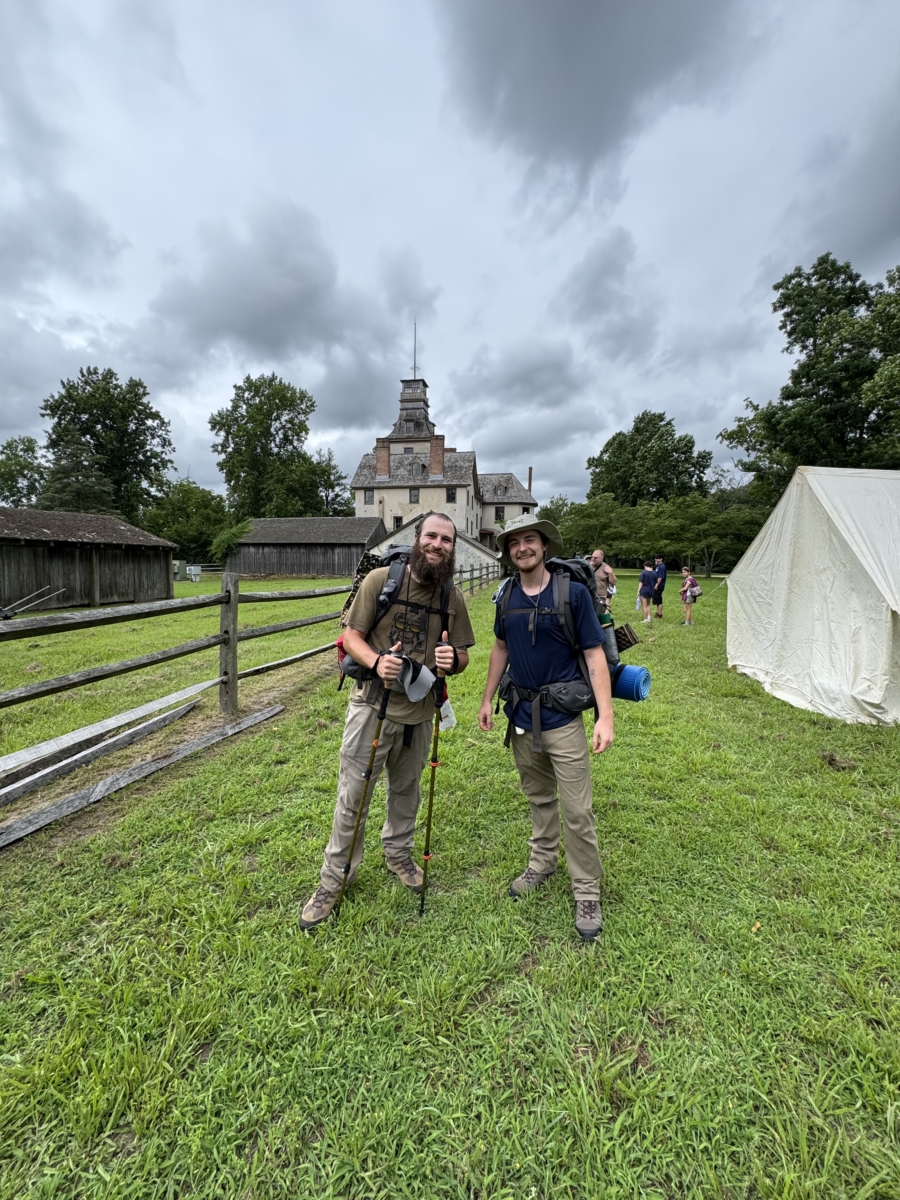
Liam McGuire and Travis Zotynia were hiking the 50-mile long Batona Trail. They started in Bass River and had covered about 20 miles when they arrived at Batsto Village.
The tour guides in the house were able to point out original built-in furnishings versus those that are period-accurate but not part of the house’s amenities. Some items that were donated by the Wharton family were also not part of the original effects. In the library one curiosity was a permanently perched parrot called Polly, adopted by Wharton as a live pet on one of his foreign travels. Polly is said to have flown the grounds and house at will.
I asked the tour guide what he found most interesting in the house that might be otherwise overlooked by the visitor. Without hesitation he responded that the hardware on the doors was manufactured by Russell and Erwin around 1874. He pointed out the intricacies of the designs and they are undeniably beautiful.
As we walked the grounds we looked at workers’ housing, a sawmill, a gristmill, a replica charcoal pit, barn, blacksmith’s shop, and much more. I found the remains of a 150-year-old iron barge most interesting. The 43-foot-long vessel with an 11-foot beam would have carried bog iron ore to the Batsto furnace.
The entire grounds give the visitor a glimpse of what shaped the region we call the Pine Barrens. Here we get a look into our heritage, and it is through understanding our past that we gain a greater sense of place.
Sources
Display at Batsto
Further can be gleaned at: https://nj.gov/pinelands/about/events/Batsto%20Through%20The%20Years%20pdf.pdf
The Visitor Center introductory movie “Batsto- Stories in the Pines” can be watched at https://www.youtube.com/watch?v=8lV7S7iUDNc