
Two-thirds of New Jersey voters think immigration enforcement efforts in this country have gone too far and 59 percent said ICE’s deportation tactics are making communities less safe, according to a Stockton University poll released recently.
When it comes to the scope of immigration enforcement, 12 percent said recent efforts have not gone far enough and one in five said they’ve been about right. More than one-fourth of voters (29 percent) said the tactics employed by U.S. Immigration and Customs Enforcement, known as ICE, are making communities safer, and nine percent said they’ve had little effect on communities either way. Sixty-two percent of voters in the poll by the William J. Hughes Center for Public Policy disapprove of the Trump administration’s approach to immigration and 35 percent approve.
When it comes to undocumented immigrants currently living in the U.S., most voters (58 percent) said they should be allowed to stay legally as long as they meet certain requirements, while 16 percent said they should be allowed to stay legally without conditions, and 22 percent said they should not be allowed to stay legally.
Voters soften on immigration: Voters demonstrated increased support for immigration on a number of measures, signifying a shift in sentiment since the last Stockton poll in October 2024, which included these questions. In the latest poll, 44 percent said immigration to the U.S. should be less difficult, 25 percent said it should be more difficult and 19 percent are satisfied with immigration laws as is.
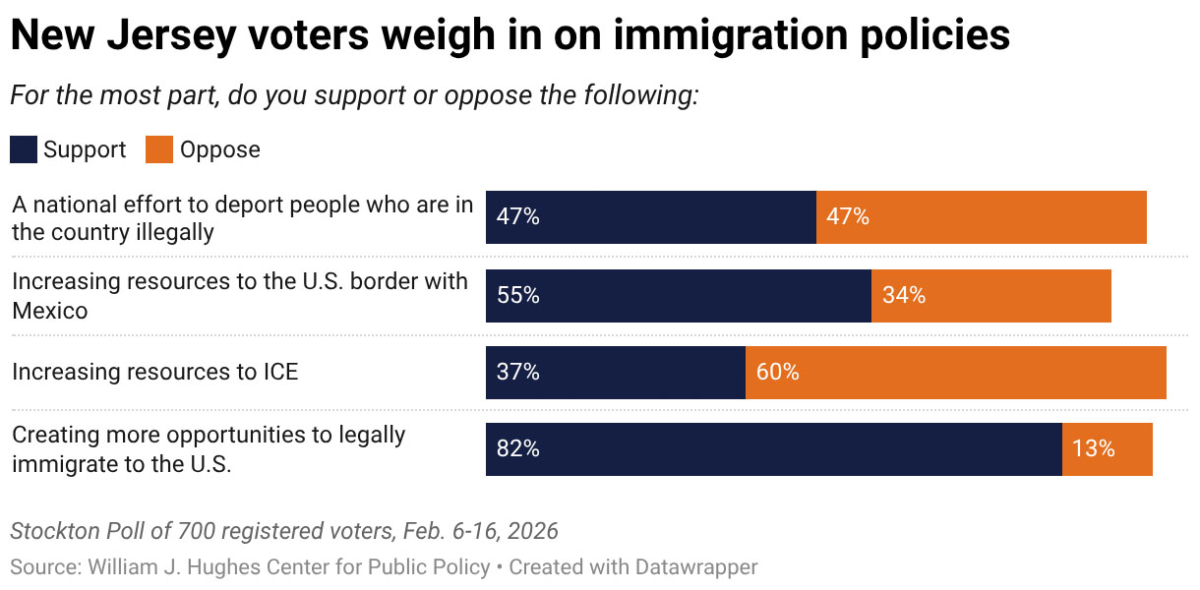
Voters are divided over nationwide deportation efforts but overwhelmingly support expanding pathways to immigrate legally. Three-fourths of voters, including majorities of all parties, said immigration is a good thing for the country overall and there is broad cross-party support for expanding legal immigration. Overall, 82 percent of voters support creating more opportunities to legally immigrate to the U.S., including 93 percent of Democrats, 65 percent of Republicans and 85 percent of independents.
A majority of 76 percent of voters think immigrants add useful skills and labor to the economy, whereas only 16 percent said the U.S labor force does not need immigrant workers to fill skill or labor gaps. As for immigration’s impact on job opportunities, 61 percent said they think it has no effect on opportunities for them or their families, whereas nearly one-fourth (24 percent) said it worsens opportunities and 11 percent said they think it improves opportunities.
A slim majority of 52 percent think immigration to the U.S. has no effect on crime rates, while 29 percent think it worsens crime, and 8.0 percent think it improves crime rates.
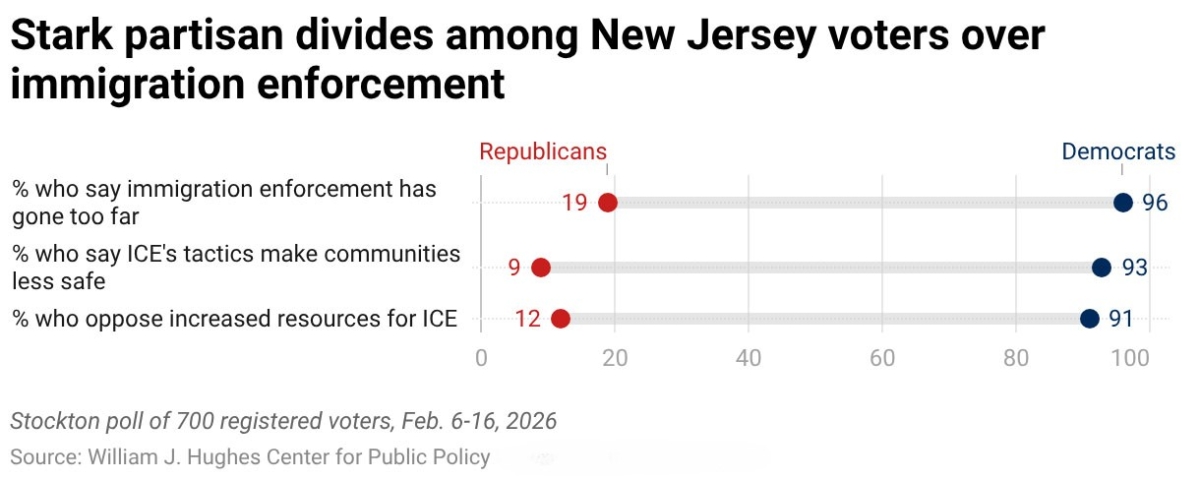
Stark partisan divides: While overall views toward immigration may have softened, the poll reveals sharp divides persist along partisan and, to a lesser extent, generational lines on matters of enforcement. Majorities of Republicans in the state approve of the Trump administration’s approach to immigration (89 percent), said ICE’s deportation tactics are making communities safer (78 percent), support increased resources for ICE (86 percent) and a plurality said enforcement efforts have been about right (46 percent).
Democrats land on the opposite side of each of these measures—96 percent disapprove of Trump’s approach to immigration and think enforcement efforts have gone too far, 93 percent said ICE’s tactics are making communities less safe, and 91 percent oppose additional resources for ICE. Independents fall between the two major parties but majorities ranging from 56-63 percent align with Democrats on these measures.
“While there is broad agreement in New Jersey that immigration contributes positively to the country and bipartisan support for expanding legal pathways, views on how immigration is enforced and the scope of those efforts remain highly polarized,” said Alyssa Maurice, Hughes Center assistant director and head of polling. “Democrats and Republicans also have vastly different perceptions on the impact of immigration.”
A majority of Democrats in the state said U.S. immigration has no effect on crime rates or job opportunities (76 percent and 70 percent, respectively), whereas most Republicans said immigration increases crime rates (63 percent) and worsens job opportunities (52 percent). Independents again land in the middle. Half said immigration does not impact crime and two-thirds said it does not impact job availability.
Voters age 45 and older support the Trump administration’s approach to immigration and recent deportation efforts at higher rates than voters 44 and younger. Higher rates of Gen Z and millennial voters said enforcement has gone too far and ICE is making communities less safe.
Hispanic voters are aligned with non-Hispanic voters on many measures, but some meaningful differences were found. For example, Hispanic voters are more likely to view immigration as a positive force and to say immigration to the U.S. should be less difficult compared to their non-Hispanic counterparts. When looking at minority voters broadly, there is a clearer divide. Significantly higher rates are pro-immigration and expressed opposition to recent deportation and enforcement efforts compared with white voters.
New Jersey state policies: Before leaving office, New Jersey Gov. Phil Murphy faced a package of immigration-related bills passed by the Legislature. He signed one measure into law that restricts immigration enforcement activity in protected locations. He pocket vetoed two others—one that would have codified elements of the state’s Immigrant Trust Directive limiting cooperation between local law enforcement and federal immigration authorities, and another that would have strengthened protections around data collection and sharing. Those proposals have since resurfaced under the new administration.
When asked about a law to limit the types of assistance that state law enforcement officers may provide to authorities like ICE, 48 percent expressed support and 43% percent opposed. Voters showed stronger support for a law related to data safeguards. Nearly six in 10 (59 percent) support establishing restrictions on how state agencies and health care facilities collect and share personal data, including immigration status.
A majority of voters (54 percent) also support creating a state portal for residents to upload documentation of federal immigration enforcement interactions, while 38 percent oppose. New Gov. Mikie Sherrill first announced plans for this portal during a January appearance on The Daily Show and the Office of the Attorney General recently launched the online platform. Examples of activity to report outlined in the announcement include “excessive force, warrantless searches or arrests, racial profiling, wrongful detentions, interference with voting or other civil-rights violations.”
The poll found a generational divide on this initiative with two-thirds of Gen Z and millennial voters younger than 45 in support, and voters 45 and older split evenly (46 percent support, 46 percent oppose). Minority voters also support the portal at higher rates than their white counterparts.
A slim majority of 51 percent are either very (22 percent) or somewhat (29 percent) confident that Sherrill will enact immigration-related policies that align with their views, while 40 percent are not too confident or not at all confident. Sherrill’s support is driven largely by Democrats, with 86 percent expressing confidence in her approach to immigration versus 7.0 percent of Republicans and 43 percent of independents.
The poll of 700 New Jersey registered voters conducted from Feb. 6-16 and released by the William J. Hughes Center for Public Policy at Stockton University has a margin of error of +/- 3.7 percentage points.
You can find the full poll results https://stockton.edu/hughes-center/polling/index.html.