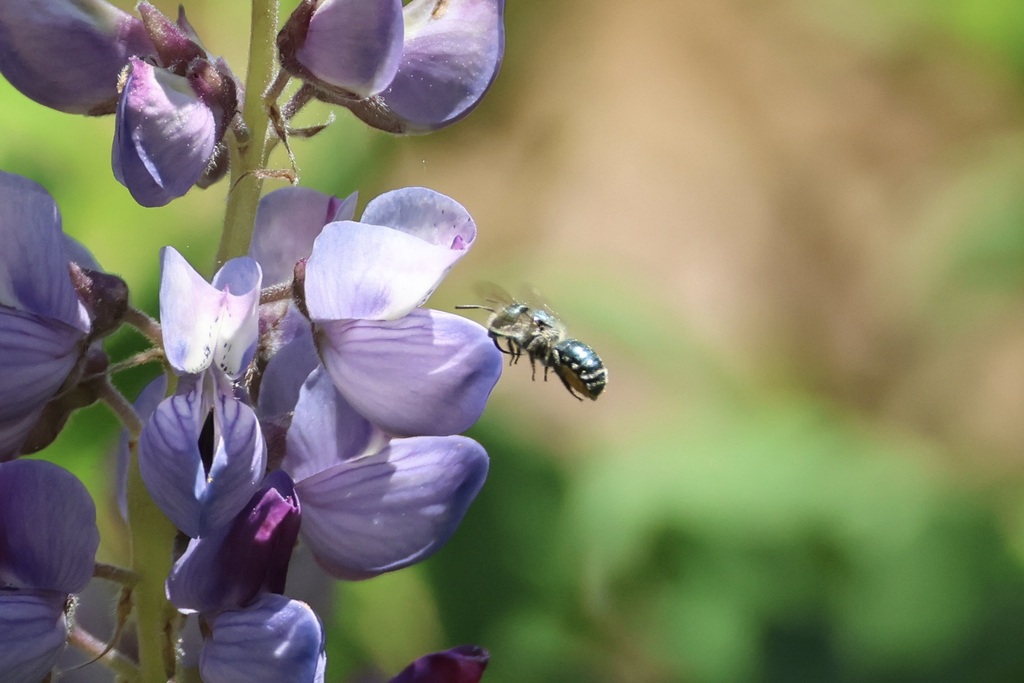
Blue orchard mason bee. Photo: er birds, inaturalist
Mason bees, a.k.a. super pollinators, have a 95 percent pollination rate that far outpaces honeybees.
Recently I attended a workshop sponsored by CU Maurice River on Hymenoptera, a large order of insects that includes bees, wasps, and ants. The main presenter was Michael Hoban of the New Jersey Department of Environmental Protection.
At the end of the workshop participants made a mason bee nursery/house. These bees are native insects, and unlike honeybees they do not produce an edible product. So there is not the demand for a commercial enterprise or a beekeeper to truck breeding boxes/hives for the species to farms or orchards around the country.
If you are shaking your head with thoughts of “So what,” recognize that more than two million bee hives are transported each year in anticipation of California almond trees blooming. These commercial hives are moved by thousands of trucks, each typically carrying 400 hives totaling millions of bees. In other words, pollination is big business.
As a homeowner or an orchard owner, you may be very interested in mason bees because they are super pollinators. In fact, these solitary native bees are said to have a 95 percent pollination rate and be up to 100 times more effective than honeybees. Six mason bees can pollinate an entire fruit tree, while it would take 360 honeybees to pollinate the same tree! I’m sure there are many logistics that make honeybees a preference beyond honey; for one thing the industry is already in place. And management of honeybees is a known business plan. But that is not my focus.
Let’s back up a bit and talk about what a pollinator is and what it does; birds, mammals, and primarily insects fill this role. The shape of a blossom that contains pollen (reproductive cells) often dictates what might fertilize a plant, because access is important. Some flowers can rely on wind or animals to transfer pollen, but a bee’s life cycle is unique in that it collects a mix of pollen and nectar for its developing young.
Hoban explained that pollination is key to the production of fruits, nuts, and vegetables, and in fact 75 percent of these crops are pollinated by insects. Bumblebees are a primary native pollinator.
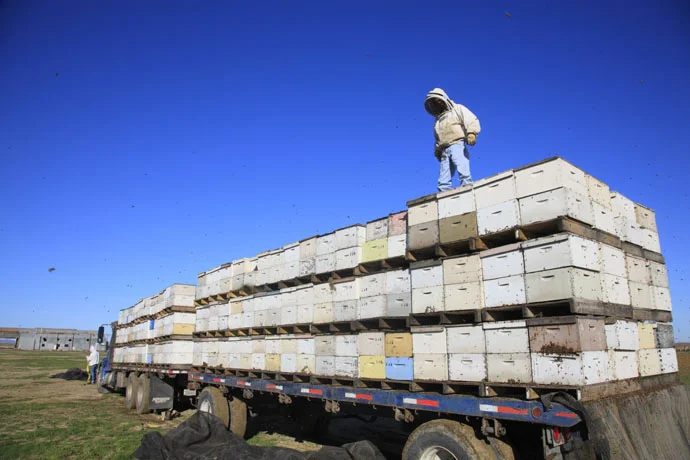
The transport of thousands of honeybee hives is called migratory beekeeping, or the “great pollination migration.” The U.S. Department of Agriculture reports the pollination services for the California almond crop account for about 81 percent of the total U.S. pollination service receipts each year at $361.8 million. Additionally, beekeepers reported 361.5 million in honey production revenue for the same year – 2024. Photo: Frasier Transport
A bee’s body surface is hairy and it collects lots of pollen. As it visits other flowers some of the dusting of pollen is transferred to each plant on its itinerary. So why are mason bees so much more effective? They collect pollen on their underside and they tend to bellyflop onto the surface of flowers dusting it thoroughly; basically they are sloppy. They are also one of the earliest bees to emerge, generally within a day of the vernal equinox, March 21. Last year our redbud tree blossoms were filled with very small, shiny bees, likely mason bees. They are especially fond of a number of native flowering plants, in addition to visiting apples, pears, strawberries, raspberries, cherries, blueberries, and almonds.
Mason bees belong to the genus Osmia, of which 30 species are present in eastern North America. It has become popular over the last 10 years or so for homeowners to drill logs or buy paper tubes to attract these busy pollinators. They are not aggressive; males have no stingers and females seldom attack.
They also tend to be localized so they remain in your garden, while honeybees can travel far or decide to move their entire colony. Mason bees are called solitary because they do not function as a colony with worker individuals, but they will nest close to other bees for community.
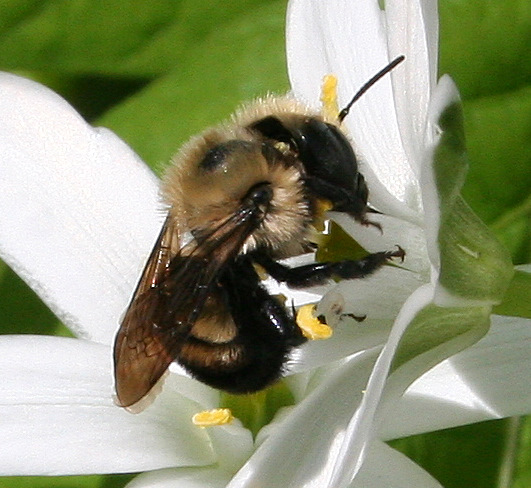
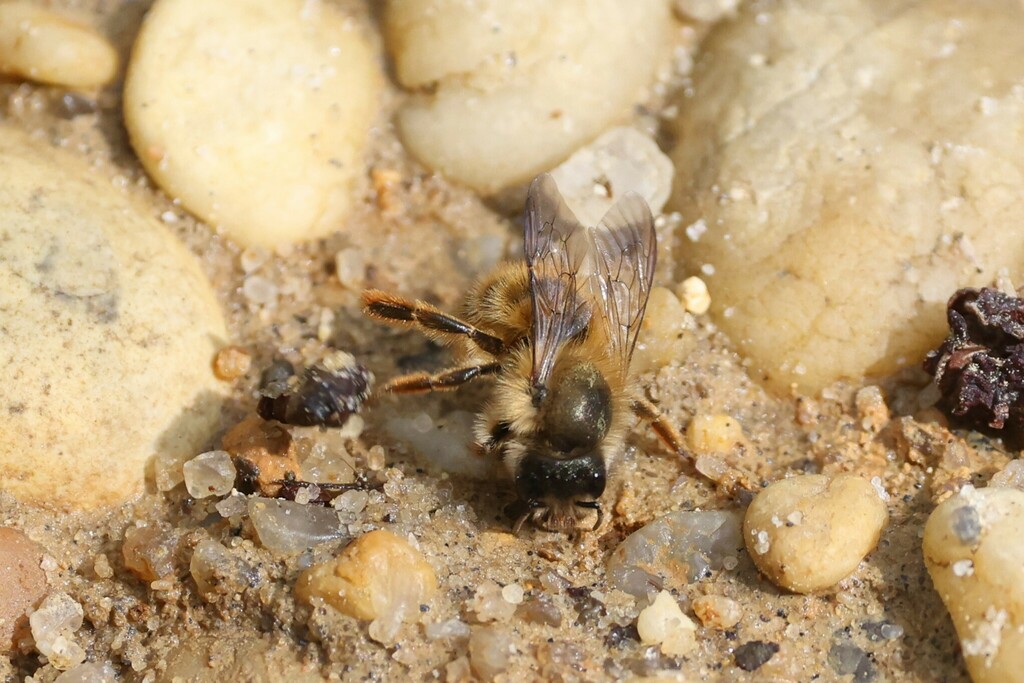
A female bufflehead mason bee works to get nectar and pollen for her nursery. Photo: Thomas Wilson, Maryland Diversity Project RIGHT: The taurus mason bee is native to New Jersey. It belongs to the genus Osmia, 30 species of which are present in eastern North America. Photo: J. Mole, inaturalist
Mason bees don’t drill holes like a carpenter bee; instead they make use of existing cavities like hollowed-out plant stems, so that providing a hollow container filled with paper tubes is advantageous to attracting them to your garden.
Prior to the vernal equinox, tubes are warmed by the sun and young bees can emerge from their chambers. Dr. Michael J. Raupp, better known as “the Bug Guy” and an emeritus professor from the University of Maryland, explains that the males emerge prior to females so they have an opportunity to secure mates early; this is called protandry and is common in the insect world.
Females will spend their daily hours collecting material to make cakes from nectar and pollen. These tiny balls will be placed in the cardboard tubes and an egg will be laid on each cake. Then the female will seal the tube with balls of mud she carries in her mandibles. The result is an individual chamber sealed or walled with mud—thus earning them the name “mason bee.” The egg hatches and grows during the summer or fall and eats the cake for food. When the larva is fully grown it spins a cocoon, changing into a pupa. By the end of summer or autumn it has completely developed into an adult and will stay sealed in the chamber during the winter, to emerge near the vernal equinox, thus completing its life cycle.
The female adult will live six to eight weeks and complete the nesting process before dying. The male’s life is shorter, only two or three weeks, and mating is its primary task. Most of its life is spent developing and hibernating inside its walled cells.
Dr. Raupp relays that he handles the females and has been bitten but never stung. Their docile nature is a plus for people who are bee phobic. In fact, most bees are not aggressive. Wasps, on the other hand, have some nasty players, but generally only if you violate their nesting territory.
Many CU Maurice River members over the years have provided mason bee nursery/housing in their yards and gardens. And CU staffers often suggest Crown Bees.com as an excellent source of information, materials, and expertise in all things mason bee, along with other native bees as well. It has a tool that is even site specific up to a 150-mile radius from your home. I will add that this pdf is available online: “How to manage the Blue Orchard Bee,” U.S. Department of Agriculture; enter the name into your browser to access the document.
Our members enjoy the benefit of attracting additional pollinators to their yard. See the green box to learn about some primary aspects of caring for your mason bee refuge.
Source
Insect crisis, by Oliver Milman
Native Bee House Care Guide
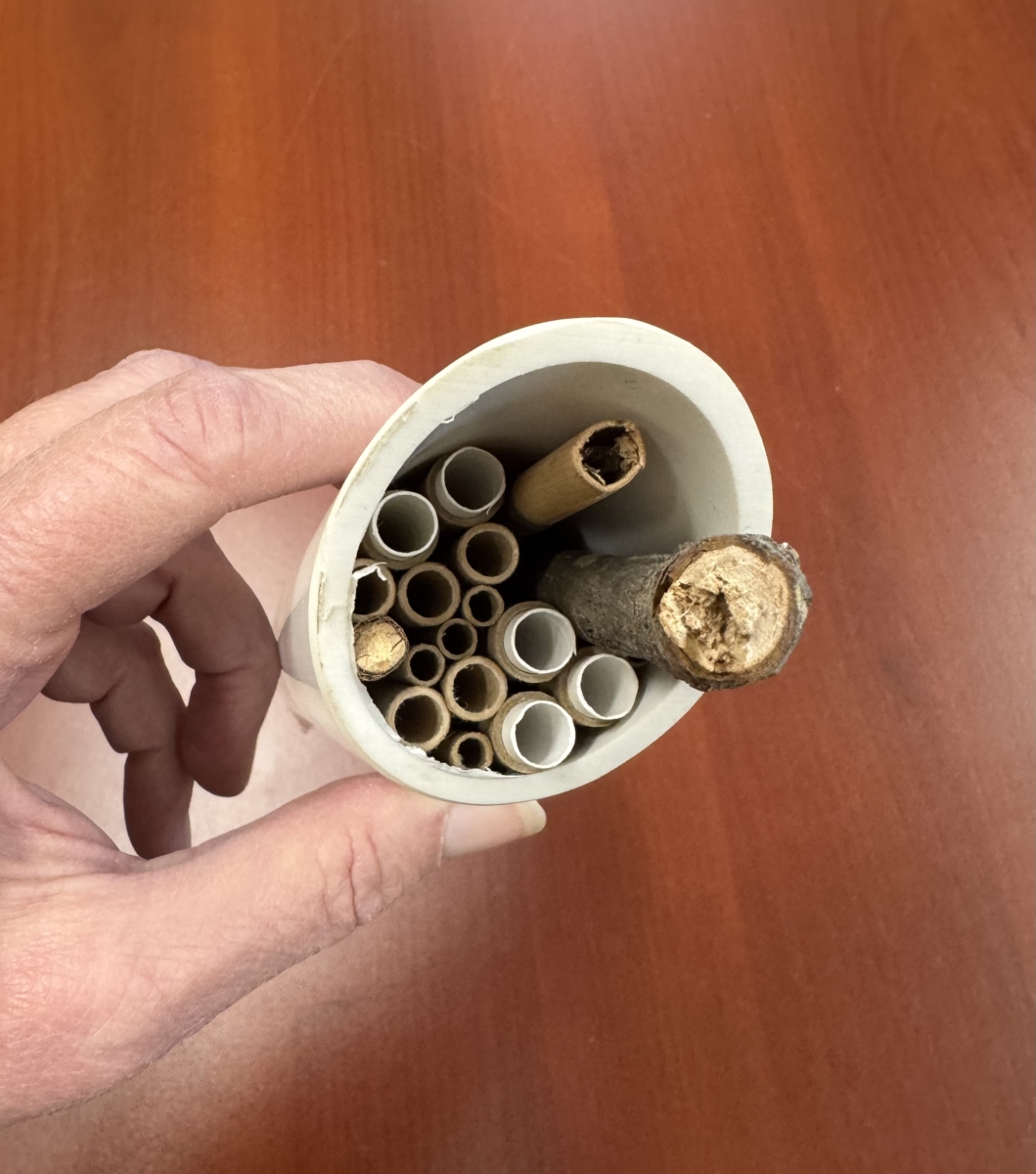
Proper maintenance of a bee nursery//house is essential to ensure it remains a safe and effective nesting site for native pollinators.
Placement & Seasonal Use
• Install 3-5 feet above ground in a secure, stationary location
• Face east or southeast for morning sun
• Choose a site protected from wind and rain, predators and, if possible, near native. flowering plants.
• Install in early spring.
End-of-Season Care
• In late fall (October/November), remove all occupied nesting tubes or the entire house; sealed tubes indicate successful nesting.
• Bring indoors and store in a cool, dry, unheated space (e.g., garage or shed).
This protects developing bees from moisture, temperature extremes, predators, and parasites.
Spring Emergence & Annual Maintenance
• In early spring, place stored tubes outdoors in a container with a small exit hole.
• Allow bees to emerge naturally.
• Replace all nesting material each year; do not reuse old tubes.
• If needed, you can clean the structure; just allow it to fully dry before reusing.
Key Reminders
• Bee houses require annual care to remain beneficial.
• Unmaintained houses can harbor disease and pests.
• Keep structures dry, stable, and well-maintained.
Additional Resources
Crown Bees website – To purchase materials, assist with identification, etc.
The Bees in Your Backyard: A Guide to North American Bees – Bee ID guide
Pat Sutton’s Wildlife Garden website – Information on native gardening and wildlife
Supporting Bees in Your Garden …Rutgers – For information on native gardening and bee management
Xerces Society website – Information on how to create native bee habitat