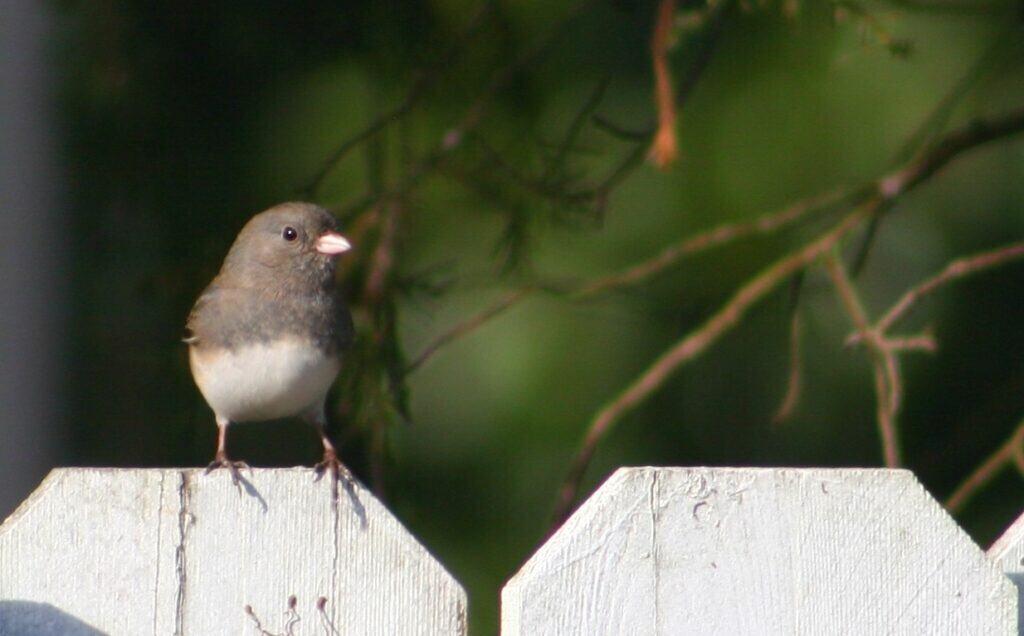
When April arrives juncos begin their springtime exodus to their breeding grounds north of our region. ALL PHOTOS BY AUTHOR
Dark-eyed juncos are so named for their arrivals in winter territories before the first snow falls. By Tony Klock, CU Maurice River
Come late September and early October, cold fronts from the northwest herald the inexorable transition from the warmth of the fading summer into the cooler weather of autumn and on to the deep chill of winter. These air masses usher out many of our migratory birds of the spring and summer months—neotropical birds like the warblers, flycatchers, and vireos—and bring in those species which will be our companions throughout fall and winter. Among our familiar winter birds—the white throated sparrows, blackbirds, and cardinals—are the dark-eyed juncos, the “snow birds.”
Despite their distinctly “unsparrow-like” appearance, dark-eyed juncos are indeed classified as sparrows. Junco hymalis is a rather small bird, five to six inches long and weighing about an ounce. Though dark-eyed juncos exhibit regional variability in appearance, the “slate-colored junco” is the form found in eastern North America. This handsome bird is slate gray with a gleaming white belly beneath a distinctly delineated gray mantle. Its conical bill is light pink to white, and as its name suggests, it possesses dark, almost-black eyes. When flushed, juncos flash bright white outer tail feathers, which may aid in identifying them in the field. The chip note of the junco is short and persistent, often heard while the flock is feeding or when disturbed. These calls serve to keep the flock together and to warn of potential danger. The species do not breed in our region, so the junco’s song, a metallic ringing trill, is not often heard except perhaps in spring before they migrate out to their breeding territories.
Sixty-six percent of the global population of dark-eyed juncos breed in the boreal forests of North America. This vast region, extending across the northern hemisphere and generally above 50° north latitude, consists of coniferous and hardwood forests. They also breed at higher elevations in the Appalachians, from North Carolina up through Maine. They are able to adapt to wildfires, which increase the brushy habitat that they prefer. During migration and throughout winter they are often found in a broad range of landscapes, including gardens, parks, along roadsides, and in fallow agricultural fields.
Juncos nest on or near the ground among the dense understory. Their compact nests, built by the females, are composed of grasses, fine rootlets, mosses, or strips of bark or hair, and are often located alongside a fallen log, boulder, exposed tree roots, or, rarely, on a low horizontal branch. They lay three to six white, gray, pale bluish-white, or pale greenish speckled eggs. Like most small passerines the period of egg laying, incubation through to fledging, takes up to about a month and most pairs try to produce two clutches a year. Nest predation is fairly high and is linked to rodent population fluctuations. Juncos are described as “socially monogamous,” as females may copulate with neighboring males and males may sire offspring with females other than their mate, yet the bonded pair defends their territory and tends to their nestlings.
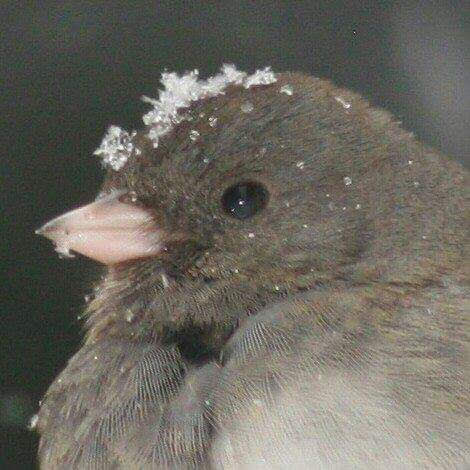
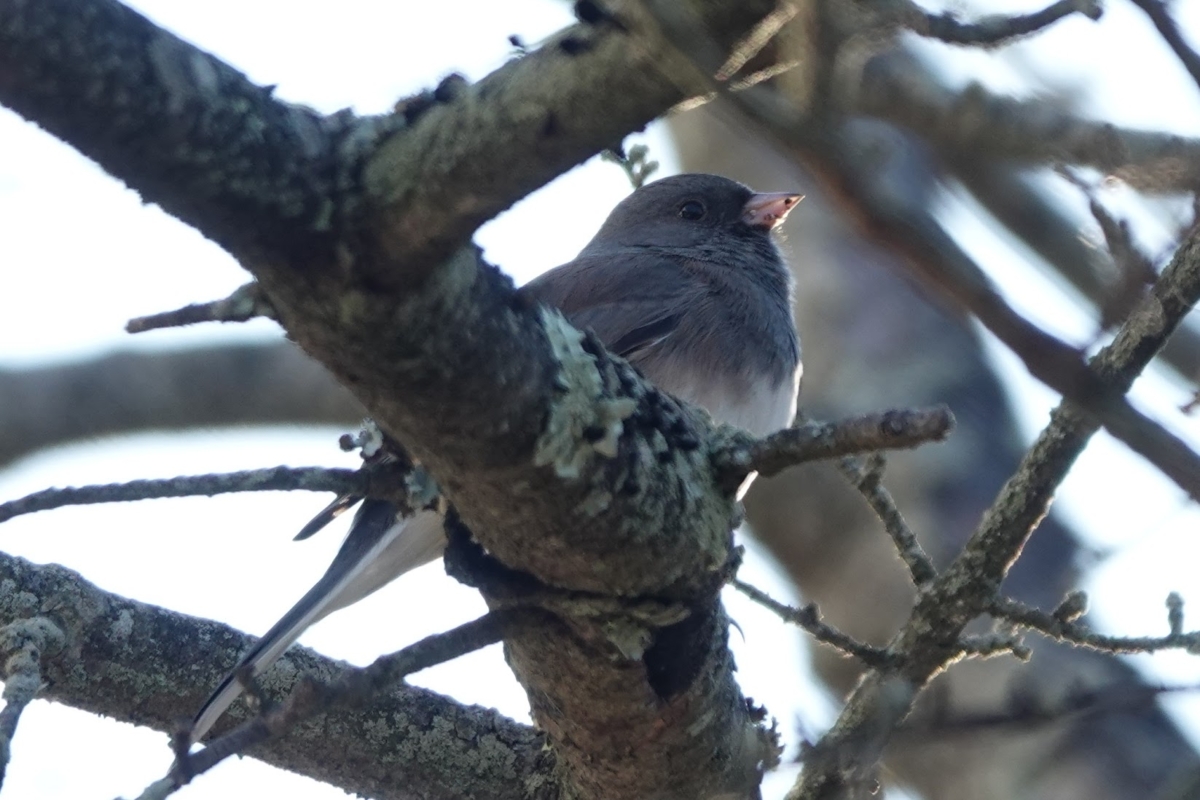
In some traditional cultures, juncos came to symbolize resilience and adaptability, due in part to their ability to survive harsh conditions. The pink beak of the dark-eyed junco and flashes of bright white outer tail feathers as it takes flight are helpful identifiers.
Dark-eyed juncos are primarily seed eaters, particularly during the winter season. Over the course of a year, grass and weed seeds make up approximately 75 percent of their diet, with insects and other arthropods like spiders comprising the other 25 percent, particularly during the breeding season when they are more readily available. Juncos are most often ground foragers, scratching and gleaning in fairly large flocks. At our feeders, they prefer millet to sunflower seeds and do best when the food is broadcast on the ground or on a platform feeder. Feeding flocks are generally hierarchical, with the larger males dominating smaller and younger individuals as well as females. At feeders juncos are often associated with other sparrow species, especially white-throated sparrows, chickadees, titmice, and cardinals.
Juncos’ winter range extends throughout the lower 48 states even into northern Mexico. Fall migration peaks in October and all populations are migratory and, as for many passerines, occurs at night. Interestingly, the females tend to migrate earlier and farther than males. Studies have revealed that merely 20 percent of northern flocks tend to be female whereas in the south females make up over 70 percent of overwintering juncos. As a result, mortality among the longer distance females is higher than those remaining further north. Conversely, harsher winters in their northern range also impact mortality rates, so differences in mortality between the sexes is balanced out. Migration among mountain-dwelling birds tends to be altitudinal with flocks leaving the higher elevations during the colder months and vice versa. Come April, juncos begin to migrate north, seemingly disappearing days, or even hours, before the “World Series of Birding” in early May, much to the frustration of our CU Maurice River team, “The CU Fish Hawks.”
Dark-eyed juncos’ nickname, the “snowbird,” reflects their arrival just before the snows fall in the northern parts of their winter territories. In some traditional cultures, juncos came to symbolize resilience and adaptability, in part due to their ability to survive harsh conditions. Additionally, in some Native American cultures they were believed to serve as intermediaries between the physical and spiritual realms and were thought of as bearers of messages and news from across great distances. In addition, juncos were assumed to offer guidance through difficult times or through important periods of life transition.
Juncos are one of our most numerous species, with their population estimated to be over 220 million globally and averaging a 0.7 percent annual decline between 1966 and 2019, according to the Partners in Flight Avian Conservation Assessment. Despite the cumulative 31 percent decline over this period, they rank an eight out of 20 in the Continental Concern Score.
For bird enthusiasts, juncos are a species that is synonymous with the season. When inviting them and other species to your gardens and feeders, be sure to keep feeders clean and provide cover, like shrubs or even a brush pile, so our feathered friends can evade predators and shelter from the nighttime chill. Providing a source of fresh water is also recommended this time of year when most water sources are iced over. Be sure to make a point to notice these diminutive winter visitors and appreciate the wonders of survival and adaptability that they represent.
Sources
https://www.borealbirds.org/bird/dark-eyed-junco
https://www.allaboutbirds.org/guide/Dark-eyed_Junco/lifehistory