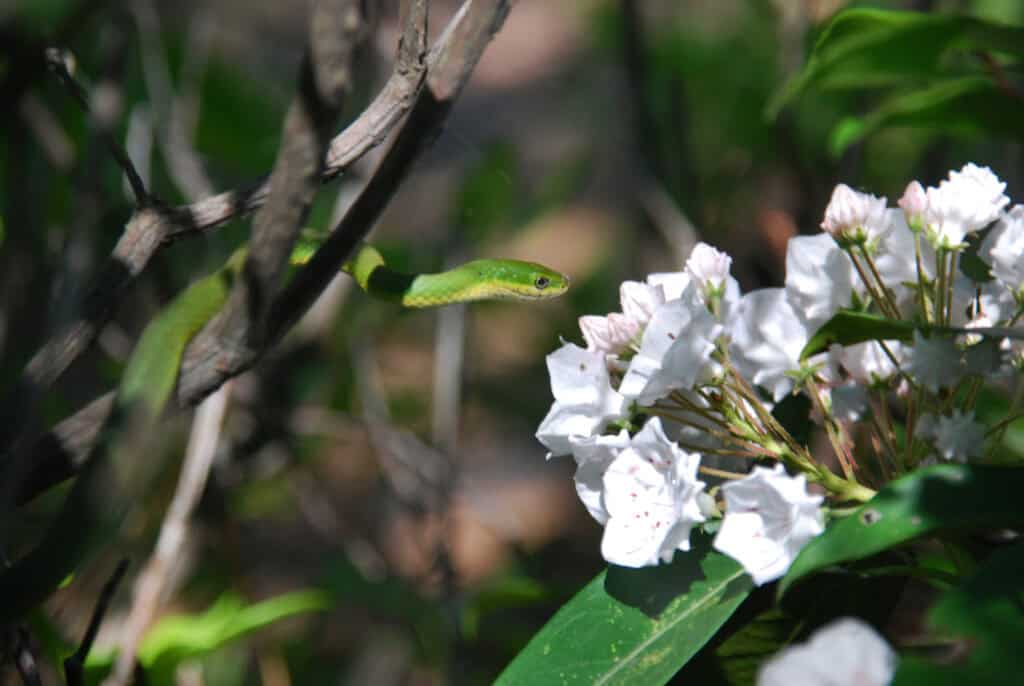
A rough green snake inspects the blossoms of mountain laurel for an insect meal. all photos: J. Morton Galetto
Unlike most snakes, the rough green species is active during the day, much to our columnist’s chagrin.
As hard as I try not to react, when I first encounter a snake it startles me. One of my fellow naturalist friends, by means of explanation, simply noted, “That’s what they are supposed to do,” letting out a rusty chuckle.
A close friend who studies snakes knows that while I’m intellectually accepting of these creatures, I’m clearly phobic viscerally. In spite of this she chose casually to hand me a docile northern pine snake during annual data collection in the field. What was I to do? I wasn’t going to drop a rare species! So I just stood there, feigning a relaxed state of mind, until it grabbed my shirt.
“Ummm, Joanna, it’s holding my shirt.”
“Oh yeah, they do that.”
“Thanks.”
We proceeded to weigh it, measure it, and look at its overall health before returning it to its winter den.
Evidently the snakes have gotten the memo that they startle me, and possibly they have found it funny to greet me at the back door over the years. Unfortunately I don’t share their sense of humor, nearly dropping the groceries or whatever else I’m lugging up the stairs when I encounter one. Eventually I come to my senses and tell myself, “Oh that’s right, I find serpents interesting,” and I go fetch the camera.
Coming to one’s senses should be a relatively easy lift in southern New Jersey, because we have but one poisonous snake and it is rare, endangered, and shy. And I presume it would flee, if push came to shove, or at least make a noise before striking. Our timber rattlesnake is only likely to bite if purposely annoyed. I can assure you that’s not happening under my watch, and surely not by me. Lastly there are no rattlesnakes within 30 miles of my yard. So knowledge, not bravery, is on my side.
Last October a rough green snake decided to greet me at the back steps. It gave me the usual scare and once again I managed not to drop the groceries on its head. These are docile creatures and don’t bite; rather they rely on stealthy retreats into underbrush or beneath the branches of trees for protection. My steps offer neither, so I was left in a bit of a showdown.
I navigated my way around my visitor, Opheodrys aestivus, and headed once again to fetch my camera. Opheodrys aestivus, the scientific name for the rough green snake, gives us insight into its nature—ophis of Greek origins meaning snake, and “drys” referring to “tree” or “oak.” Aestivus is Latin for “summer,” the full name allowing us to understand that the rough green snake is arboreal (tree-dwelling) and is active during the warmer months. Furthermore it is a long slender non-venomous snake, 22 to 32 inches in length, brilliant green with a pale green underside (texts normally describe their underside as white, yellow, or pale green). Their proportionally large eyes have a golden ring around a large round pupil, encircled by a dark black border.
This species is diurnal—unlike most species of snake they are active during the day, making it a bit more likely to encounter one. At night they sleep coiled in the branches of deciduous trees and shrubs where the slender green branches and leaves offer them good camouflage.
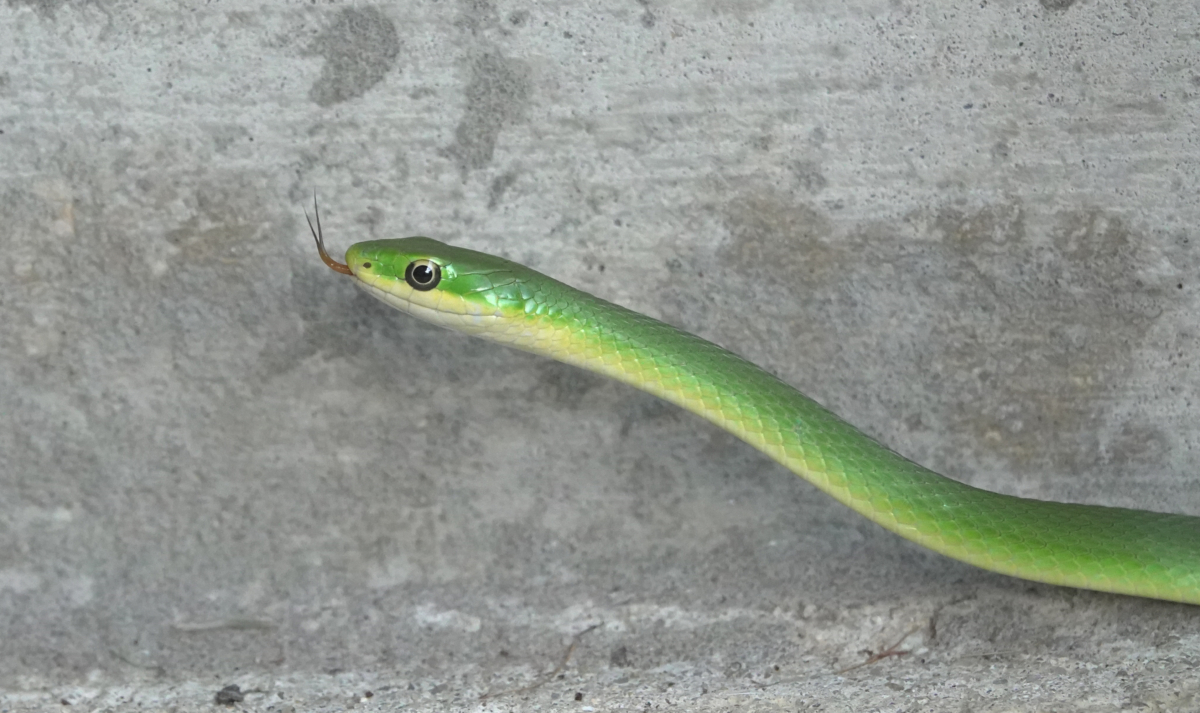
The tongue of the rough green snake enables it to pick up chemical clues for hunting. Its keen eyesight is invaluable for catching prey.
Their preferred habitat is dense vegetation near lakes, rivers, and stream shorelines. In fact they normally stay within 10 feet of waterways. They will venture further to lay their eggs and then return to the shoreline trees. Although our back door is about 250 or 300 feet from the river they have greeted me there a number of times over the past 43 years. Generally I come upon them in the fall, so they may be taking advantage of the relative warmth of some foundation structure for brumation (hibernation by cold-blooded reptiles). They are generally solitary but are thought to possibly use communal dens.
“Male rough green snakes court females using a variety of motor patterns, including chin rubbing, tail waving and head jerking. They usually leave the female immediately after breeding occurs (Chesapeake Bay Program).” Females are sexually mature at 21 months and males at 33 months.
These snakes mate in a relatively short period of time, aligning alongside each other in less than three minutes and staying paired for about 15 minutes. Brevity is important because two snakes are easier to spot than one and they are more vulnerable to predation when paired, especially due to their small size.
After a gestation period of five to 12 weeks, three to 12 eggs will be laid in June or July. The female selects secluded spots to lay her eggs—hollows of living or dead trees, under rocks, and places that have some moisture—generally about 30 meters from a shoreline. Several females will often deposit eggs in the same nest. After laying her eggs the female returns to her arboreal habitat, usually only about 10 feet from the shoreline. Eggs hatch in August and September, yielding baby snakes that are seven to eight inches long.
When their eggs are laid they are already fairly well developed, meaning that they have a short incubation period resulting in less exposure to predators and a better chance of survival. They reach a mature size in about a year’s time. Females are larger than males.
Michael Plummer, professor emeritus at Harding University, who has studied rough green snake nesting, suspects their early maturity is necessary because they are heavily preyed upon by birds, larger snakes, and domestic cats. So to ensure success they must have larger clutches earlier in life to perpetuate their species. High mortality is not only caused by predation but also by encountering hot, dry conditions.
The rough green snake forages on insects. When hunting, these snakes sense chemical cues with their tongue and employ keen eyesight. Just a twitch of antennae from a grasshopper or cricket will alert them. Biology professor/naturalist Steven K. Goldsmith explains their hunting behavior as consisting of fast irregular advancement, until they are very close to their prey. Once within about two inches they assume a curved stance and spring forward by abruptly straightening their body. Often they lift their prey so it can’t get traction on the ground’s surface.
For most snakes your reaction is often their first and only defense. So I suppose my fetching up upon first spotting one is just as nature intended it.
Sources
Plummer, M. 1990. Nesting Movements, Nesting Behavior, and Nest Sites of Green Snakes (Opheodrys aestivus) Revealed by Radiotelemetry. Herpetologica, Vol. 46, No. 2: 190-195.
Goldsmith, S. 1986. Feeding Behavior of an Arboreal, Insectivorous Snake (Opheodrys aestivus) (Colubridae). The Southwestern Naturalist, Vol. 31, No. 2: 246-249.
Chesapeake Bay Program, Rough Green Snake, chesapeakebay.net
Special thanks to Kris Schantz, Principal Zoologist for the New Jersey Department of Environmental Protection’s Endangered and Nongame Species Program
HOW TO HELP
Major threats for reptiles and amphibians: Forest fragmentation from development and roads, off-road recreation, road mortality, deliberate attacks/persecution and/or poaching by humans.
In the Maurice River watershed, all 18 species of snakes are NON-venomous.
You Can Help:
• Be careful when you operate vehicles to avoid running over reptiles and amphibians.
• Do not use poisons to kill rodents; use mechanical traps when necessary. Poisoned animals kill non-target wildlife.
• It is illegal to kill, harass, or collect any native, non-game wildlife.
• Report snake collectors or other wildlife violations to NJ Fish Wildlife’s Law Enforcement – Operation Game Thief Hotline 1-855-648-8477. Gather any data you can—car description, license number, etc. Information is law enforcement’s friend.
• Construct brush piles to help snakes and other animals escape predation and the elements.