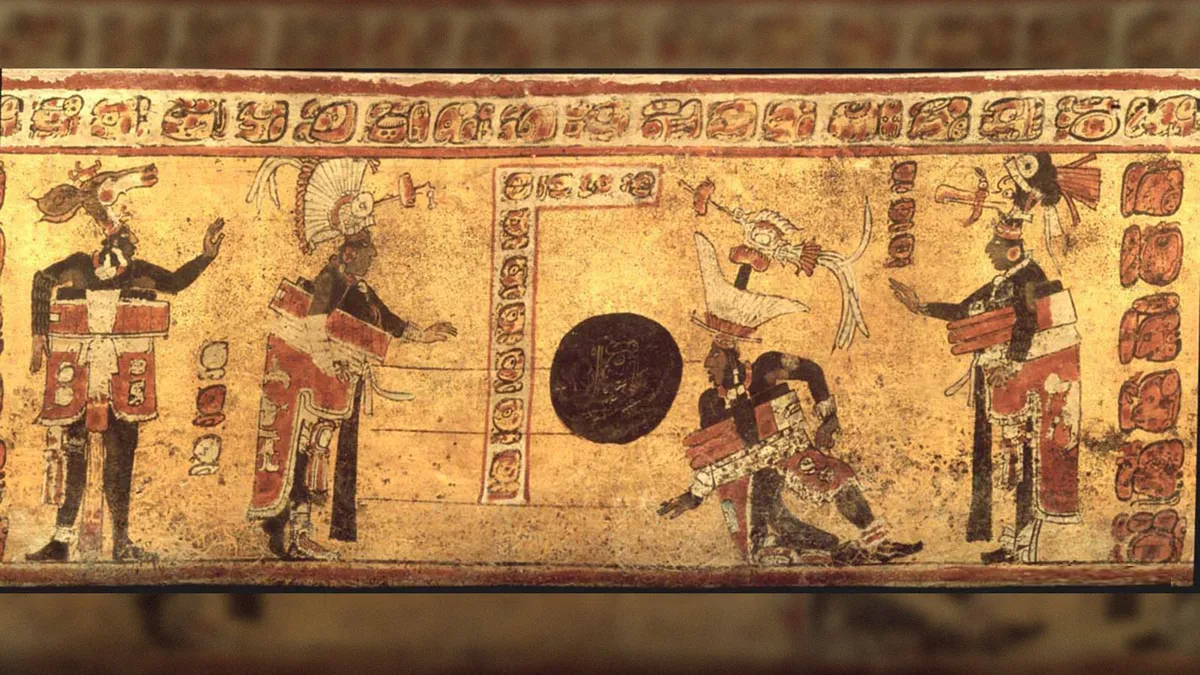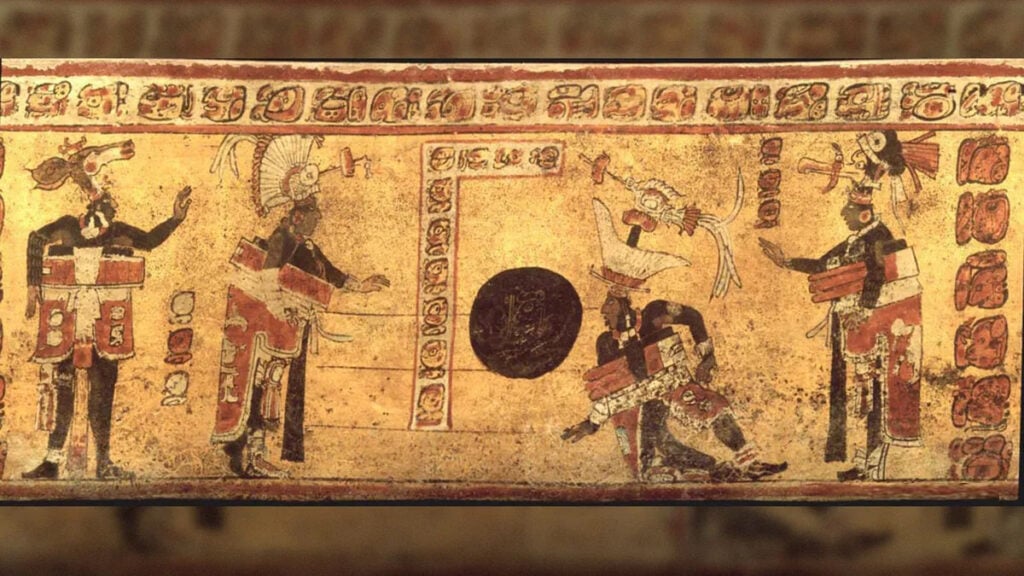
Pok-to-pok ball game, depicted on a ceramic vessel, c. A.D. 682-701. The rubber ball, symbolic of the sun, was thrust by hips and knees. Team members who lost were sacrificed, according to signage at archeological sites but present-day archeologists disagree on this outcome. (Dallas Museum of Art).
From Mesoamerica to ball games, the raw material grows in trees.
In recent years my husband and I have travelled to Mesoamerica to explore avian species and Mesoamerican archeological sites in Mexico, Costa Rica, Belize, and Guatemala. These visits have not been as lofty researchers, but rather simply due to curiosity—as adult learners and tourists.
Mesoamerica was originally defined by German-Mexican anthropologist Paul Kirchhoff, in 1943, as being a civilization that shared a maize agriculture, complex calendars, polytheistic religions, and monumental architecture like pyramids. The political and geographic region today includes Central Mexico through Belize, Guatemala, El Salvador, Honduras, Nicaragua, and northern Costa Rica.
Last February we returned from Guatemala and in July of 2025 we went to Singapore. On both trips we encountered aspects of an agricultural industry, the rubber that had its first modern-day boom in connection with the development of the automobile in the late 19th century, when the demand for car tires skyrocketed.
Rubber transformed little-known towns like Manaus, Brazil on the Amazon into affluent centers of trade. Manaus was the center of the rubber industry. In a few short years, it acquired Brazil’s first telephone system, 16 miles of street car tracks, and an electric grid that rivaled cities with populations of one million, in spite of its mere 40,000 inhabitants. Like the stories about our local oyster industry, rubber barons were said to have lit cigars with hundred-dollar bills as a gross display of wealth. But the stories of giving thirsty horses buckets of champagne, sending dirty laundry to Portugal for cleaning, and feasting on elaborate European delicacies seem far more ridiculous than the New Jersey Delaware Bayshore oystermen’s extravagances. The citizens of Manaus “were the highest per capita consumers of diamonds in the world.” (One River, by Wade Davis 1996)
Adequate help was an issue at rubber plantations and the brutality of the industry’s owners in securing help knew few bounds. Native Indian slaves were terrorized into compliance. Even human stud farms were employed, with one baron owning 600 enslaved women whom he bred like livestock to produce workers.
According to an article by World Rain Forests.com, rubber baron Julio Cesar Arana terrorized slave labor. “As the Indians died, production soared: In the 12 years that Arana operated on the Putumayo River in Colombia, the native population fell from over 30,000 to less than 8,000 while he exported over 4,000 tons of rubber earning over $75 million. The only thing that stopped the holocaust was the downfall of the Brazilian rubber market.”
At the Singapore Botanical Garden (SBG), we learned that Kew Gardens in England sent 22 rubber seedling trees to SBG in 1877. This began experimentation by Henry Ridley, a botanist and the director of the SBG. Ridley managed to develop a new method of tapping rubber trees for their latex and he persuaded farmers to try its cultivation. Malaysians were more interested in traditional crops like coffee; however, the onslaught of a coffee tree disease and the invention of Dunlop’s pneumatic tire gave Ridley’s idea traction, and he was successful in getting some coffee growers to give rubber a go. Over time, the exotic rubber tree has become dominated by Southeast Asian countries—Thailand, Indonesia, and Vietnam.
Today Guatemala has established itself as the key supplier in Latin America and ostensibly the ninth largest producer worldwide. Interestingly, the species of tree that is the commercial producer of rubber there, Hevea braxiliensis, is not native to Guatemala, while a different latex-producing tree, Castilla elastica, is indigenous to that country as well as to the rest of Mesoamerica.
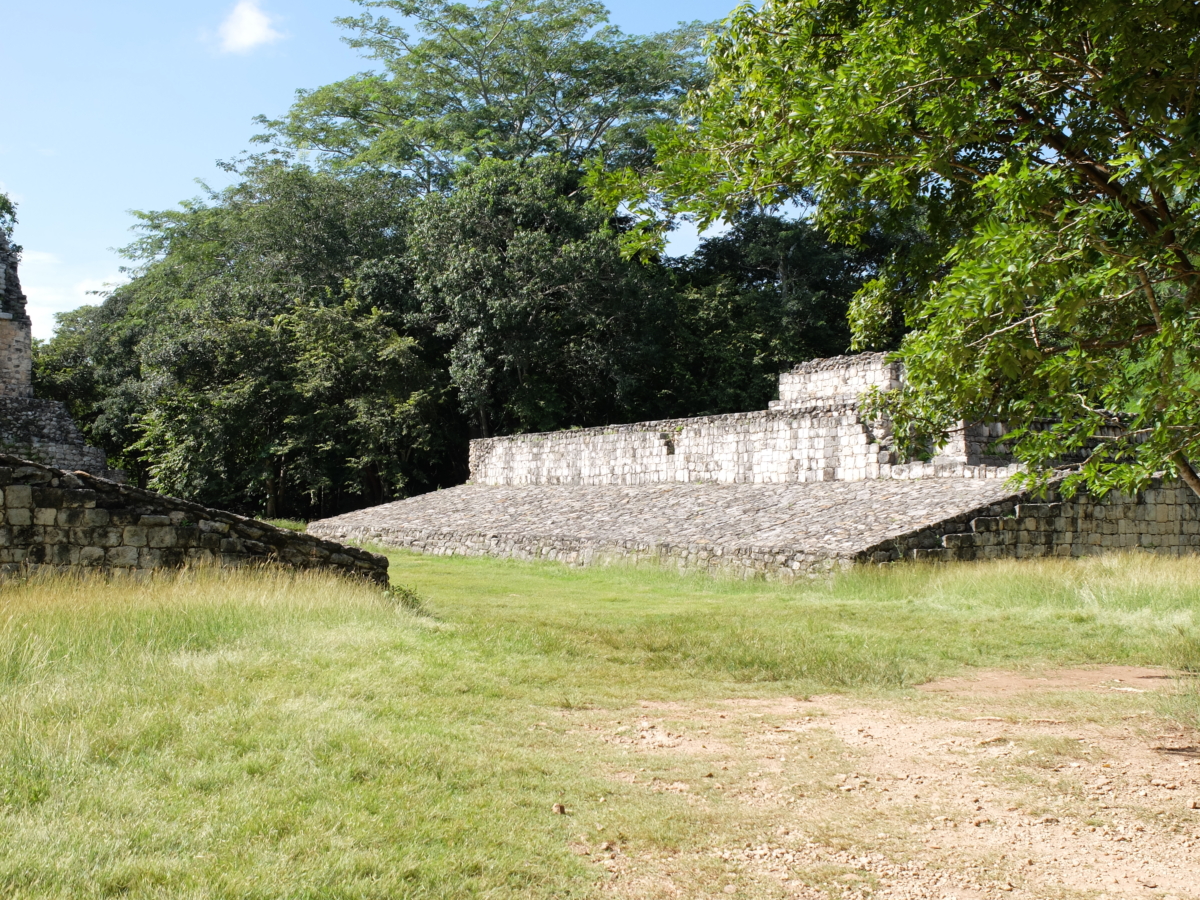
Mayan ball court in Ekʼ Balam is a Yucatec-Maya Temozón archeological site – Yucatán, Mexico. Photo: J. Morton Galetto
These trees do not produce “rubber” but rather latex, to which other ingredients must be added to fabricate the end product. Hevea braxiliensis plantations were introduced in 1940 and we passed many of these farms in our travels. Each tree had a collection cup or taza para látex attached to the trunk. From my readings, I assume these are emptied in the cool of the morning when latex flows best. They are not as biodiverse as coffee tree groves, so we did not go birding in the rubber tree plantations.
We did learn about Castilla elastica, which provided the spheres for the famous ball alleys found in Mesoamerican archeological sites. The ancient game’s anglicized name is Pok-to-pok, Pok-a-tok, or pitz, in reference to the sound of the ball hitting the players. The game is played using a heavy rubber ball that is passed between players using hips, elbows, and knees (in some cultures paddles). Opposing walls have a stone hoop, with the object being to pass the ball through that hoop. Most of what is known about the Mesoamerican ball games comes from a present-day variation of the sport and likely conjecture, but yes, a variation of the game is still played today. It was a popular sport and there are about 1,500 ancient ball courts that have been identified in Mesoamerica, averaging 65 feet in length.
The defining feature is a court with two opposing walls. Most interpreters suggest that the game was a combination of athletics and politics, involving slaves and with politically predictable outcomes. Some balls were as large as beach balls, weighing seven kilograms, and were used not only in this ritual game but also in elaborate religious ceremonies.
Interdisciplinary scientists called Archaeological Materials Scientists at Massachusetts Institute of Technology (MIT) study the relationship between ancient societies and their material use. In 1999, they made some interesting discoveries about the rubber balls used in Pok-a-tok. Castilla elastica tree latex alone would be too brittle for play, and so Mesoamerican cultures added crushed morning glory vines to provide an essential ingredient and create a rubbery material.
So why is this astounding? Manufactured rubber is believed to have originated in 19th-century Europe. Yet the MIT research team, led by Professor Dorothy Hosler and undergraduate Michael Tarkanian, uncovered the fact that by 1600 BC Mesoamerican people were using latex and morning glory vines to formulate the same material: A bouncy ball 3,000 years before the development of vulcanized rubber!
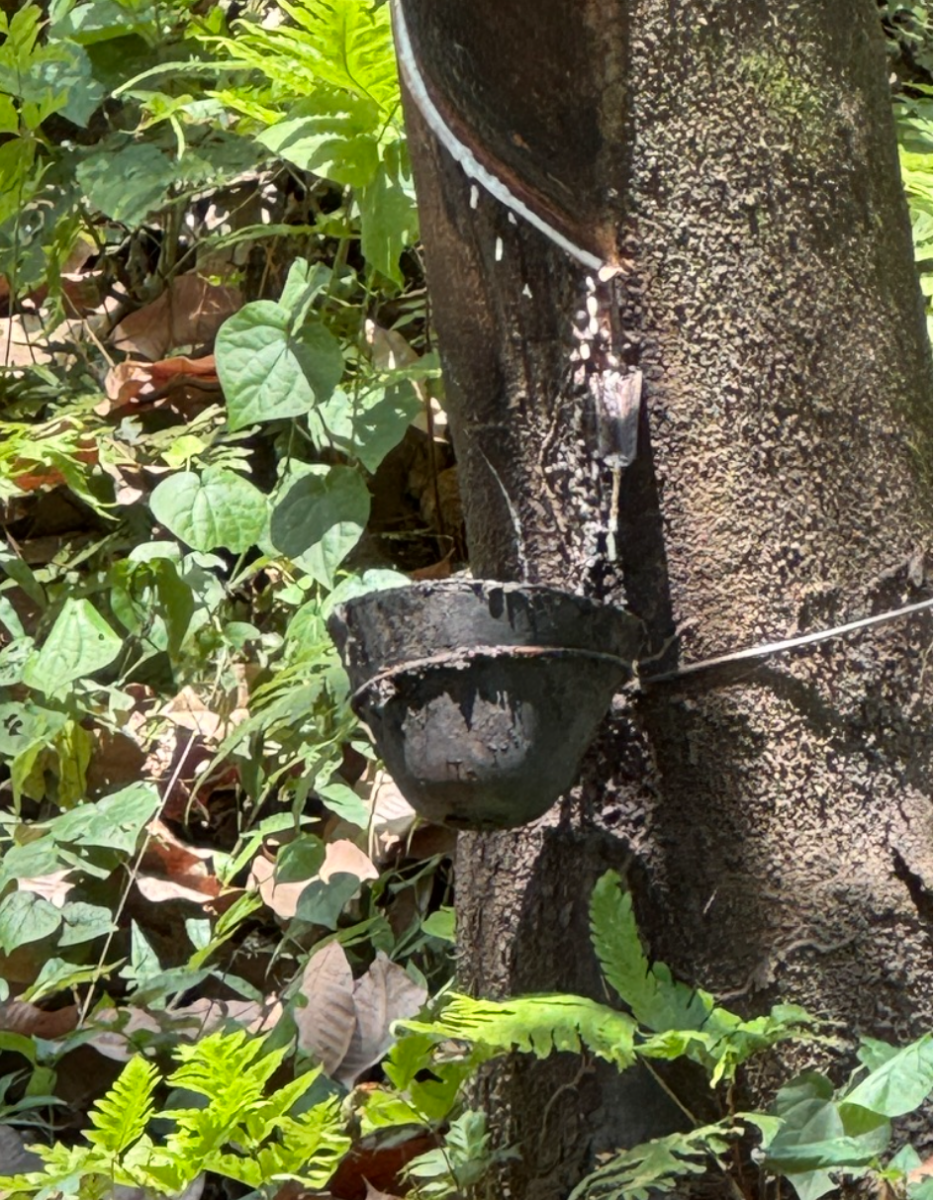
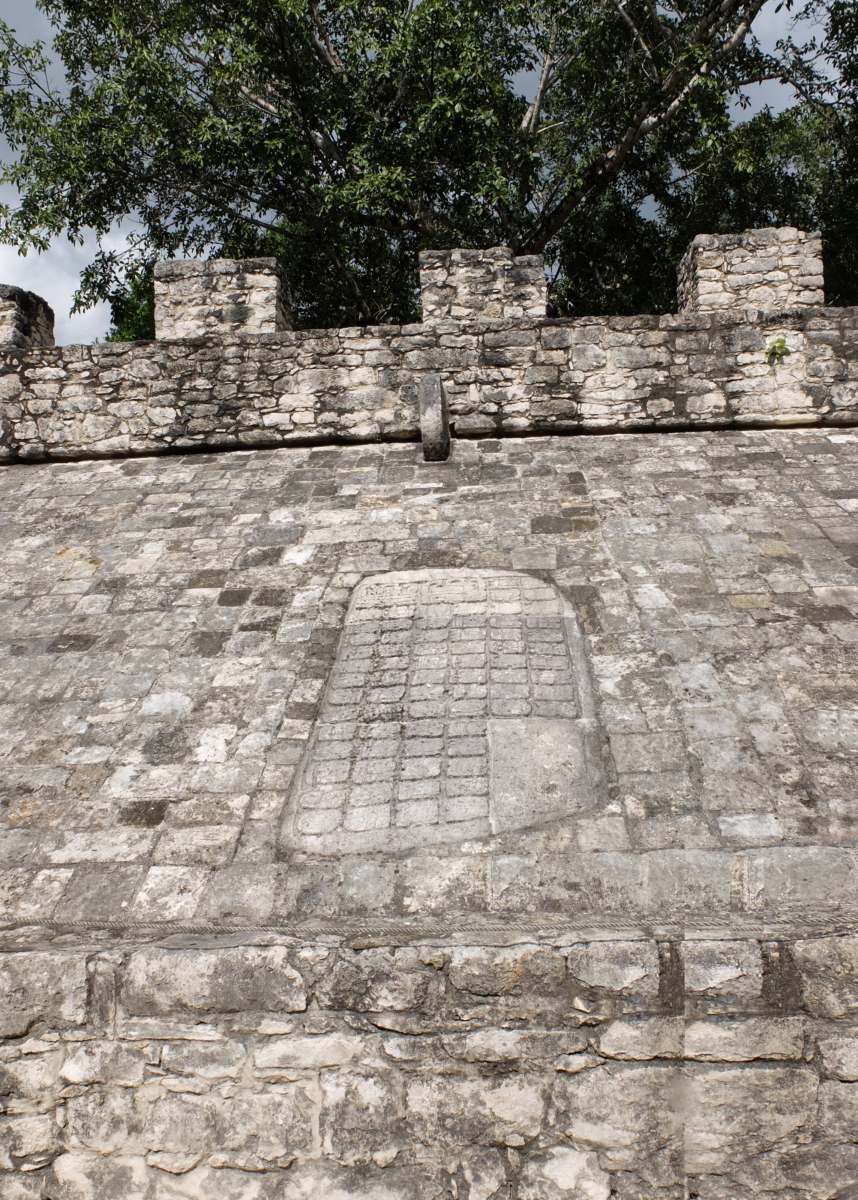
Bark of the rubber tree is incised in a downward spiral. Then a spout drips latex into a collection cup or taza para látex. site – Yucatán, Mexico. • RIGHT: Walls of a pok-to-tok or pitz alley used for ancient Mesoamerican ball games. Mayan city of Coba archeological zone, Yucatán Peninsula, Quintana Roo, Mexico. Photos: J. Morton Galetto
We saw many other examples of Mesoamerica’s scientific prowess, especially in the people’s use of observatories to develop calendars. We visited the Popul Vuh Museum at Universidad Francisco Marroquin in Guatemala City to learn more about Mesoamerican culture. Popul Vuh is named after the Mayan equivalent of the Book of Genesis, transcribed from oral traditions in the 1500s. In this text, the sacred ball game was characterized as pitting good against evil, and like the gladiator games it involved human sacrifice and also concepts of fertility and regeneration. The ball in play represented the sun. Versions of this game were also played in Native American cultures in Arizona, New Mexico, and South America.
Other Mayan implements were made of rubber formed from latex and morning glory vine—figurines, axe head attachments, sandal soles, hammers, and drumsticks. The mixing of the two substances allowed for pliability and a workable material; latex polymers and sulfur from the morning glory cross-linked the two substances, thereby producing “rubbery properties.”
There have been huge swings in the world’s reliance on rubber and its regional sourcing since Henry Ridley’s introduction of rubber trees to Southeast Asia in 1895. By 1910 Asian harvesting innovations eventually out-competed Brazilian production, by 1914 Brazil’s market share was 30 percent, and by 1940 it was less than two percent of the source.
World War II caused a new shift. Japan was occupying major rubber-producing Southeast Asian countries when rubber was a vital material for armaments and machinery. The likely sourcing disruption led to development of an oil-based synthetic alternative. By 1964, synthetic rubber made up 75 percent of the market.
Then in 1973 geopolitics once again influenced rubber composition with the OPEC oil embargo. By 1993, natural rubber was only 39 percent of the market in the United States. Today, nearly 50 percent of every auto tire and 100 percent of aircraft tires is made from natural rubber, with 85 percent being sourced in Southeast Asia. This naturally raises concerns about such diverse influences as leaf blights, terrorism, embargos, and tariff wars.
Our travels continually unveil the fact that the intersection of natural and cultural history is endlessly varied and intertwined, and should never be taken for granted. The geopolitical implications of rubber sourcing today are just as complex as the Mesoamerican use of a rubber ball to determine not only the fate of those in the ball court but of society as well. And that’s the way the ball bounces.
Sources
Custom Rubber Corporation, website.
“Prehistoric Polymers: Rubber Processing in Ancient Mesoamerica,” Science, June 18, 1999.
Rubber processed in Ancient Mesoamerica, MIT News, July 14, 1999.
One River, by Wade Davis, 1996
A Brief History of Rubber, Tropical Rainforests, World Rainforests.com 2024.
“Did the Maya Really Sacrifice their Ballgame Players?” By Laura Geggel, Life Science.