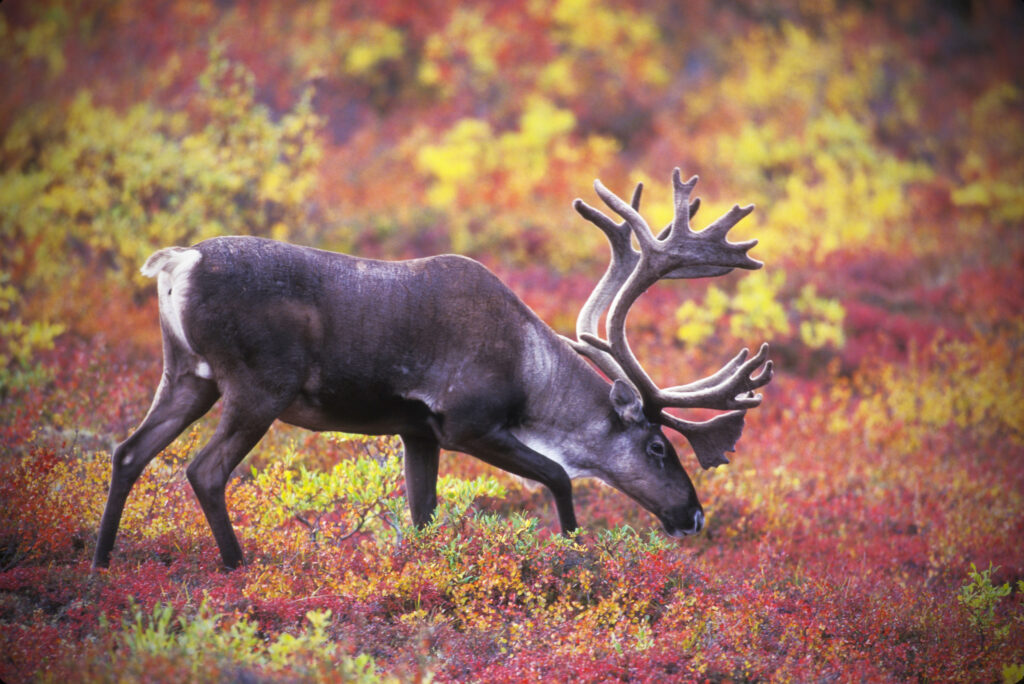
What’s your reindeer been eating? Photo: Bauer, Erwin and Peggy
A lesson in lichenology is an apt one for this time of year.
Last month we went on a tour with biologist Jason Hafstad, who works for the New Jersey Department of Environmental Protection, Office of Natural Lands Management (ONLM). He oversees some 100 nature preserves across the state of New Jersey totaling over 30,000 acres. Plants come under the umbrella of ONLM and Jason has a special interest in mycology and lichenology. Our tour involved a portion of The Nature Conservancy’s Manumuskin Preserve, with Jason joking that our walk was more of a stand or crawl since as we explored we attempted to closely inspect various lichens—a neophyte inspection to be sure. Each species examination meant progress was slow at best.
Generally on CU walks we discuss what you may have heard called “reindeer moss,” which is not a moss at all but rather a lichen. We do not distinguish between the species of Cladonia that are commonly called “reindeer moss” and found in New Jersey, we simply call them “reindeer lichen.”
In New Jersey there are 48 species in the Cladonia genus, though not all resemble the reindeer moss. Jason gave us a mini crash course in some lichen basics. He told us that in our state alone at least 540 species of lichen have been identified, many of which can only be determined under magnification. We were each given a jeweler’s loupe to aid in our inspections.
In honor of the holiday season we’ll discuss four reindeer lichen found on the Manumuskin Preserve, sharing only the most basic lichen facts. The origins of this lichen species’ common names, “reindeer” or “caribou” moss, come from these animals’ propensity to eat it—especially the species Cladonia rangiferina, C. stellaris, and C. portentosa—when other food sources are scarce. They will dig in the snow to access these mini coral-like structures, the body of which is called a “thallus.” Rudolph and his fellow sled companions dare not depend on it too heavily because it is very slow growing and vulnerable to fire, so easily depleted.
The coral-like, branching structures of reindeer lichen are often used as landscaping for Christmas model train layouts, sometimes after being dyed different colors because the various species of the reindeer lichen conveniently have an appearance of miniature shrubbery.
Furthermore, when you look at the individual stalks of the lichen, the secondary branches are called “podetia,” and together these look much like an antler—also giving further basis for their common name. When the air is dry the podetia are crispy and break easily; conversely when the atmosphere is wet they can be soft and almost cottony. But no matter their state or the proper origins of their name, I’m beginning to feel a bit more Christmassy.
Lichens are a composite organism made up of layers of fungus and alga. They are unique in that they are composed of two or more different species from different kingdoms. Lacking the vascular tissues of plants that move nutrients and water from the ground, they instead absorb them from the air. As a result, certain species of lichen are strong indicators of air quality. Usnea, or old man’s beard, is one such lichen genus that we have discussed in previous articles, and its presence is a sign of higher air quality. However, since not all lichens are suggestive of high air quality you have to know which ones are indicator species.
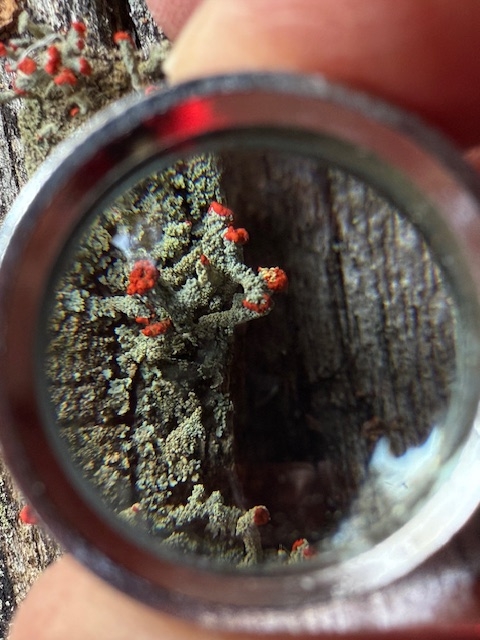

Participants on the CU Maurice River Lichen Walk, examined various lichens through a jeweler’s loupe. Photo: Lowenstern and Galetto / RIGHT: Biologist Jason Hafstad stands in a colony of reindeer lichen discussing how lichen reproduces using clone packets. Photo: J. Morton Galetto
I’ve heard people say that you can use lichen growth as a compass by looking at which side of a tree’s trunk it is most prevalent. I asked Jason to address that idea. He told us that the lichen on trees will primarily grow where the truck gets the most moisture, such as a place where a branch has broken off and a node is present that collects the damp, or a tilt in the trunk that allows water to run down the face of one side more than the other. On stone surfaces, areas where moisture can puddle might support lichen. So as far as their indicating due north, nope. It is simply “bunk.”
Lichen comes in three forms or structural types that aid in their identification. “Crustose” is basically flat and firmly attached to the substrate like rocks or bark. It almost looks “painted-on.”
“Foliose” is flat and leafy, with a distinct lower and upper surface. Its attachment is often central, allowing you to see both surfaces. Lastly, “fruticose” has a bushy, shrubby, or tree-like structural appearance—very three-dimensional with no clear top and bottom. In this instance attachment is only at the base and it will be upright or hang from an appendage. The reindeer lichen is the fruticose form, as you may have already predicted from the prior description, and it grows on the ground.
A portion of the lichen that we see is the reproductive part; the secondary structure of podetia are surmised by some biologists to capture windblown algae. Jason said that the remarkable aspect of the lichen reproduction is that the algae and the fungus have to interact to effect it, and conditions enabling that are complex and unlikely.
The U.S. Forest Service describes the complexity of reproduction: “Unlike plants that can produce seeds that grow into new plants, lichens do not have a straightforward way to grow more lichen. Since the fungus is the dominant partner in the relationship, it gets to develop its fruiting bodies and produce spores. These spores can produce another fungus, but unfortunately, for the alga it does not get the opportunity to reproduce at all. Either the new fungus has to find an algal partner or it perishes.”
Lichens mostly solve the reproductive problem by vegetatively reproducing through fragmentation—essentially releasing clones. Miniscule fragments of the thallus containing both fungal and algal partners can result in new individuals. Reproduction in reindeer lichens can also occur through fungal spore production but it is reliant on finding a suitable photosynthetic algal partner. Fragmentation is considered to afford the best odds for success but results in lower genetic diversity.
Growth in lichens is very slow and greatest where ungrazed, humid, and somewhat sheltered sites offer longer growing seasons. Cool or colder climates are in general where C. rangiferina grows, so it strikes me as interesting that it is found in our pine barrens. This appears to be due to lack of competition, lots of humidity, and well drained sandy soils, which are also advantageous to its success.
On our excursion Jason pointed out four species of reindeer lichen: Cladonia subtenuis, a fine filamented variety that is quite common; Cladonia uncialis, a heavier stalked variety with more yellow hues; Cladonia rangiferina, which has an extensive range from arctic areas and throughout boreal regions of North America; and Cladonia submitis, often called “beach broccoli” due to its heavy stalks and sand dune habitat.
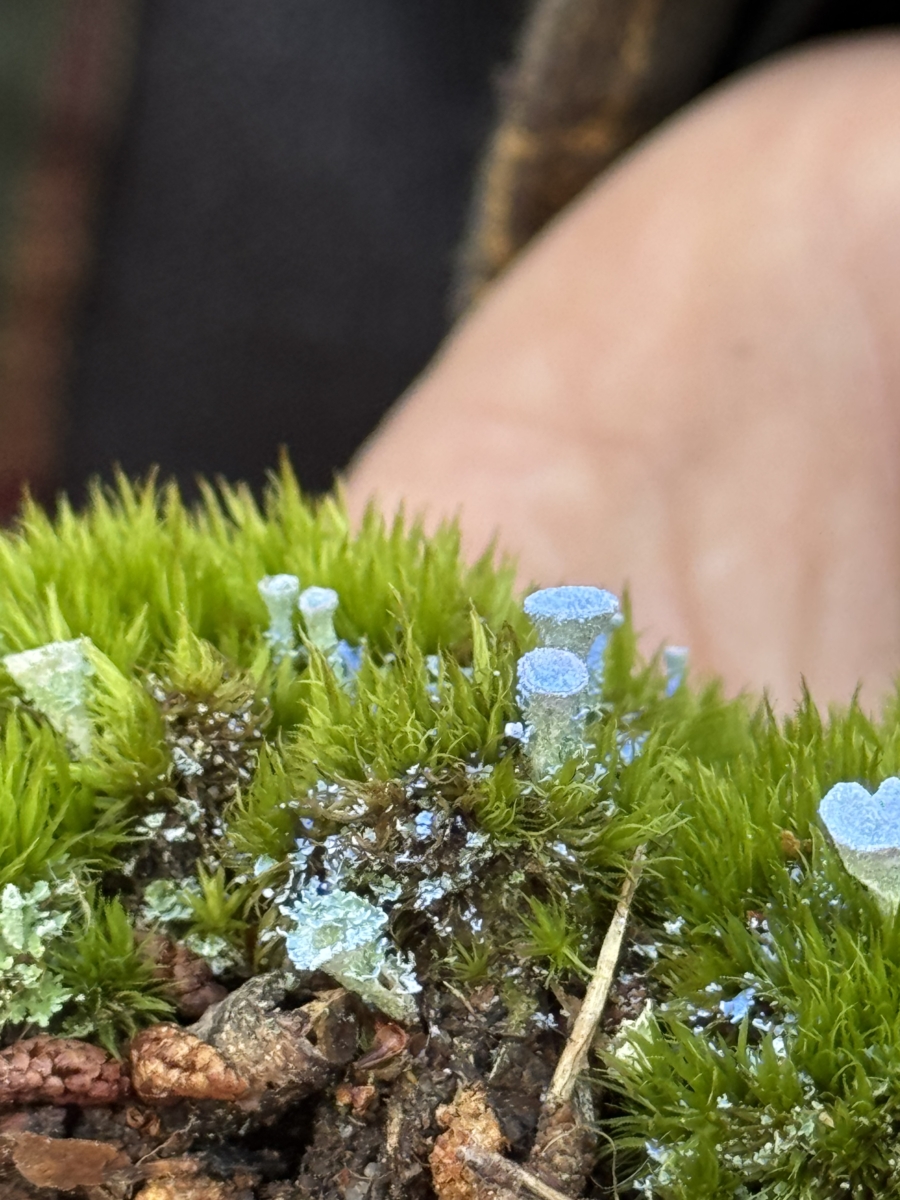
Gray pixie cup, Cladonia grayi, is a squamulose lichen that is gray but when exposed to a UV flashlight turns blue. These goblet-shaped thallus are protruding from a bed of green moss. Photo: J. Morton Galetto
Cladonia submitis is rare and Jason shared the most information on that species. It has a narrow distribution from Maine to North Carolina, but is most abundant in the mid-Atlantic from Massachusetts to New Jersey. It can be found in scattered populations throughout the Pine Barrens and on coastal maritime dunes. C. submitis has wider stalks than the other species we noted, with fine terminal ends. While it is rare because coastal development has destroyed many of our high-quality coastal dunes, its decline is compounded by its slow growth. Since it is not fire tolerant, if it is present you can conclude that the area has not been subjected to conflagration for over 10 years.
Honestly, I’m challenged in my understanding of lichen; I was bowled over by the number of species that were pointed out to us in a mere 100-foot section of woods. At one point we looked at a cup lichen that glowed blue under ultraviolet light; holy Christmas, it was stunning! There were also many lichens that we didn’t examine, but inspection of other samples through a jeweler’s loupe opened up a new miniature world that I had not appreciated prior to our excursion. It may have strained my eyes but it expanded my thinking. It was a kind of Christmas gift that was there all along, I just didn’t know it.
When you hear the reindeer hooves on your rooftop this Christmas, take a moment to ponder the role lichen played in feeding the team prior to the long journey.
Sources
USDA Forest Service Lichen Biology
Fire Effects Information System, Species: Cladonia, US Department of Agriculture, U.S. Forest Service. www.fs.usda.gov.