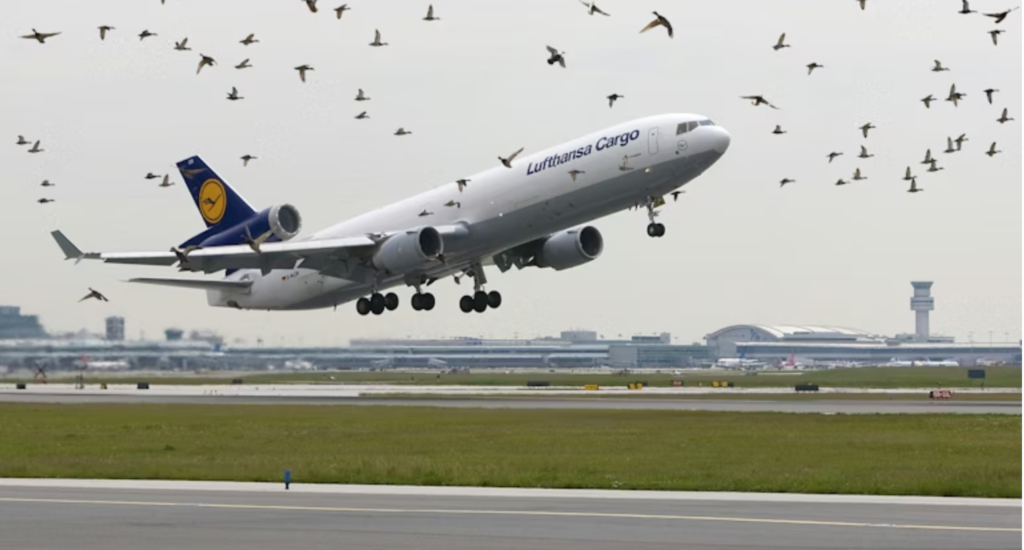
Bird strikes with airplanes are dangerous and costly for airports and airlines. Photo: Falcon/Faucon facebook page
Wildlife management at airports is essential in preventing bird strikes, keeping both human and avian flyers safe. By Pam Hull, CU Maurice River
In the January 14 issue, my article “True Lark” described horned larks’ habitat preference for the closely mowed grass found along airport taxiways and runways. The horned larks are not alone in their choice, and birds are not the only grassland creatures drawn to airports. As forests, open fields, farmland, wetlands, and other wildlife habitat is lost to development, the displaced creatures are forced to find a suitable, safe alternate habitat with available food and water. Some, like the horned larks, choose airports. Some bird species come to airports during migration; others, such as waterfowl, arrive there due to their water habitat proximity.
Many large airstrips have thousands of acres of grassland vegetation. Whether arriving via wing, leg, or belly, wildlife doesn’t necessarily remain in the grassy areas. It may sound almost idyllic, something like the scene in the famous painting, “The Peaceable Kingdom” by Edward Hicks, with birds of prey, animals of prey, and their own prey cohabitating in close proximity at airports. All creatures are ever vigilant and that vigilance extends to pilots and airport wildlife managers. For example, birds may fly at the same time and in the same air space as an airplane. A coyote might see prey on the other side of a taxiway at the same time an aircraft is taking off, or a large snake may be sunning itself on the tarmac, oblivious to danger.
As I was researching the horned lark story, I came across films, Federal Aviation Association (FAA) papers, and other articles about wildlife management at airports and about the importance of keeping the flying public safe. Airport staff juggles the protection of numerous animals—owls, hawks, starlings, herons, and other birds as well as coyotes, alligators, snakes, kangaroos, cattle, monkeys, and reptiles. I wonder how often travelers think about a “bird strike” or “animal strike” when taking off or landing. Strikes are frequent, dangerous, and expensive—and a lot of energy is expended on avoiding them.
Strike is the technical term (rather than collision) for an encounter of creatures with an aircraft. The first one ever recorded was in September 1905, less than two years after the Wright Brothers’ first flight at Kitty Hawk, North Carolina, in December 1903. Appropriately, that bird strike was recorded by Orville Wright as he flew over a cornfield in Dayton, Ohio. He was quite sure that it was a red-winged blackbird flying up from a huge flock feeding on corn residue, but no damage was done.
Fast-forward 57 years to Boston’s Logan Airport on the afternoon of October 4, 1960, when an Eastern Airlines Lockheed Electra L-188 turboprop with 72 passengers aboard took off for Atlanta and at an altitude of 120 feet. It slammed into a flock of probably 10,000 American starlings, plummeted into Winthrop Bay, and sank. Sixty-two of the 72 passengers were killed and the fuselage was split in two. The entire episode took about one minute, and bird parts were found in three of the four engines when the plane was recovered from the bottom of Boston Harbor/Winthrop Bay. This strike remains the worst and most deadly disaster of its kind in U.S. aviation history.
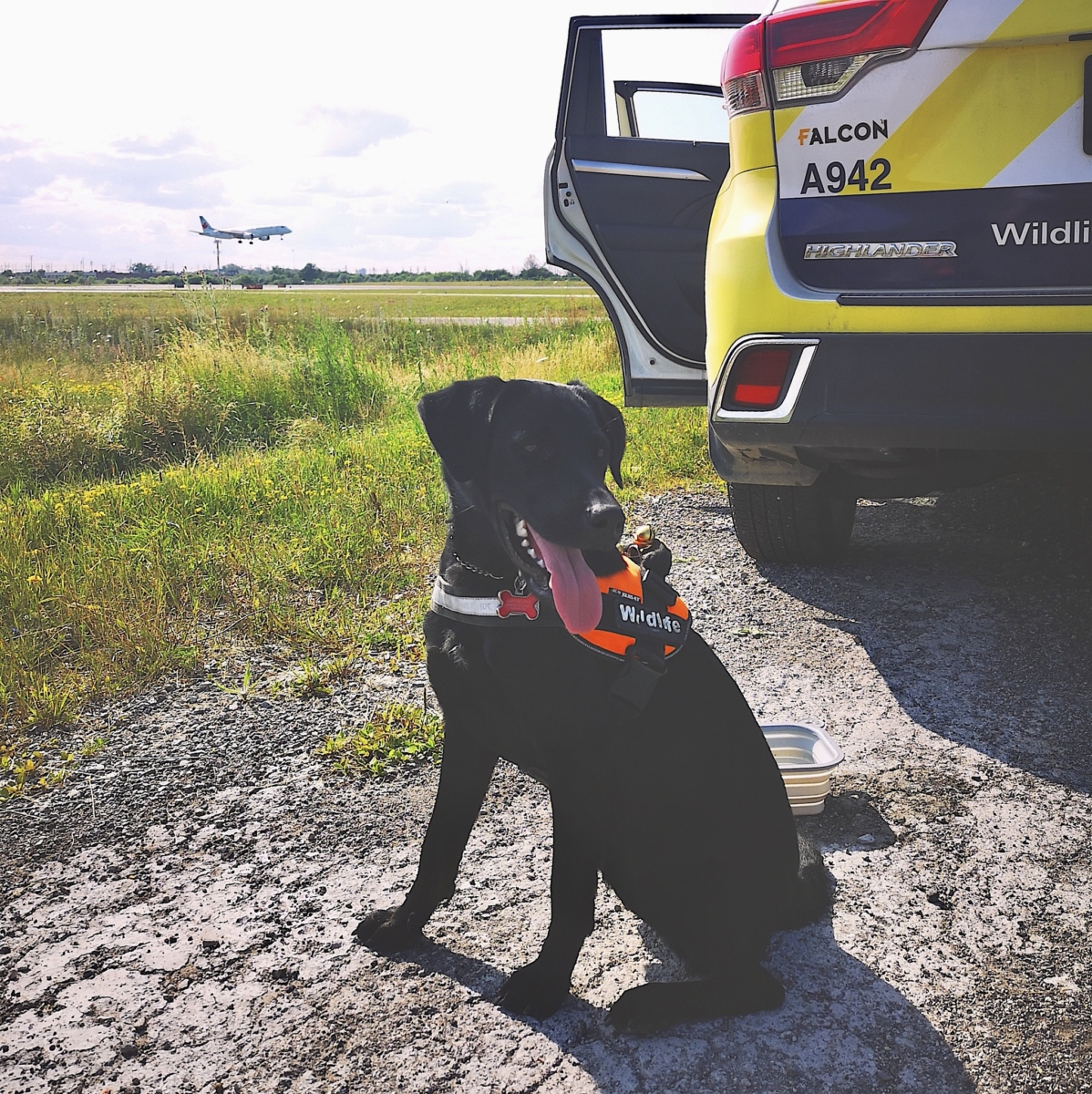
Airport animal control makes use of dogs to move animals to safer locations on airports. Photo: Falcon/Faucon facebook page
Prior to this tragic incident, wildlife management was informal or nonexistent—and generally localized with no standard, across-the-board industry control procedures. After the strike, Bird Patrols formed with the instruction to kill any birds seen at Logan Airport. To prevent more tragedies, federal agencies—including the Federal Aviation Association (FAA), the U.S. Department of Agriculture (USDA) and the U.S. Fish and Wildlife Service (USFWS)—determined that the best approach to keeping both humans and animals safe would be coordinated, scientific programs that would include “habitat modification and attractant control.”
For example, at that time a number of major U.S. airports were located near large dumps that attracted gulls and other species, such as crows, eagles, and vultures. These huge trash dumps and open dumpsters can still be found in a number of countries worldwide. However, preventive safety programs have spread across the globe to airports large and small, and now the U.S. agencies often collaborate with international airports to mitigate wildlife safety issues. Many airports now forbid garbage dumps or burning trash within an eight-kilometer radius of the airport.
In 2024, the FAA and the USDA published Wildlife Strikes to Civil Aircraft in the US 1990-2024 with data from 2,360 U.S. and international airports. During that 24-year period, 319,047 wildlife strikes occurred, an average of 9,384 annually; 98.3 percent or 313,716 strikes occurred in the U.S.
Also, during those 34 years of research, 54 percent of the bird strikes happened between July and October and 39 percent of the deer strikes occurred between September and November. Our country has a large white-tailed deer population; in 1900 there were only 150,000 but by 2019 the numbers had risen to 30 million white-tailed deer. They make up the second largest “strike” population. The report also documents “wildlife strikes to civilian aircraft.”
During this period, circumstances evolved that made this database even more crucial. With the increase in the number of daily aircraft flights, the rise in populations of large birds, and the use of quieter turbo fan-powered aircraft, the industry needed to learn what safety changes to make in terms of wildlife management as quickly as possible. Strikes were starting to increase. In 2024, there were 22,372 strikes, up 14 percent over 19,628 strikes in 2023.
In the early days of flight, planes with their propellers were very noisy—noisy enough to scare wildlife off before a strike occurred. However, as incidents increased other measures were necessary. In 1965, the FAA and the USDA established the FAA National Wildlife Strike Database. By 2024, this extensive database helped identify trends in strike patterns and specific locations in need of new or further habitat control in areas around airports across the globe.
With this valuable data gathered, airline manufacturers have been able to design aircraft to limit, as much as possible, damage to the planes. The new data come from detailed strike reports, which are require to be filed after each incident. The reports must include geographical strike location, time, date, strike location on aircraft, and animal remains, called “snarge.” Any feathers remaining on the aircraft are sent to the Smithsonian Feather Lab for species identification. These data provide a “scientific basis for FAA policies.”
The data showed that from 1990 to 2024, most strikes occurred at takeoff and landing and during taxiing. In addition to safety, wildlife strikes are costly to the airlines and their patrons. The estimated costs are $79 million to $600 million annually in the U.S. alone. Sometimes the aircraft can be salvaged and repaired after a strike, but at times the plane is beyond recovery. In any case, there are thousands of flight hours lost while an aircraft is being repaired or replaced.
In recent years, many airports have added their own wildlife biologists to staff, while other airports use local wildlife biologists who may work for other agencies simultaneously.
Over many years, Logan Airport has become a favorite overwintering spot for snowy owls, with the highest concentration of the species in the Northeast. Massachusetts Audubon and others in the state did not want the snowy owls to be shot. Norman Smith, the retired director of the Mass Audubon Blue Hills Trailside Museum and a raptor specialist, has worked with snowy owls for more than 60 years. Since 1981, he has trapped 900 from Logan Airport to release them elsewhere. There is a delightful documentary about Smith and the snowy owls of Logan Airport available on YouTube.
At some airport locations in the U.S. and around the globe, other types of “active deterrence” are employed, including pyrotechnics, distress call systems, canine patrols, falconry, bird robots, and radar-based bird detection systems. Some use an “advance vehicle” to flush birds away ahead of take-off. In many instances, a mix of methods are implemented to keep birds away from the runways. Multiple tools prevent “habituations,” as birds can readily adapt to repeated stimuli. Good operator training and wind and visibility play into the success of various programs.
One of the most unusual challenges exists at Orlando Airport—and this phenomenon is experienced in various locations internationally. After heavy rains, the saturated soil adjacent to airport taxiways and runways results in huge numbers of earthworms stranded on the tarmac. The earthworms not only create a slimy, slippery mess but also attract large numbers of hungry birds (especially gulls), increasing the chance of a bird strike.
Wildlife management, using creativity based on scientific data at airports large and small, is a key component in keeping the flying public safe as well as the animals and birds unharmed. Many airports are on oceans and seas and have perfect conditions for migratory and native bird and animal species. While researching for the horned lark article, I could not imagine that this topic would turn out to be as huge and varied as the globe’s airports and all of their habitats.
Sources
Edited by Devault, Travis L, Blackwell, Bradley F and Belant, Jerrold L; Wildlife Management in Airport Environments: Preventing Animal-Aircraft Collisions through Science-Based Management; 2013, Johns Hopkins University Press
Abstract of Presentation at Bird Strike Committee Usa & Canada Meeting Lake Mary and Sanford, Florida August 2008, As the Worm Turns: Investigations into Earthworm Control at Airports
Airways Magazine, “How Airports Manage Wildlife Hazards,” December 5, 2025
Boston Magazine, Throwback Thursdays: The Worst Bird Strike in U.S. History, October 5, 2017
EC Cleary, FAA, Wildlife Hazard Management at Airports July 2005
WCVBTV-Boston, December 24, 2025 Meet the Owl Man Who Helps Keep Boston’s Logan Airport Safe for Travelers
FAA and USDA Wildlife Strikes to Civil Aircraft in U.S., 1990-2024

Birds No Match for Capt. Sully
A bird strike somewhat close to home occurred on January 15, 2009, involving U.S. Airways Flight 1549 from La Guardia to Charlotte and Seattle with 155 passengers on board. The plane was an Airbus A320. Shortly after takeoff from La Guardia, Captain Chesley “Sully” Sullenberger radioed Air Traffic Control that he had struck a flock of Canada geese and that neither of the plane’s two engines were working. For a couple of seconds, he was going to turn around and get back to LaGuardia but it wasn’t logistically possible, nor was a landing at nearby Teterboro Airport in New Jersey an option, so he told the controller that he was going into the Hudson River. The time from the bird strike to the ditching was four minutes. Five people were injured but all were rescued.
The story was made into a 2016 movie, Sully, directed by Clint Eastwood, with Tom Hanks in the lead role as Sullenberger (movie cover pictured above).
The day after that water landing, I was in New York City for a trade show taking place at the Hudson Piers and Javits Center. I witnessed the amazing and miraculous sight of the plane sitting in the Hudson; a day or so later it was towed to the lower end of Manhattan. After the ditching, 1,235 Canada geese were “captured and exterminated” near La Guardia and 16 other locations in the city. Between 2009 and 2017, approximately 70,000 birds in and around New York were intentionally killed to prevent encounters with aircraft. —PH