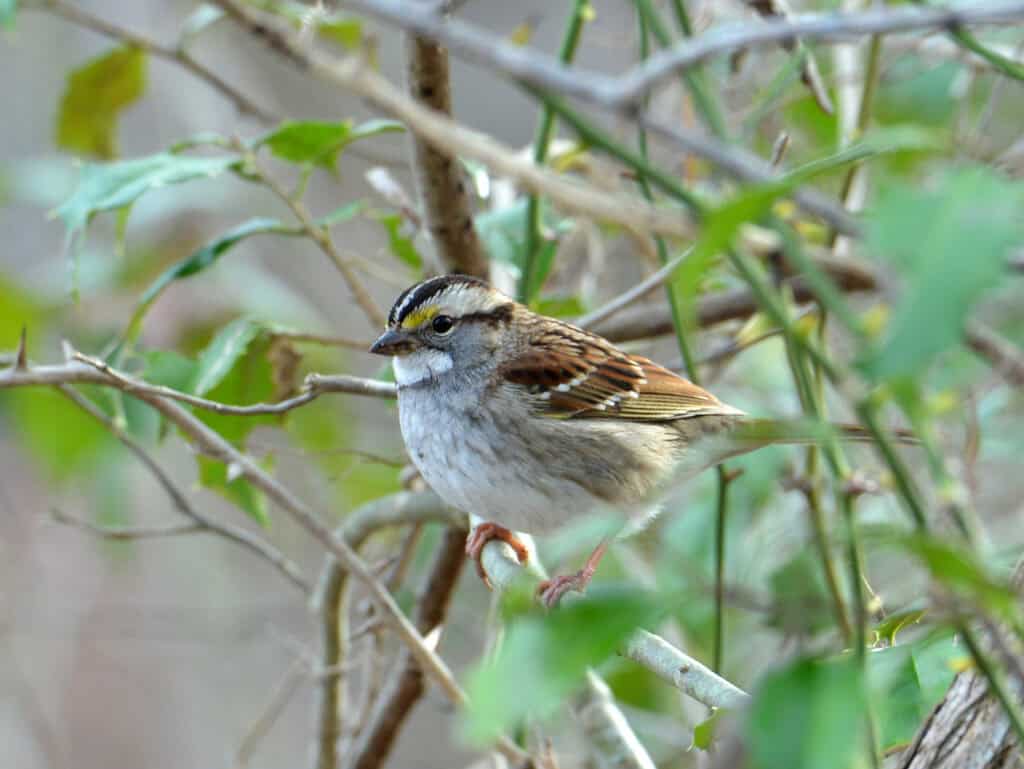
The white-throated sparrow’s most distinctive markings are the white patch beneath its bill and the two white wing bars. It is a passerine, a bird that has feet adapted for perching. Photo: J. Morton Galetto
White-throated sparrows, arriving now from Canada, have an interesting variation related to their plumage.
From my office window each winter, I get to view birds in the leaf litter along the edge of the woods. One avian cold weather performer putting on a show is the white-throated sparrow. Normally I see the leaves being tossed about and a blur of motion rather than the bird itself. If it ventures onto the mowed grass then I can more readily pick it out. In photographs one might think they are easy to spot but their plumage is very obscure, and without the help of optics they can be difficult to see clearly.
During the spring breeding season, they are primarily confined to Canada. There they raise young in open cup-style nests on the ground, and camouflage and flight are critical to their survival. Their spring habitat is the boreal forests of our northern neighbor; these are characterized by coniferous and deciduous trees—a mixed forest. They nest in clearings with dense low vegetation—shrubs on the edges of forests. These clearings are often the result of fires; however, ponds, bogs, and roadsides offer similar edge habitat.
White-throated sparrows migrate each winter to our region. Some hardy birds are known to live year-round in the northeastern United States, but here in southern New Jersey they are winter residents.
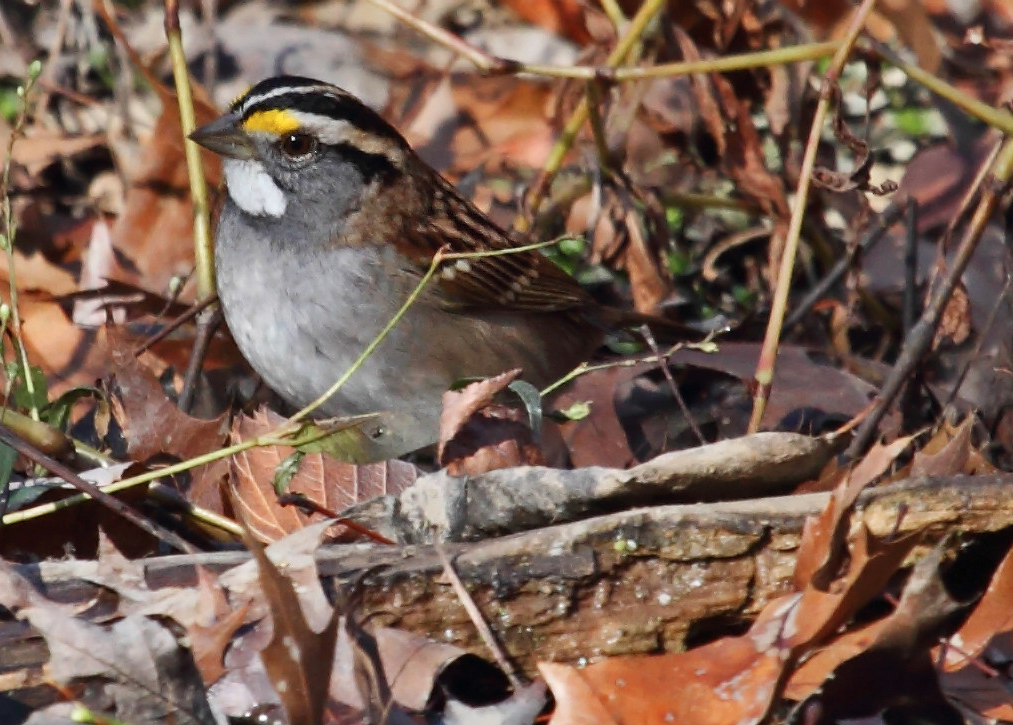
White-throated sparrows feed and nest on the forest floor. Photo: Courtesy Steve Gifford
Beginning in November, I have been hearing them announce their presence with a call described as “Old Sam Peabody, Peabody, Peabody,” or, possibly more aptly, “Oh Sweet Canada, Canada, Canada.” Ornithologist David Sibley offers this description: Song a high, pure whistle sooo seeeeeee dididi dididi dididi with little or no pitch change. For me it sounds like someone whistling a bugle reveille. However you describe it, the song is a clear sweet call of two “pay attention notes” followed by a repetitive phrase, often delivered three times.
In some regions white-throated sparrows have developed dialects. Northern British Columbia biologist Ken Otter discovered a new two-syllable song in the region. His team of biologists, studying the evolution of different bird species vocalizations, found that between the 1960s and 2000s a doublet-ending song had emerged. Their research found the song to be travelling via usage by migrating birds. In experiments, white-throated song sparrows, known for their aggressive protection of nesting territory in spring, responded with equal antagonism to either presentation of their song, be it a triple ending or double ending.
The evolution of song is normally slow. At first researchers thought the doublet was confined to the western side of the Rocky Mountains, but once a few birds east of the Rockies learned the double ending it took off and by 2019 birds were singing it in Québec. They theorize that young males heard different dialects when establishing their song and copied the new version.
When it comes to singing and aggression, white-throated sparrows have a surprising variation linked to their plumage. There are two morphs of white-throated sparrows—a “white-striped form” and a “tan-striped form.” Females and males that have the white facial stripes are more aggressive than their tan counterparts. White-striped males actually have higher levels of testosterone than the tan males. Furthermore, birds are drawn to the other color morph when pairing up. You might say “opposites attract.”
The morph differences don’t stop there. The white-striped morph males spend little time tending to the young while the tan-striped morph males are very dutiful about parental responsibilities. The white plumage males spend more time defending territory with their song.
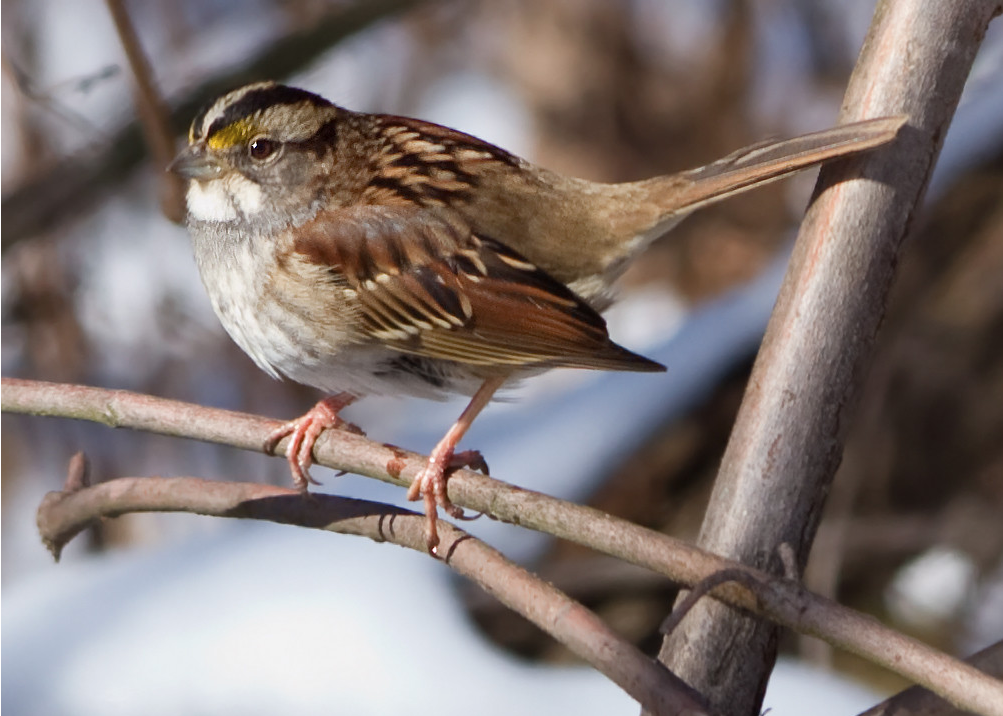
There are two morphs of white-throated sparrows a “white-striped form” and a “tan-striped form.” In 1961 ornithologist James Lowther discovered that the coloring was a morph, not simply a feather variation or age difference. A young birds’ plumage resembles that of the tan morph. Photo: Courtesy Steve Gifford
Their aggressive behavior is primarily confined to the breeding season. By the time the white-throated sparrows are here in southern New Jersey they flock together, even with other species like juncos and chickadees (called a mixed flock). In winter they are essentially chilled out. If you have a feeder you will often see them eating on the ground with juncos. There are pecking orders at the feeder but the aggression you would witness on breeding grounds has essentially vanished.
White-throated sparrows mainly eat seeds and berries, making them important dispersers of plants. The pigments in seeds and berries provide carotenoids that give them the yellow lores, the feathers between their eye and bill.
When nesting their diet is especially reliant on insects and invertebrates caught on the forest floor. These include “dragonflies, wasps, stinkbugs, beetles, flies, and caterpillars, as well as spiders, millipedes, centipedes, and snails (Cornell).” Their foraging style is to hop and kick leaf litter backward with their feet and seize any prey that appears. They uncover seeds on the ground with a similar tossing behavior.
White-throated sparrows are considered to be stable as a species. But sadly, as we have discussed before, birds are on the decline and these sparrows are no exception. Cornell reports that between 1966 and 2019 their numbers have diminished, with an estimated 0.74 percent decline for a loss of a third of their population. Habitat disappearance, effects of windows, and feral cats are major contributors to these decreases. Since they are nighttime migrants, lighted buildings and tall structures also play a part in their decline.
You can help birds by providing native plants that offer seed sources in winter. Leaving leaf litter on the ground is also critical to these birds’ and many other avian species’ foraging style. You may also consider window stencils for preventing collisions with the glass. On the web the American Bird Conservancy offers a host of advice on how to prevent avian deaths due to windows.
Sources
White-throated sparrow Zonotrichia albicollis, Animal Diversity Website.
White-throated sparrow, All About Birds, Cornell Lab of Ornithology.
How a White-throated Sparrow’s New Tune Went Viral. By Priyanka Runwal. July 2020, Audubon Magazine.
10 Fun Facts About the White-throated Sparrow, by Jenny McKee, March 17, 2022. Audubon Magazine.
The Sibley Guide to Birds, by David Sibley.
Ehrlich, P. R., D. S. Dobkin, and D. Wheye (1988). The Birder’s Handbook. A Field Guide to the Natural History of North American Birds, Including All Species That Regularly Breed North of Mexico. Simon and Schuster Inc., New York, NY, USA.
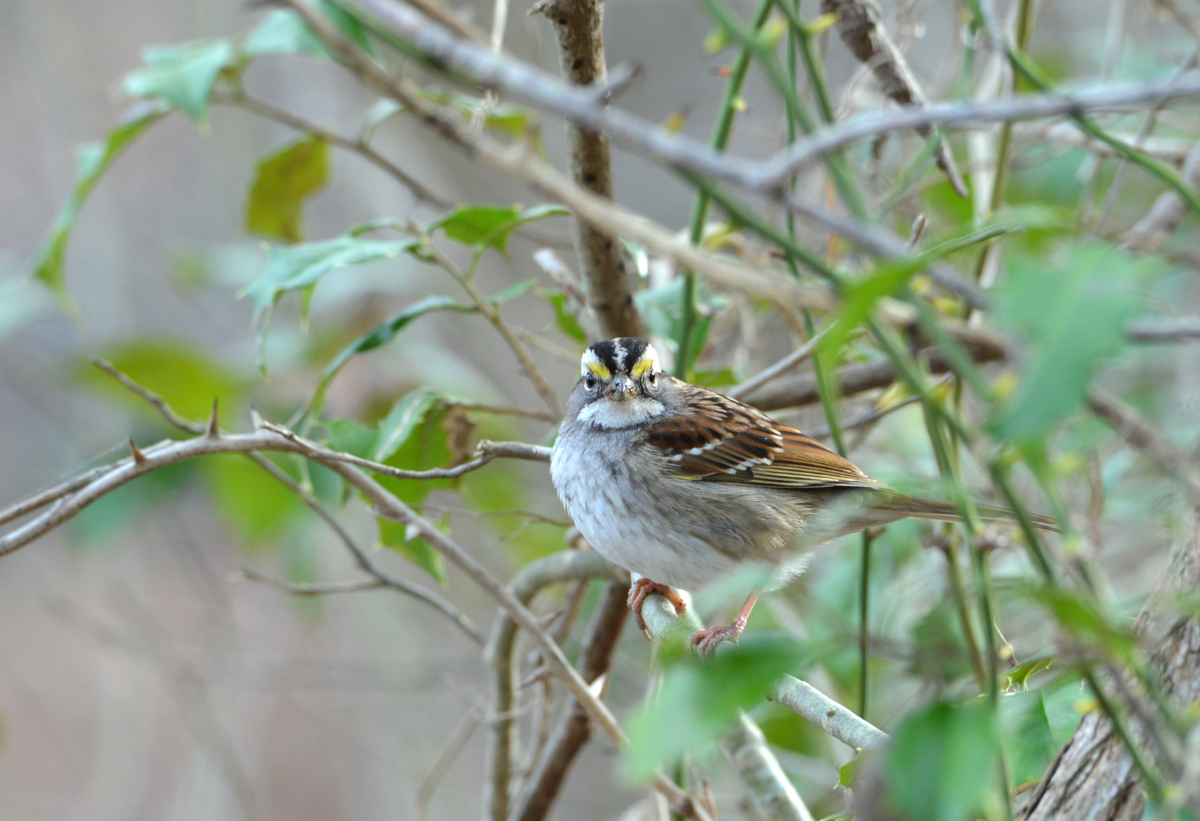
Note the yellow lores above the white-throated sparrow’s eyes. Photo: J. Morton Galetto
FAST FACTS: White-throated Sparrow
Scientific name: Zonotrichia albicollis
Size: 6.3 to 7.1 inches long
Wingspan: 7.9 – 9.1 inches
“This species is named for its distinctive bright white throat patch that stands out against its grayish chest and cheeks. It has a dark gray bill and a distinct yellow spot between the bill and each eye. On each side of the face, a thin black stripe extends from the base of the bill, and through the eye to the back of the head. Two thicker black stripes run from the bill across the top of the head. Three white or tan stripes run between these four black stripes. White-throated sparrows closely resemble white-crowned sparrows, which have a pinkish colored bill (instead of gray), lack a yellow spot in front of each eye, and lack the stark white throat patch.” (Oklahoma Dept. of Wildlife)
Nest: Open cup-style constructed from grasses, twigs, pine needles, fine roots, animal hair, and moss.
3-6 pale greenish-blue eggs; can have a second brood
Incubation: 11-14 days
Chicks: Altricial – meaning helpless and requiring significant parental care at birth.
Fledging: 7 to 12 days
Females and males are sexually mature within a year
Lifespan: typically 6 years. A record bird that was banded in Canada was recovered at 14 years 11 months.
Conservation status: least concern