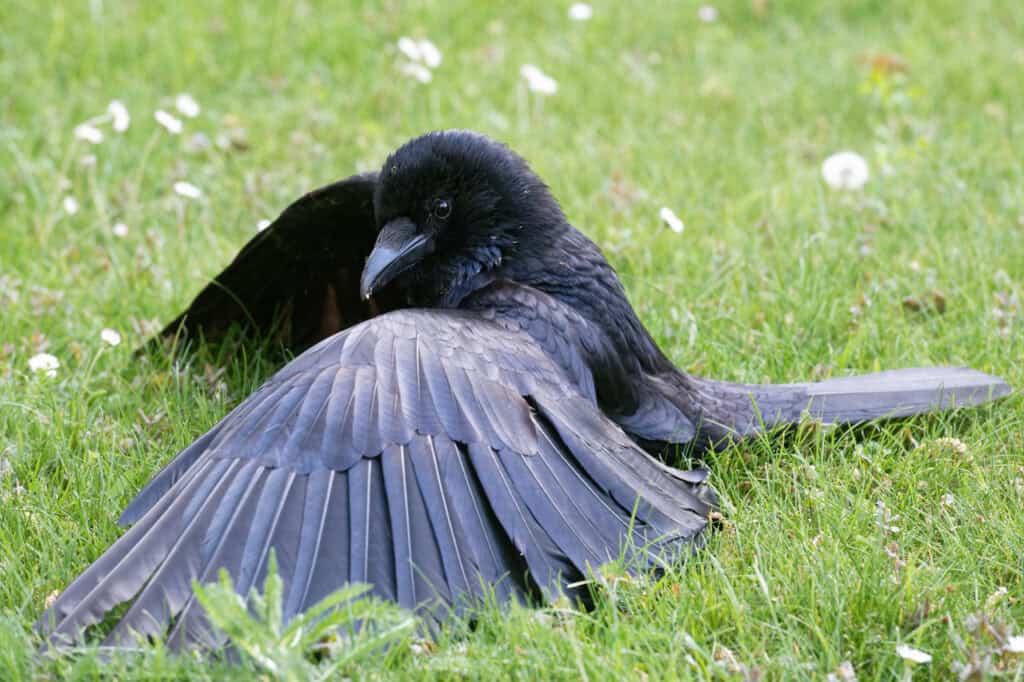
This crow is “passive anting” by spreading its wing feathers to allow ants to crawl over feathers. PHOTO: Marie-Lan Taÿ Pamart, CC BY 4.0, via Wikimedia Commons
Read about a creepy crawly practice seen in birds—and not only during the Halloween season.
Possibly you recall an article we published about Allegheny mound ants mid-2023. We discussed their practice of killing plants near their mounds by injecting formic acid into their bark. The insects’ intent is to keep shrubs from shading their mounds from the sun so that the colony can maintain a higher temperature. These ants chew a hole in the plant’s outer layer to apply the acid, halting sap production and choking the plant.
In researching crows with hopes that these intelligent corvids would provide some seasonal Halloween lore to offer up a good case of the willies, I uncovered something much more frightening called “anting.” I was already familiar with birds taking insects and plants to their nests to discourage invasion by other pests; certain of these species harbor chemical properties that ward off ectoparasites such as fleas and mites. But birds lying down on a nest of ants as a passive treatment for the crawlies was not what I expected to offer for your creepy reading pleasure.
Many bird species, especially passerines, have an adaptive maintenance behavior that involves using ants as a pesticide, fungicide, and likely even an agent to promote feather growth and health. Crows took me down this path because many members of the corvid family practice anting. Corvids include crows, ravens, jays, rooks, jackdaws, choughs, and magpies.
However, Nicholia Morozov, a researcher at the Institute of Informatic Problems, Russian Academy of Sciences, found at least 200 birds, documented on six continents, using this practice.
Ants belonging to the Formicinae family, to which Allegheny mound ants (Formica exsectoides) belong, produce formic acid that is employed by birds for this purpose. Morozov also calls out two other subspecies of ants as useful for anting; Dolichoderinae and Myrmicinae take “second and third places respectively.”
“…birds lying down on a nest of ants as a passive treatment for the crawlies was not what I expected to offer for your creepy reading pleasure.”
Anting behavior works like this: A bird takes an ant in its bill, squeezes it so it will release formic acid, and then rubs it on its feathers to repel or kill ectoparasites. This is called “active anting.” A bird may do this for several seconds or up to an hour.
The second type of anting is “passive anting,” involving lying atop an ant mound and simply letting the insects crawl all over it while releasing their formic acid. After my experience with fire ants, this is not something I would volunteer to imitate. No sirree.
Passive anting further involves visiting an ant colony and getting the ants good and riled up such that they attack. In this case, the bird spreads its wings atop the ant nest and lets the critters race about in its feathers. One article suggested it was somewhat like a “visit to the spa!” This is serious business because a number of pesky microorganisms are known to stick to birds’ feathers and over time they can destroy them. The formic acid prevents the growth of these microorganisms, thus promoting feather health.
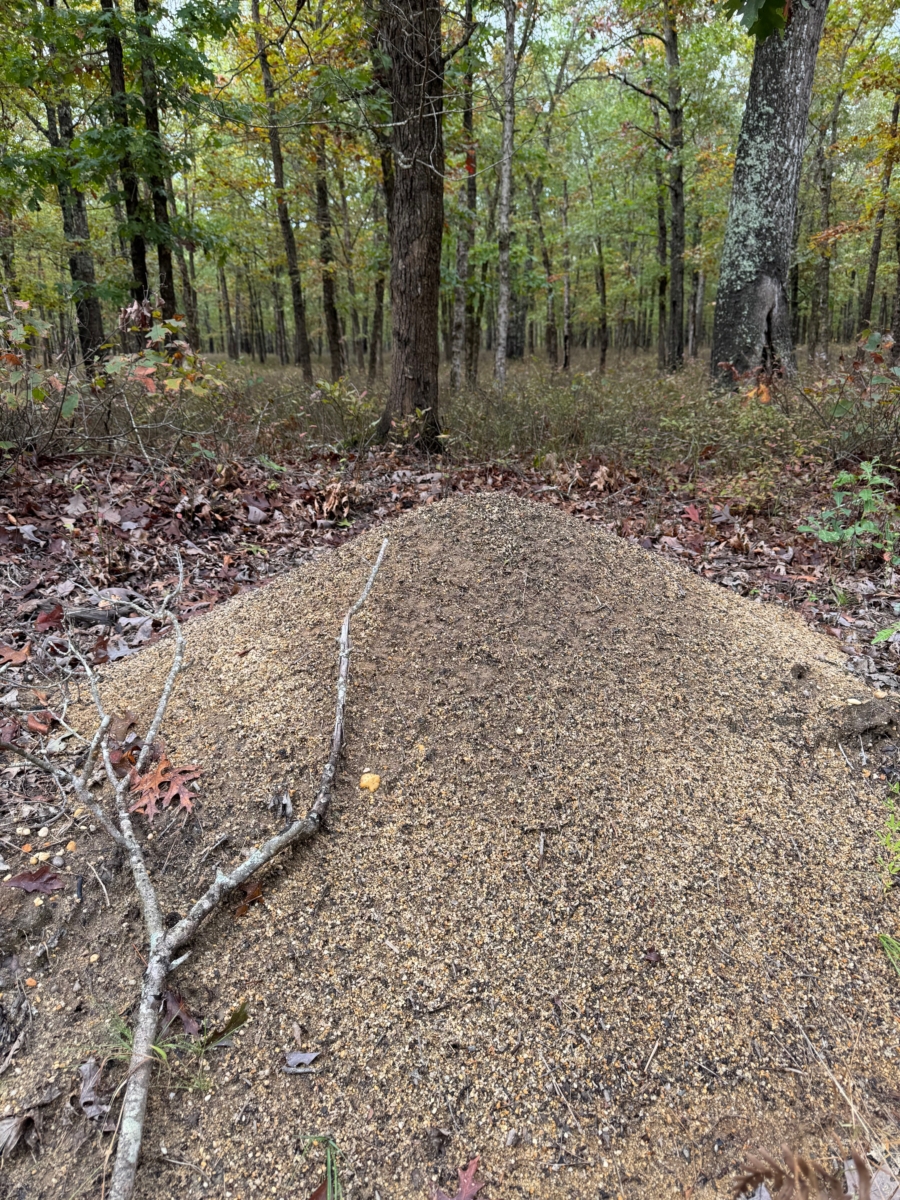
Allegheny ants are one of a species of ants that contain formic acid, utilized by birds for its fungicide, miticide, insecticide, and biocide properties. Allegheny ants build a very large mound, like this nearly two-foot-tall mound in Peaslee Wildlife Management Area, Milmay. Photo: J. Morton Galetto
John James Audubon is said to have been the first to observe the practice being used, in that case by wild turkeys.
When you see a wild turkey or other ground bird taking a dust bath it might involve an ant colony. But it is more likely just dusting. The cloud of dust simply absorbs oils that can mat their feathers. Sometimes preening oil builds up and allows parasites to stick. The dusting and shaking remove dry skin and vermin, working like a dry shampoo. But it can also involve ants.
There are a number of theories about how anting works. Some or all could be true. Researchers suspect that the liquid acid removes old preen oils, acting as a wet bath versus a dry shampoo.
Some authors also believe that the glands of some ant species secrete fluids in which the odor itself acts as a pest repellent. These types of ants lack the stinging ingredient of formic acid like members of the Dolichoderinae and Myrmicinae families.
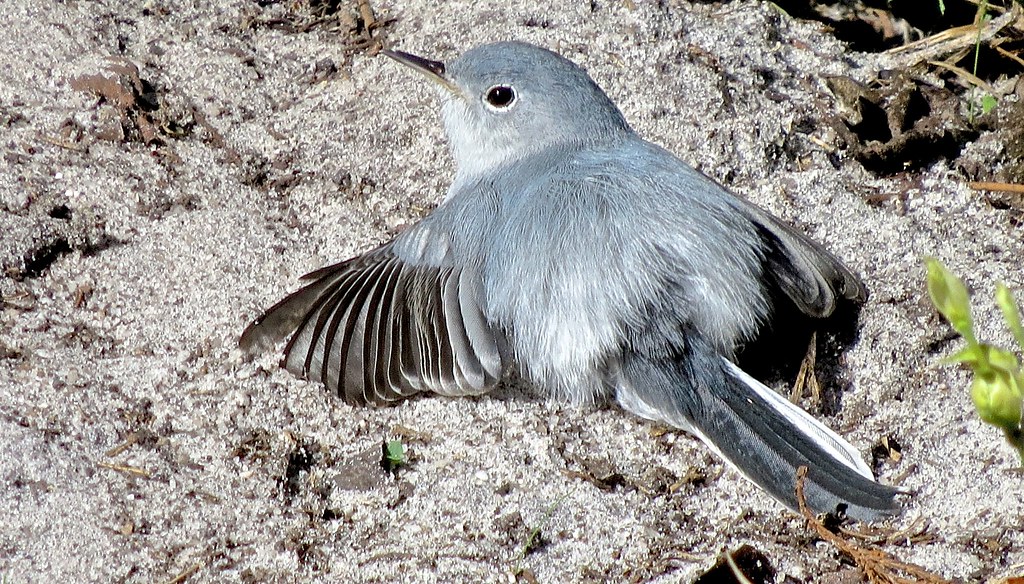
Professor Gilbert Blankespoor, faculty emeriti of Augustana University, caught this picture of a blue-gray gnatcatcher, laying on what he thought to be an abandoned ant colony. Our columnist suspects it was in fact anting.
Researchers suggest that the birds seem to enjoy the ant bath so much that they close their third eyelid across their eyes more frequently, as if to focus more completely on the sensation. Morozov hypothesized that birds may simply enjoy the feeling of being tickled.
This theory isn’t working for me but then I’m not a bird. I’d prefer a Lycra suit, like the one I was made to wear to keep deadly box jellies from biting me when diving in Australia, to inviting ants to tickle my fancy with bites. And allow me to elaborate that the only thing that would encourage me to be seen in public wearing Lycra is indeed the threat of a deadly bite.
Furthermore, birds employ their third eyelid—called a nictitating membrane—like goggles. When we band osprey the chicks will often shield their eyes with this milky lid. In my humble opinion, they are protecting their eyes from being bitten. Birds are also described as trying to keep ants away from their head by frequently shaking them off while anting.
Some passerine birds focus on their larger plumes such as the tail and wing feathers when practicing “active anting,” rubbing them with ants pinched between their beaks. This supports the theory that feather growth may be enhanced by anting during molt, which is the production of new feathers and loss of old ones.
Scientists theorize that anting also gets the insects to disperse their toxic secretions on the birds’ feathers, so they can be ingested without dangerous side effects. It is likely that a combination of benefits is derived from the practice. If you are feeling a bit of the Halloween creeps while reading this, please blame it on the birds and the ants, not me. Happy Halloween!
Sources
“Why do birds practice anting?” Nicholai Morozov Uspekhi Sovremennoi Biologli. July 2015 ResearchGate
“Avian Expert Articles, Anting: A fascinating Glimpse into Nature’s Spa for Birds.” By Matt Rowe. Lafeber Company, May 2024,
A résumé of anting, with particular reference to a captive Orchard Oriole. By L.M. Whitaker. Wilson Bull, 1957, vol. 69.
Apparently, Crows Love Luxurious Ant Baths. By Bill Chappell. NPR June 7, 2021.
Corvus brachyrhynchos, American Crow, By Cynthia Sims Parr. Animal Diversity Website.