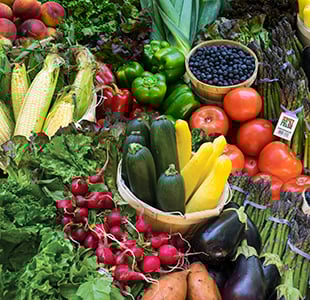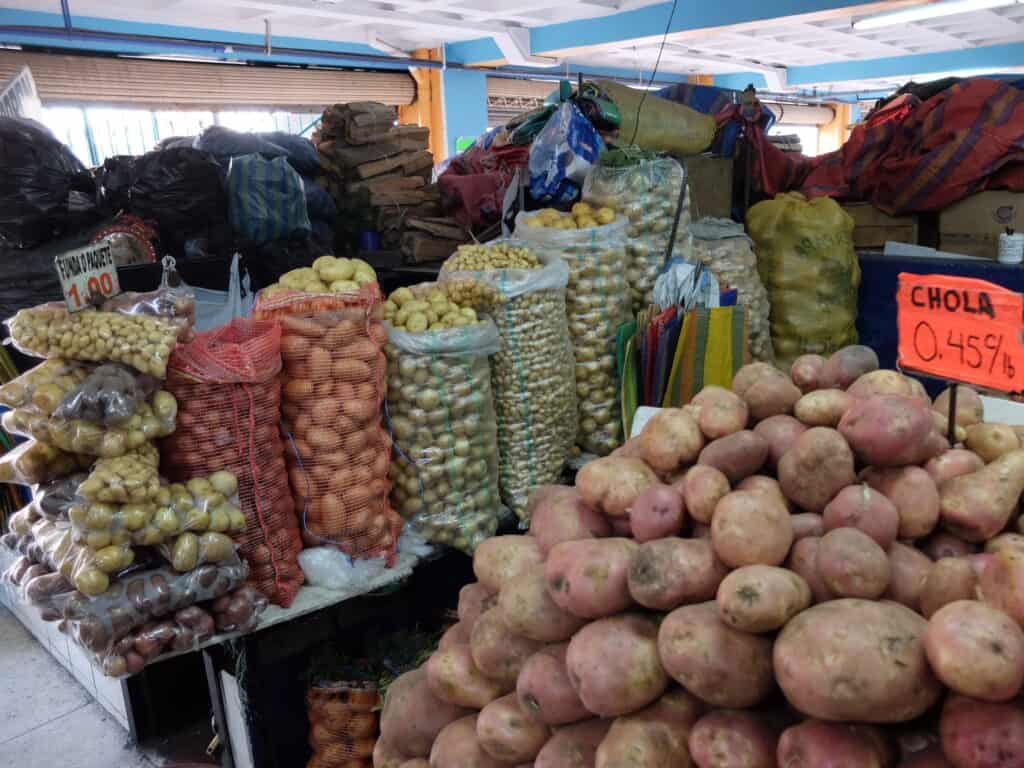
Potatoes originated in South America’s Andes mountains. More than 4,000 varieties are grown in Peru, with local markets boasting a huge selection. Note the different types in the background. Photo: Lima, Peru. Photos: J. Morton Galetto
The versatile tuber, genetically related to the tomato, is destined to star at our holiday tables.
As we embark on the winter holidays, let’s address a worldwide favorite, the potato. When I delved into the history of this vegetable it seemed as though sharing my brother-in-law’s candied sweet potato recipe would have been a whole lot easier than discussing the origins of spuds. But honestly, although his recipe is a family favorite, it would really sell the potato short if we didn’t address its 9-million-year history. Don’t panic, though. I’ve not the fortitude for anything too complicated and neither does the editor.
Potatoes show up on the scene some 9 million years ago in the Andes, but their domestication by the Andean people took place about 8,000 years ago. However, it was just this year that botanists made major inroads into the unraveling of its genetic beginnings.
Maybe in July you saw the science news headlines proclaiming that the genetic links between the tomato and potato were revealed by a team of Chinese botanists. You possibly noticed that the plants resemble one another to some extent. My compost pile unveils their similarity each year as they willingly sprout and I say, “Tomato or potato?” and conclude, “Let’s call the whole thing off.”
Scientists have known that potatoes were closely related to tomatoes and to a collection of three species called Etuberosum. But the genes of the plants suggested a strong link going in either direction. When a plant doesn’t fall clearly into one category, that is an anomaly for botanists to explore.
Sandra Knapp with the Natural History Museum in London was interviewed by NPR’s Ari Daniel of Short Line. She is a colleague on the team of the Chinese botanists who discovered the origins of the potato and its lineage. Apparently there was an inbreeding event in the Andes between tomatoes and Etuberosum—hybridization. In their genome sequencing they found equal amounts of tomato and Etuberosum genes. Neither of these plants grows rhizomes but it was this hybridization or inbreeding event that resulted in a plant with tubers—the potato.
Tomatoes grow above the ground and the tubers of potatoes that we consume are beneath the earth. The tubers allow the plant to store starch and persist in harsh environments from one season to another. When the hybridization occurred some 9 million years ago, the Andes was a high altitude, cold, dry, inhospitable place. The evolution of the potato couldn’t have been more fortuitous—survival of the fittest.
Spanish explorers in South America encountered potatoes around 1536. By the 18th century they had become a staple crop in Europe. Over the centuries they have spread around the world such that today they are ranked as one of the three top crops, surpassed only by wheat and rice.

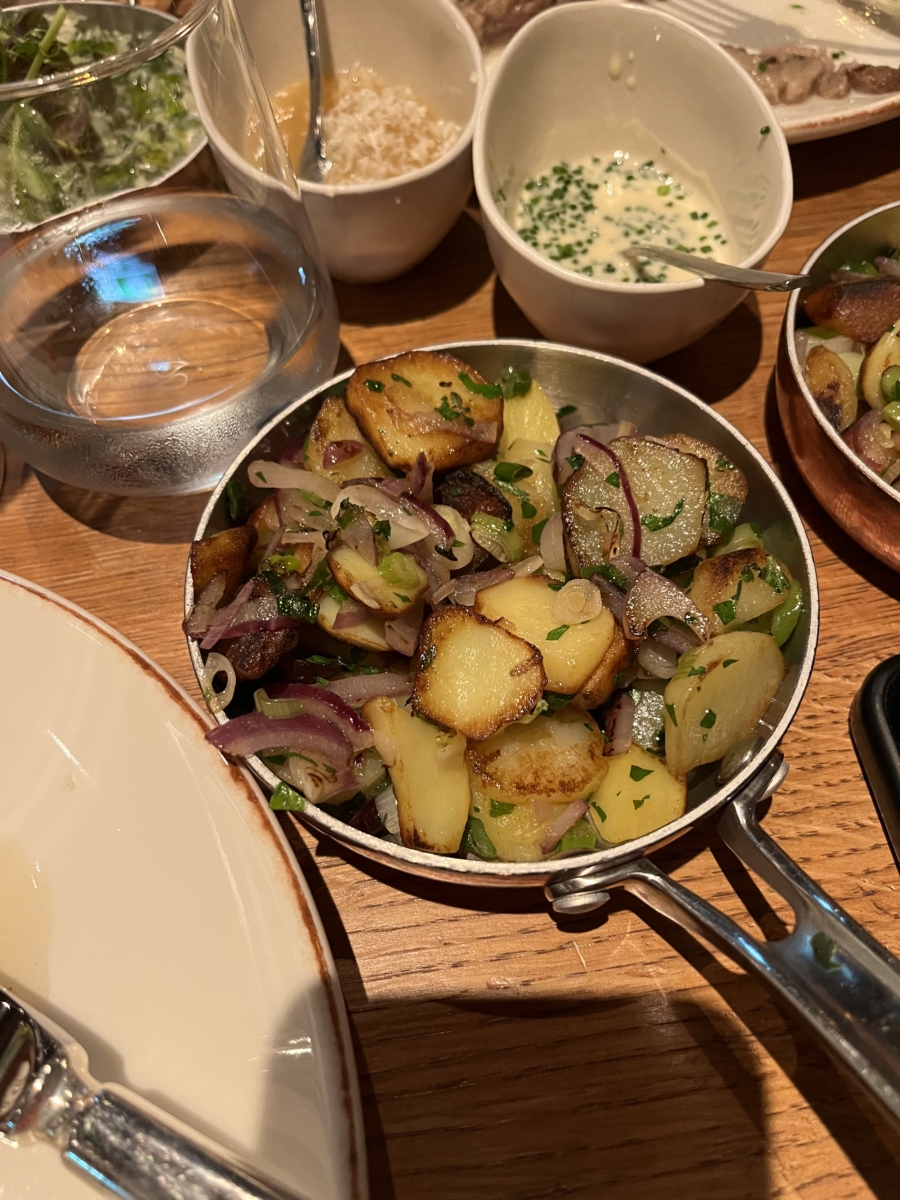
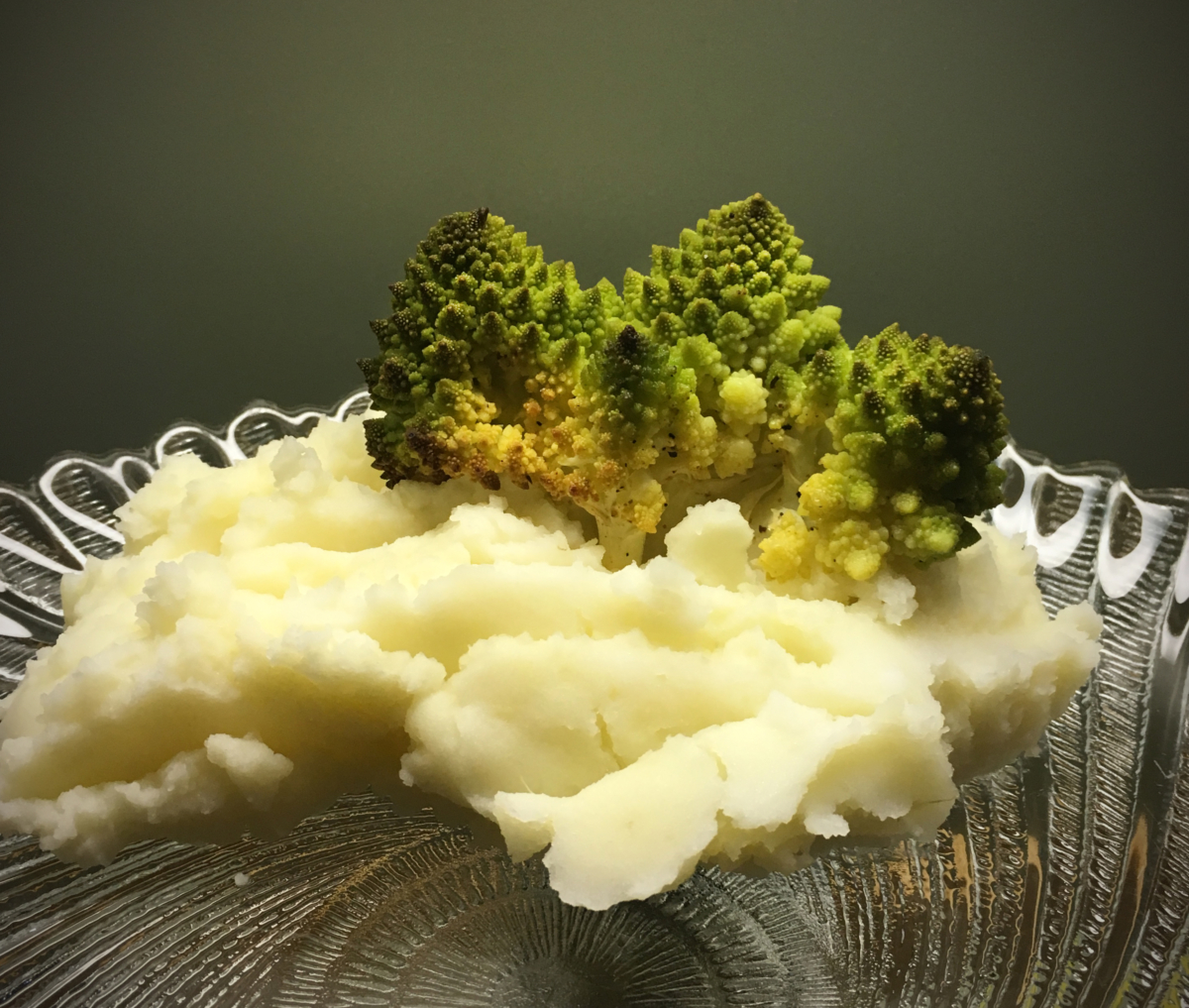
Potatoes every which way! All-time favorite ketchup and fries, home fries, and mashed as a Thanksgiving dinner staple.
Our columnist made mashed potatoes and put romanesco cauliflower-like trees on the “snow.”
The discovery of the hybridization is significant, providing clues to plant geneticists who work in agronomy about how they might develop potato varieties to meet the challenges of diseases and climate change. For those of you who are shaking their heads about science getting into your spuds, know that most all the species of this tuber are domesticated, with only about 107 known to be wild. The Inca people have domesticated potatoes over centuries of time.
Today farmers use chunks of the tuber to grow potatoes, so that all potatoes produced will be genetically identical and therefore equally prone to diseases. Sandra Knapp says that agronomists hope to develop a “seed” incorporating tomato and Etuberosum genes that would allow them to breed potatoes resistant to pests and climatic changes.
On my trips to Peru, I was flabbergasted by the number of species of potatoes for sale in its beautiful farmers markets. The colors and quantities are astounding. Huge bags are crammed to the brim. I came to learn that there are 4,000 different varieties of spuds in that country, the result of thousands of years of cultivation in the Andes mountains.
The Inca have developed a method of preserving potatoes for up to 15 years called chuño, the result of a process of freezing and dehydration. Commonly used in Bolivian and Peruvian cuisine, chuño is an ingredient in stews, soups, and other dishes that offer rehydration. It is a source of calcium, potassium, phosphorus, and iron.
From the Andes in South America to the far reaches of the globe, potatoes are common fare. Historians often contend that they have become a key staple in preventing famines.
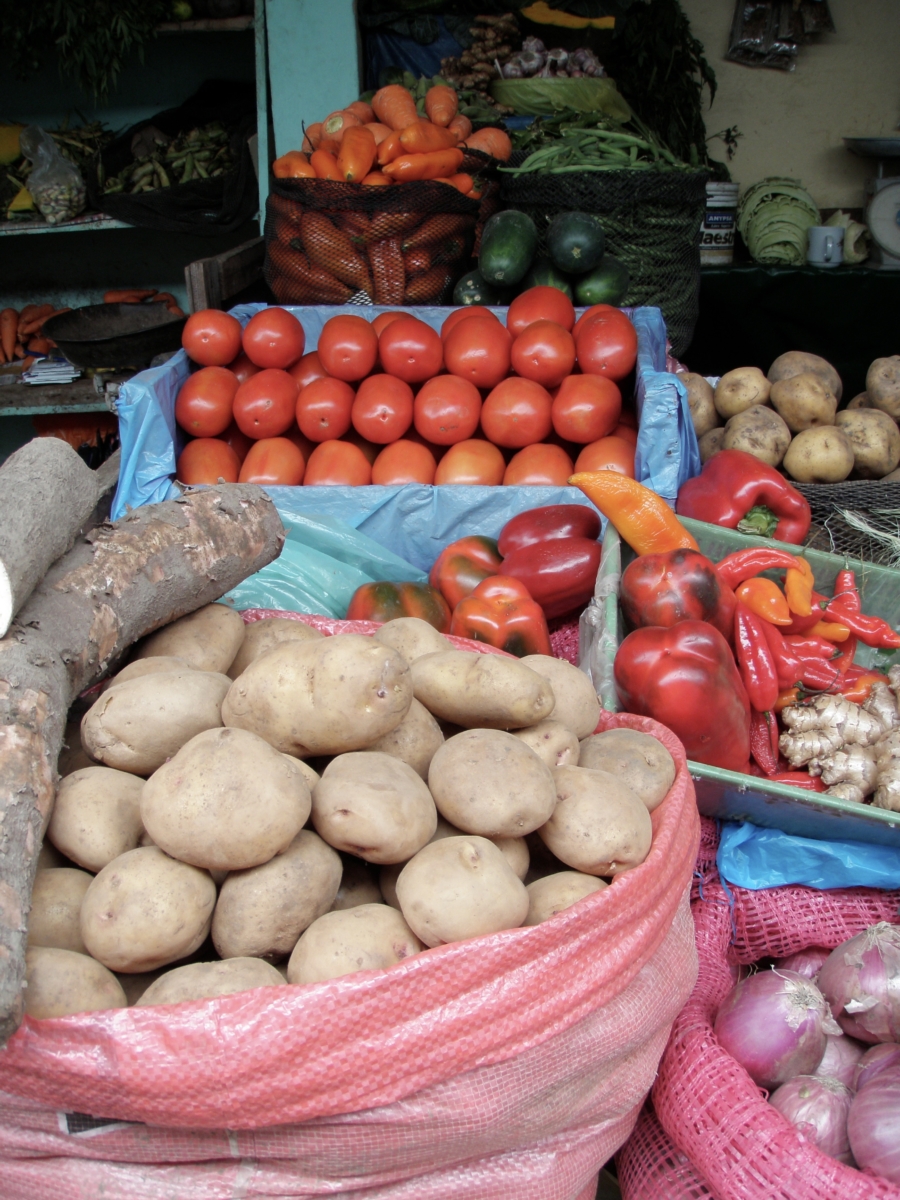
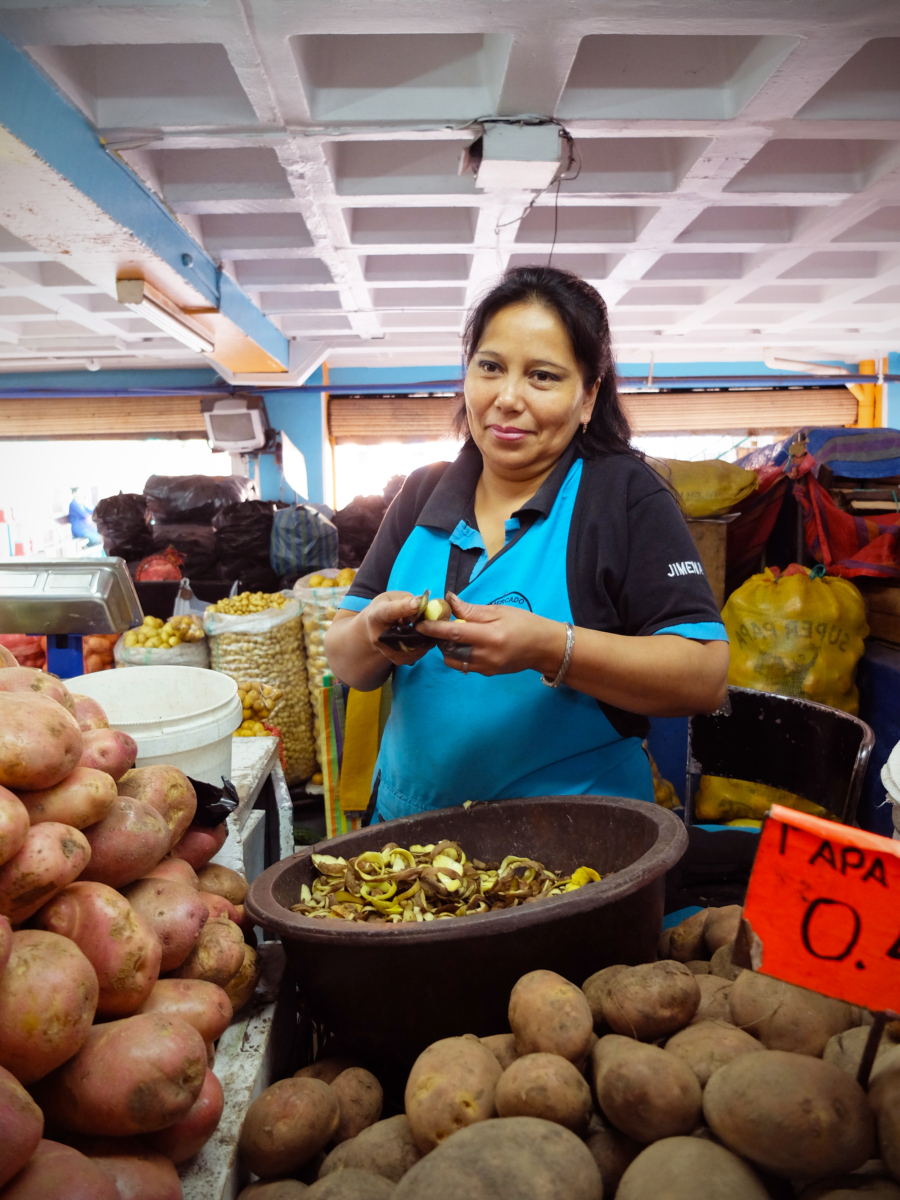
Genetically, potatoes have a close link to tomatoes. Peruvian market, left. Potatoes are the third most important food crop in the world after rice and wheat, and are the leading vegetable crop in the United States, International Potato Center, 2016. Peru.
Potato diseases and blights have caused famine as well. The best known is the Irish potato famine. The Irish had conquered starvation with potatoes and it became their mainstay. Tragically they were so reliant on these tubers that between 1845 and 1852, when a fungus destroyed their primary food crop, one million people died. Another one million emigrated to the United States and two million more went elsewhere. The lack of potatoes halved the population of Ireland.
This impacted the country to such an extent that to this day, even if you were born outside of Ireland, you are automatically an Irish citizen by birth in the event that either one of your parents was born in the Emerald Isle and was therefore entitled to Irish citizenship.
I turned to APRE, the Alliance for Potato Research & Education, about the dietary values of potatoes. APRE is a non-profit funded by the potato industry; consider that my disclaimer. Yet I suppose they know the most about potatoes, surely more than I. This is their declaration: “Potatoes provide a great-tasting, affordable nutrient package that enables people to meet their goals for nutrient intake and for vegetable consumption. Contrary to popular belief, while potatoes are the most consumed vegetable, they aren’t over-consumed in the United States.”
So allow me to say that I intend to make this personal commitment: On Thanksgiving Day I will not only over-consume potatoes, but everything else that makes its way to my plate. From the turkey dinner to the pumpkin pie, when it comes to Thanksgiving I’m all in, waistline be damned. And I’m giving you the blessing to do the same; after all Thanksgiving is but once a year and we don’t want to seem ungrateful.
PS. My brother-in-law’s candied sweet potato recipe is a well-kept secret. I suppose with enough brown sugar, butter, maple syrup, lemon, ginger, and a tad of cinnamon your end result will be similar, but know that it will never be as tasty as Mark’s!
Sources
How the Humble Potato Changed the World, Diego Arguedas Ortiz, BBC, March 2020
“Food security: Ten Crops that Feed the World”. Allianz.
Citizenship Division, Department of Justice, Home Affairs and Migration Office
Rosanna Road, Tipperary, Ireland, August 2025.
Potatoes & Public Health Consumption. Alliance for Potato, Research & Education