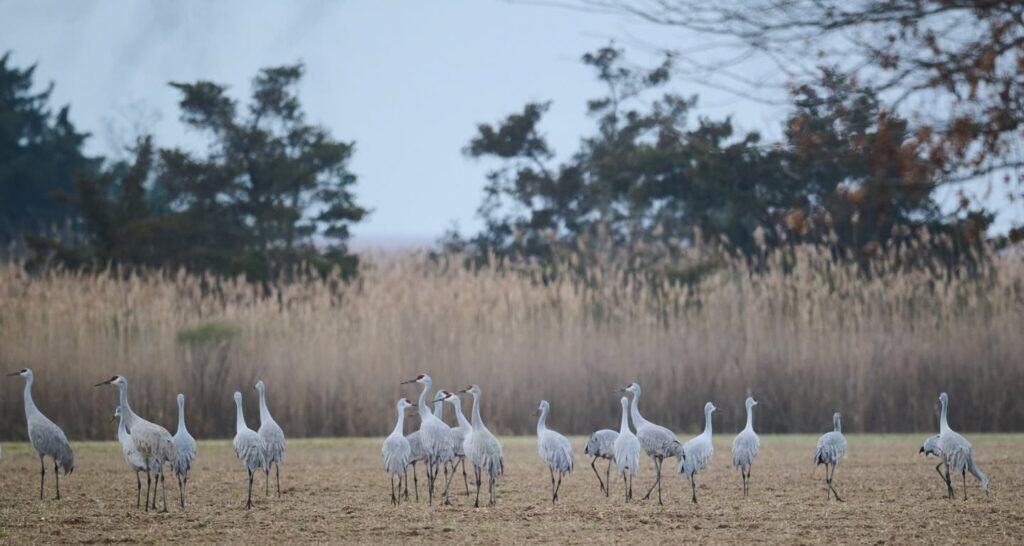
Sandhill cranes congregate side by side. Delaware Bayshore, Cumberland County, New Jersey. Photo: Paul Guris
Sandhill cranes pair up to become devoted lifelong mates, share parenting duties.
In honor of Valentine’s Day let’s explore one of nature’s more faithful and miraculous couples—sandhill cranes.
Sandhill cranes commonly make pair bonds for breeding between two and three years of age. One source suggests their average lifespan to be seven years old, yet depending on the subspecies (defined by territories), maximum lifespans vary greatly, showing maximum age anywhere from 19 to 40 years old. Most first-time breeders fail to raise chicks, and some don’t even make pair bonds until eight years of age. Thus, calculating and predicting breeding success is difficult.
Complexities aside, sandhill cranes mate for life and will only break their bond if they can’t successfully reproduce, or if a mate dies and they are truly romantic.
Sexes look nearly identical, with the male weighing slightly more than the female—eight versus seven pounds. The cranes are monomorphic, and their most differentiating sexual feature beyond their size is the repose of their heads during courtship. When courting they share synchronized calls. The male holds his head nearly straight up and the female raises her head at a 45-degree angle in order to trumpet. To me, their calls sound like loud chattering laughter. They can also make other sounds, not necessarily related to mating, referred to as bugling, rattling, purring, or croaking.
Courtship is an elaborate and fancy affair made more striking atop their tall legs. They reach heights of three and a half feet with wingspans of six to seven feet. Although they are tall, with a body shape similar to herons, they are not in the same family. Cranes belong to an order of birds called Gruiformes that are actually the oldest living bird, dating back 60 million years and having originated shortly after the extinction of the dinosaurs.
Courtship can happen any time of the year but reaches its height in spring before nesting. Cranes are so amorous that if a couple in a large flock of paired birds begins displaying, the entire field may break out in dance. It’s not break-dancing but rather more of a hopping cabaret featuring samba and plumage. A flock of cranes may be referred to as a “construction,” “sedge,” “siege,” “swoop,” or possibly most appropriately, a “dance.”
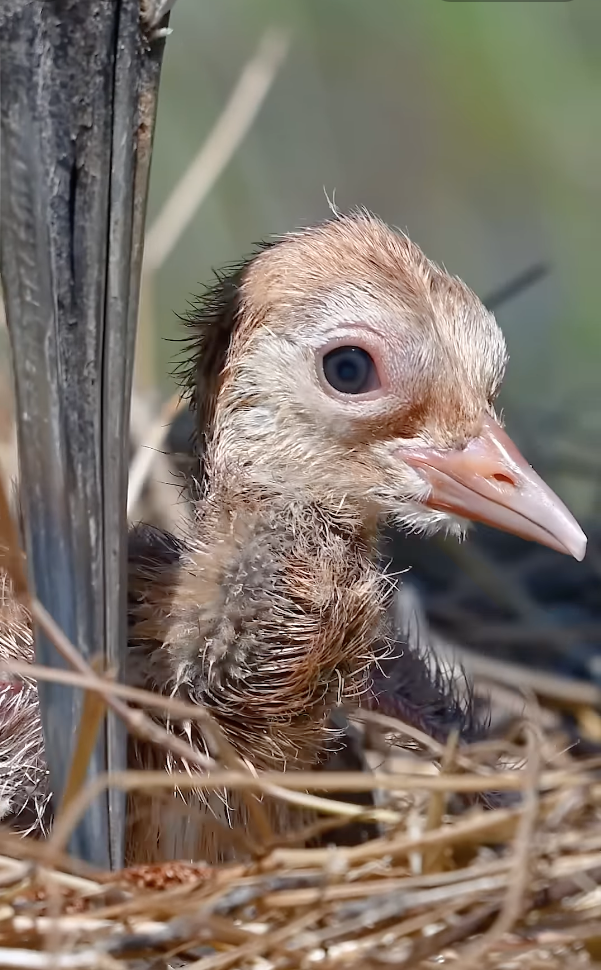
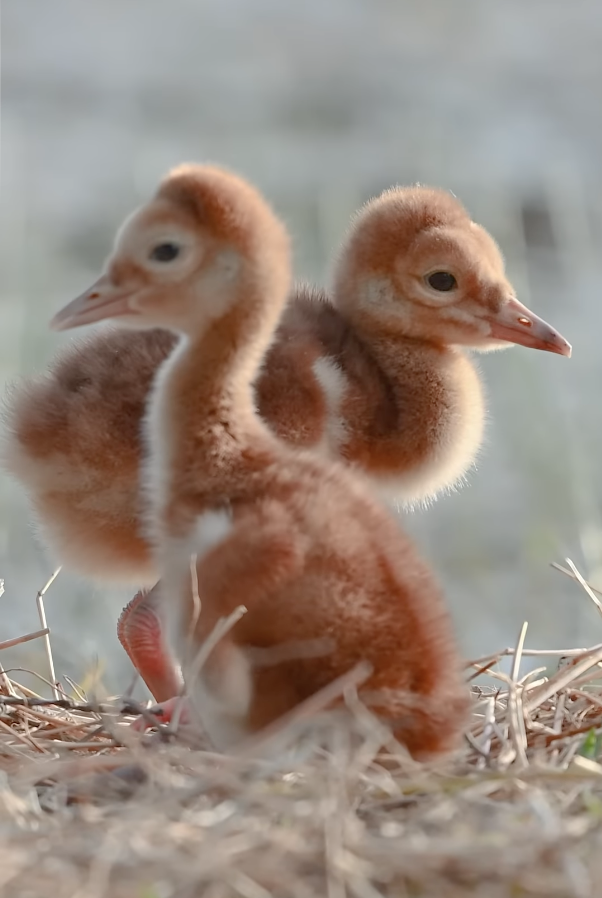
Chicks are precocial, meaning once their feathers are dry they can move about much like a hen’s young. In fact, they normally leave the nest within 24 hours of hatching, though still needing a lot of parental care during their first month of life. Photos: Mark Smith Photography (subscribe to HIS Facebook page)
Often the female will toss a stick, stone, or tuft of grass initiating the display. The tail feathers are lifted, fluffed, and shaken. The birds bow down their heads, flap their wings, and twirl and hop about. They nearly touch beaks, an air kiss of sorts. It’s a very sexy and elaborate courtship that leads to mating. Dancing is a learned activity and adults will teach chicks at a very young age.
Bachelor and bachelorette birds maintain single-sex flocks. They remain in these nomadic groups until paired between the ages of two and eight.
Over two- to four-weeks time, they build a ground nest that is about three and a half feet across on a slight elevation upon an open marshy area. On average, a pair will raise two chicks. During daylight hours adults take turns incubating the eggs. At night the female is on duty. It requires about a month for the eggs to hatch.
Similar to American bald eagles that we reviewed in a recent article, sandhill cranes have a brood patch. This is a bare spot on the belly that allows additional blood vessels to have closer contact with the eggs during incubation. This breeding season adaption allows better heat transfer than would the feathered body. The adult’s feathers regrow after nesting season.
Nesting is not without perils. Ground predators like foxes, bob cats, skunks, and raccoons can eat the eggs or chicks. Avian threats include birds of prey, ravens, and crows. Like killdeer, the sandhill will sometimes feign a broken wing, in order to lure would-be predators away from the nest. Adults will also attack predators with their feet. They assume a threatening stance by spreading their wings, pointing their bill, and making hissing sounds.
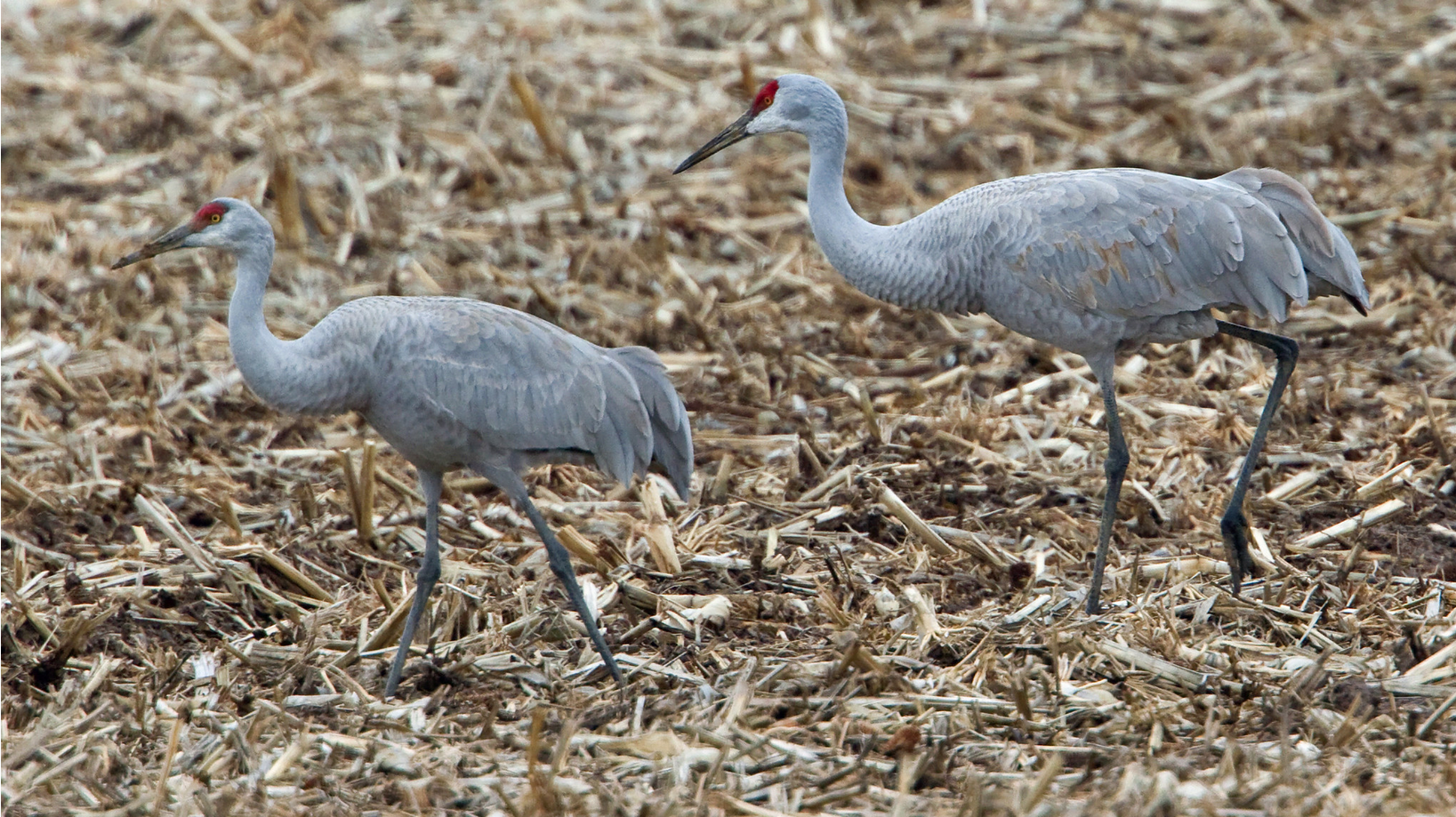
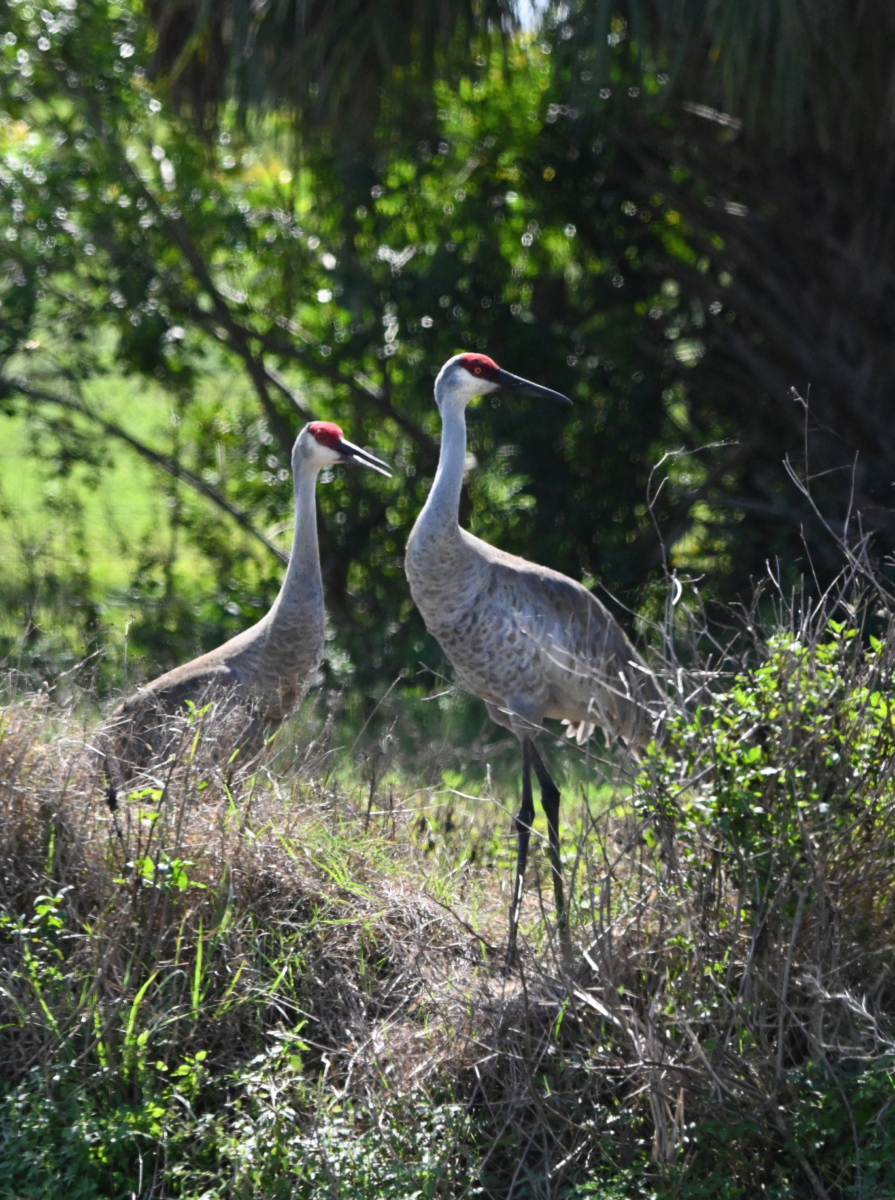
“While once headed towards the verge of endangerment due to hunting and habitat loss, sandhill crane populations have held steady or increased over the last few decades. However, human activity such as hunting and habitat disturbance still impact some populations. All populations are vulnerable to habitat loss from farming, human development, oil fields, and climate change,” United States National Park Service. Photo: Steve Gifford • RIGHT: There is a year-round population of sandhill cranes in Florida. Merritt Island National Wildlife Refuge. Photo: J. Morton Galetto
The cranes have a varied diet of seeds, vegetation, cultivated grains, berries, small mammals, insects, snails, reptiles, and amphibians. Although they feed on crops it is often after harvest, and since they also eat insects and rodents that damage crops they are primarily beneficial.
If a nest fails early enough in the season a pair may reclutch, but typically they will only have one chance each season to successfully raise chicks.
Chicks are precocial, meaning once their feathers are dry they can move about much like a hen’s young. In fact, they will normally leave the nest within 24 hours of hatching. However, they continue to need a lot of parental care during the first month of life. In month two, they are called “colts” and they learn to fly and dance. By their third month of life, they are foraging on their own, as well as taking off and landing, but parental guidance is still evident. By summer’s end they are ready for southern migration to winter climes.
It is during their winter exodus from breeding territories that we get to appreciate them in New Jersey. Breeding in New Jersey remains an oddity. If you see a flock of birds with stretched-out necks along the Delaware Bayshore it just might be a romantic sandhill crane.
Sources
Harris Kirschbaum, M. 2000. “Grus canadensis” (On-line), Animal Diversity Web. Accessed January 27, 2026 at https://animaldiversity.org/accounts/Grus_canadensis/
Old Crooked Toe and The Cranes of Southern New Jersey, Chris Neff, 2020. https://njaudubon.org/old-crooked-toe-and-the-cranes/
Colorado Crane Conservation Coalition. Sandhill Crane Frequently Asked Questions. Coloradocranes.org.
Notes: https://coloradocranes.org/crane-nesting-facts-faqs/
Cranes in New Jersey
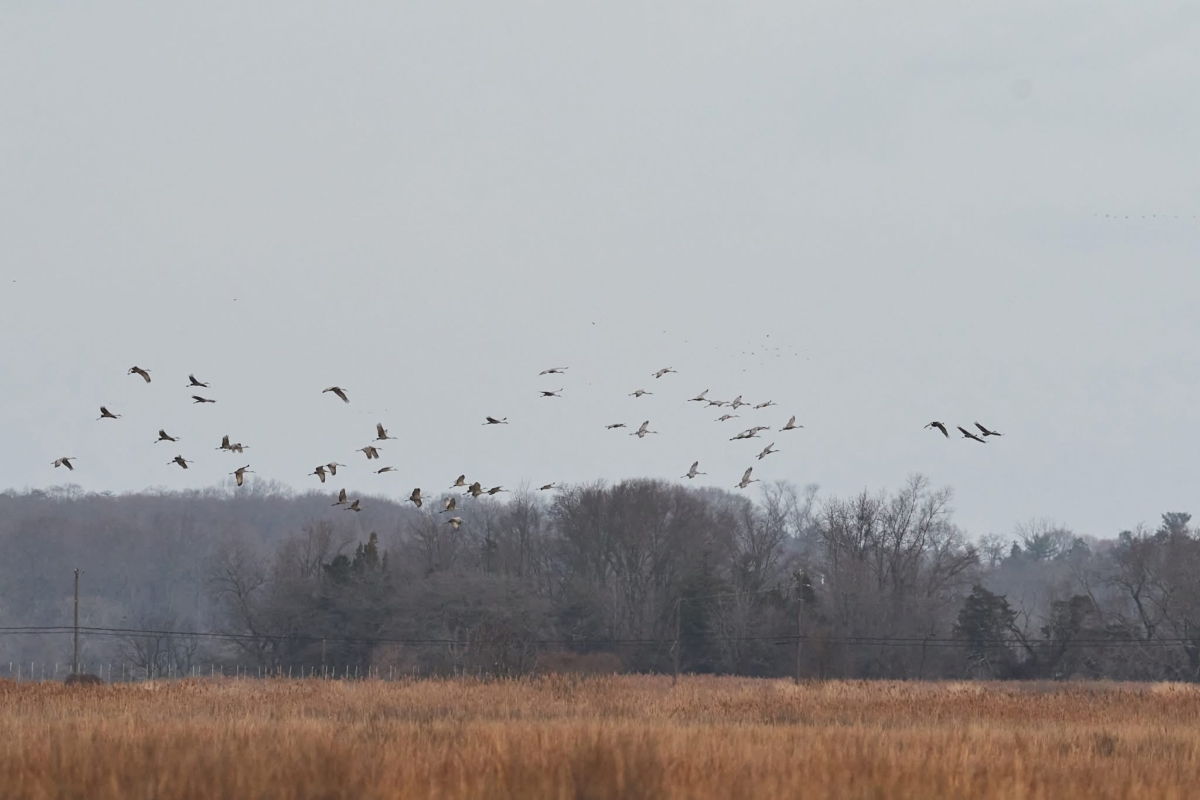
“Paulagic Birding” Facebook post, on the Dec. 29, 2024 Christmas Bird count recorded 72 birds in the Cumberland County flock. This picture captured 47 birds in one snapshot. Photo: Paul Guris
Most cranes’ migratory routes travel the center of the United States west of the Mississippi. Another cohort moves from Lake Michigan to Florida for the winter. That being said, the species is spreading out from the end of September until they are firmly established in their wintering areas in January. By the beginning of April, they are concentrated in the most northern parts of the United States and headed to their breeding grounds in Canada. A smaller cohort nests in the northwestern United States and there is a year-round population in Florida.
Migration to northern Canada for breeding means fewer predators and greater food resources.
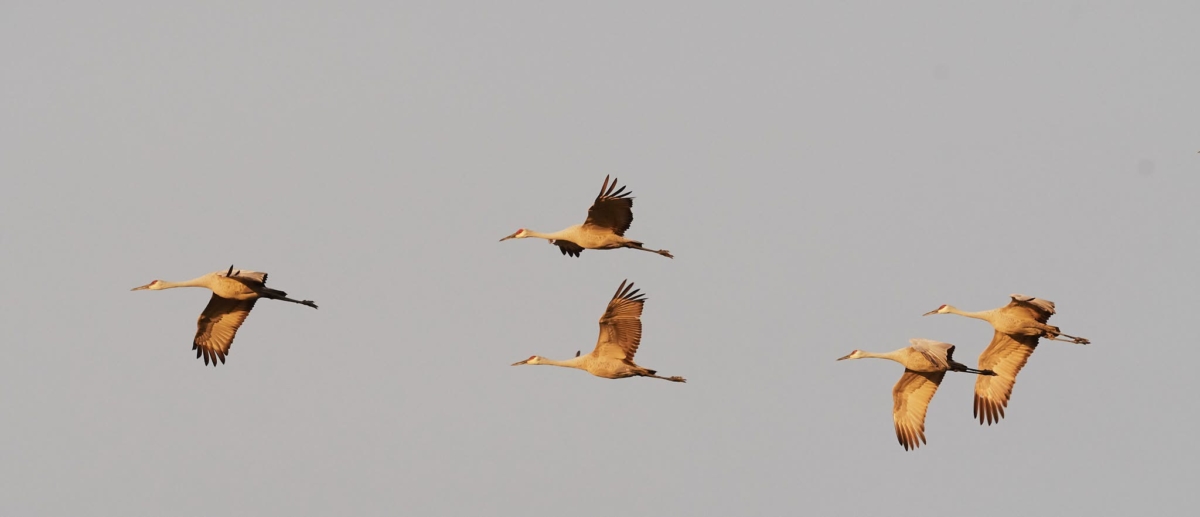
A crane can be distinguished from a heron in flight by its outstretched neck. A heron flies with its neck crooked. “Paulagic Birding” Facebook post on the Dec. 29, 2024, Paul Guris, Delaware Bayshore, Cumberland County, New Jersey.
Sandhill cranes did not traditionally winter in New Jersey and this was unheard of prior to the last two decades. Our wintering group has been growing since 2009. The annual 2024 Christmas Bird Count in New Jersey has shown 137 sandhill cranes in the state with the Cumberland County population reaching a record 72 birds in 2024.
There is a much-storied common crane, a European species that was speculated to have possibly hybridized with the sandhill cranes in Cumberland County. This theory has generated interest within the birding community (see sources: “Old Crooked Toe.”)