Witches’ Butter, Anyone?
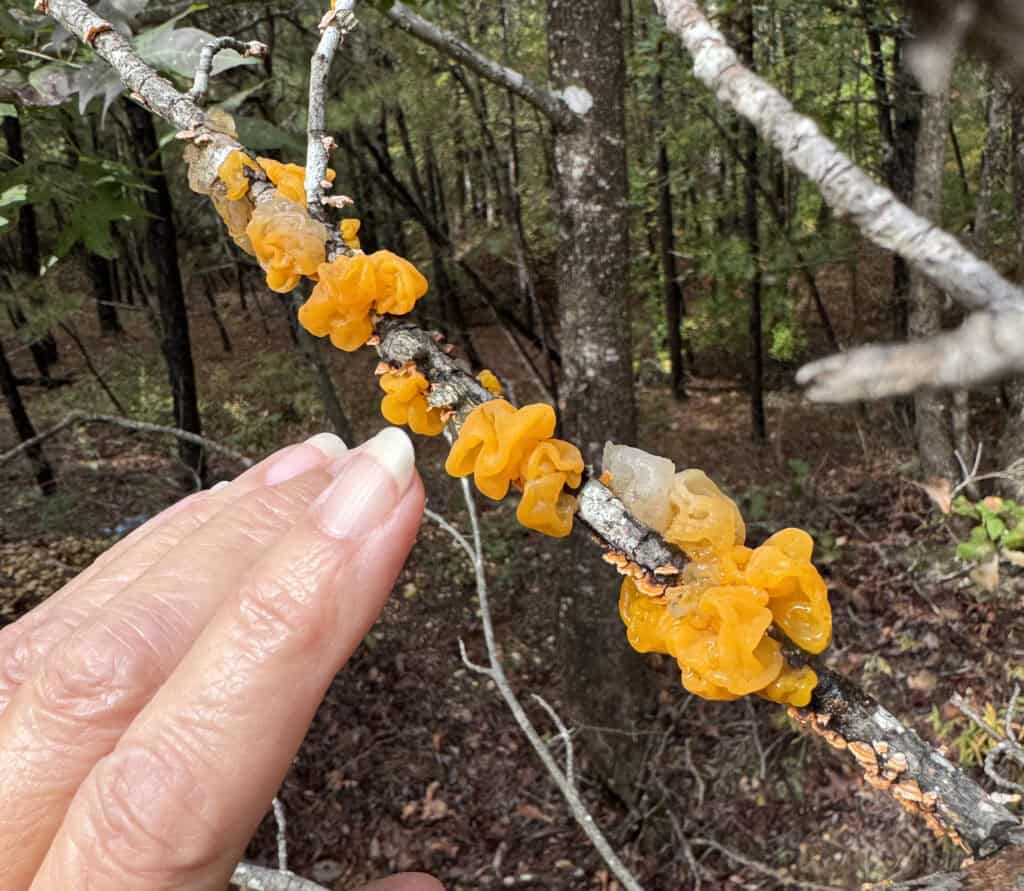
It’s the perfect topic for all ghosts and goblins of the dark woods and forest glens.
Witches’ butter is a jelly fungus and saprophyte, a type of mushroom found on dead hardwood sticks and branches. It is most commonly seen in spring and fall, but also appears in winter during warm periods after a rain. The name comes from the gelatinous, viscous texture of the fruiting bodies.
PHOTO: J. MORTON GALETTO
We were driving along in Peaslee Wildlife Management Area a few days after a rain when mushrooms were prevalent, needing only a bit of moisture to be coaxed into making an appearance. “Whoa,” I exclaimed, bringing our vehicle to a halt.
To which my passenger responded, “Witches’ butter,” with her slight Yorkshire accent.
“Really?” I asked. “I’ve seen it before but never knew the name.” There is something about those British accents that seems to convince this American to accept their declarations.
There was no need to say what I had spied, for a brilliant yellow jelly clung to a branch at eye level with our vehicle. It was wrinkled and nearly neon-bright; nothing else could have captured my eye with such impact.
Depending on your perspective it is moist, shiny, and lovely. Conversely you could view it like tablespoons of gelatin with a corrugated brain-like surface. And with a moniker like “witches’ butter,” maybe it is even a tad spooky. The Missouri Department of Conservation’s online Field Guide on its “witches’ butter” entry states, “Fungi can be strikingly beautiful—or breathtakingly strange! Discovering fungi can bring out our innate capacity for awe and wonder.” Well put! Say it with a British accent and it will seal the deal.
We got out and upon closer inspection, plus employing the phone app iNaturalist Seek, we affirmed it was indeed “witches’ butter,” or Tremella mesenterica. My Yorkshire chum is normally correct about such things. In a broad sense it is a fungus and in this instance a mushroom. Mushrooms have some similarity to plants but they lack chlorophyll and have to obtain nutrients in association with other dead or living organisms. They are neither plants nor animals, but belong to the kingdom of fungi, which includes mushrooms, yeasts, molds, smuts, and rusts.
Tremella mesenterica has other common names as well—yellow brain, golden jelly fungus, black jelly roll, yellow and trembler, but clearly witches’ butter is the most prevalent. Besides, it’s the season for witches and goblins, so we’re going down that spooky path. Tremella comes from the Latin tremere, “to tremble”; mesenterica combines the Greek mesos, “middle”, and entero, “intestine”—so, trembling viscera. (Oregon Coast National Wildlife Refuges).” Yikes!
Scandinavian and Swedish folklore involves stories about thieving troll cats which vomit bile that is called “butter of witches.” Early references to this vile habit comes from 15th century writer George Sinclair (ca. 1630-1696), who is known for his work on witchcraft entitled “Satan’s Invisible World Discovered” (c. 1685). Sinclair was a Scot, and well known as a mathematician, engineer, and demonologist. Quite the diverse resumé.
Sinclair speaks of this phenomenon as devil-created beasts, which present themselves in the shape of a cat and a bird. They take away people’s provisions like “cheese, milk, bacon, and all sorts of seeds, whatever they can find,” and deliver them to witches. While the witches can keep the items brought by the bird, those brought by the cat must be relinquished to the devil. Their carriers are often so full that they must spew up some of their booty. This falls on gardens in the color of gold and is called the “butter of witches.”
On Oregon’s Coast National Wildlife Refuges web page, the gelatinous plot thickens even further. “T. mesenterica’s disconcerting habit of sprouting directly from fence posts, door frames, and other domestic woodwork lent the fungus something of a nefarious quality: Stricken inhabitants imagined they were under the pall of a witch’s curse, and sought to lift the hex by pricking and draining the viscid fruiting bodies. Needless to say, this lancing did little to diminish the fungus, which simply rehydrated when the seasons occasioned it. For those inclined to superstitious beliefs, this Lazarus effect only deepened their despair.”
Survivalists point to T. mesenterica’s ability to rehydrate as a source of moisture in a pinch. Indeed, this fungus is edible and so are its lookalikes. Nevertheless I discourage eating any fungus without expert knowledge. This particular member is said to have little to no flavor, and in Asian cuisine it is used to thicken soups and desserts.
One article I came upon, on the Purdue University botany website, suggests that vomiting and erratic behavior may have been caused by mushrooms and associated with the hysteria that made New Englanders declare people witches in the late 1600s during the Salem Witch Trials.
In consulting iNaturalist, T. mesenterica is present on all continents but Antarctica, in both temperate and tropical regions. It is found on hardwoods, especially oaks, beech, and maple trees where moisture causes thin, shriveled, dark orange masses to revive into plump yellow jelly. It grows on decaying wood fungi, making it a parasite of a parasite, and it is a contributor to the breakdown of wood into forest soil.
If you forage in the woods this Halloween I suggest you avoid the mushrooms without the help of an expert, for we wouldn’t want you to be mistaken or persecuted as a witch.
Sources
“Tremella: A Bewitching Blend of Jelly, Butter and Intestines,” Oregon Coast National Wildlife Refuges, U.S. Fish and Wildlife Service, Newport, Oregon.
“Witches Butter,” Missouri Department of Conservation, Online Field Guide.
“Could a fungus be behind the Salem witch trials?” By Lindsey Berebitsky, Purdue University, Botany and Plant Pathology.
“Satan’s Invisible World Discovered” (c. 1685), by George Sinclair, page 123 available on WellcomeCollection.org
“Jelly Fungus.” University of Arkansas, Division of Agriculture Research & Extension, Plant Health Clinic Newsletter