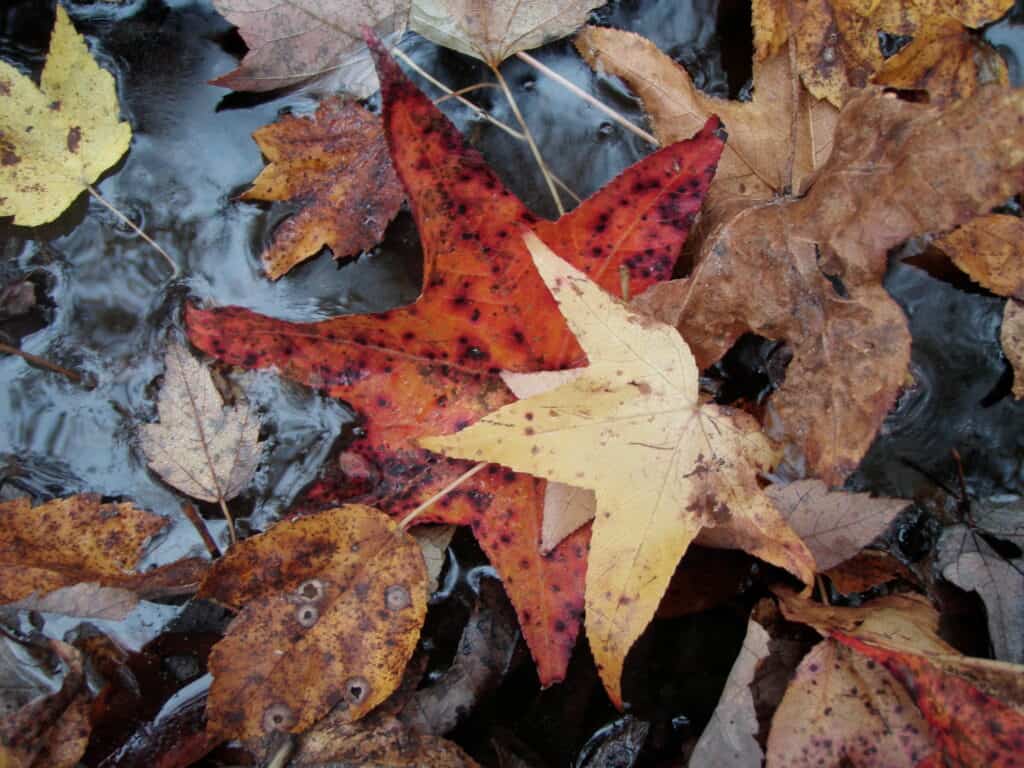
Sweetgum leaves—the red and yellow in center of photo—offer varying colors to our autumn display of foliage. All photos: J. Morton Galetto
Sweetgum has many notable characteristics, but its fall leaf colors are stand-out brilliant.
My first memories of sweetgum come from my childhood when we called them “gum ball” trees, this moniker being earned by virtue of their round fruit. We used to toss the spherical “mace”-shaped ammo at each other every fall.
The scientific name for the tree is Liquidambar styraciflua and its common names do indeed include gum ball, sapgum, star-leafed gum, and redgum.
Today when I walk with my older contemporaries some will remark that the one inch to 1½ inch fruit balls can make them lose their footing: “Geez, I nearly twisted my ankle!” Barefooted people will find their spiny-tipped surface particularly unpleasant.
The seed-filled fruit is most appreciated by the forest creatures, especially birds, who explore the small holes of the spheres to access seeds. Sparrows, Carolina chickadees, doves, wild turkeys, juncos, quail, and gold and purple finches are among the species known to feed on them. These morsels are enjoyed by squirrels and chipmunks as well.
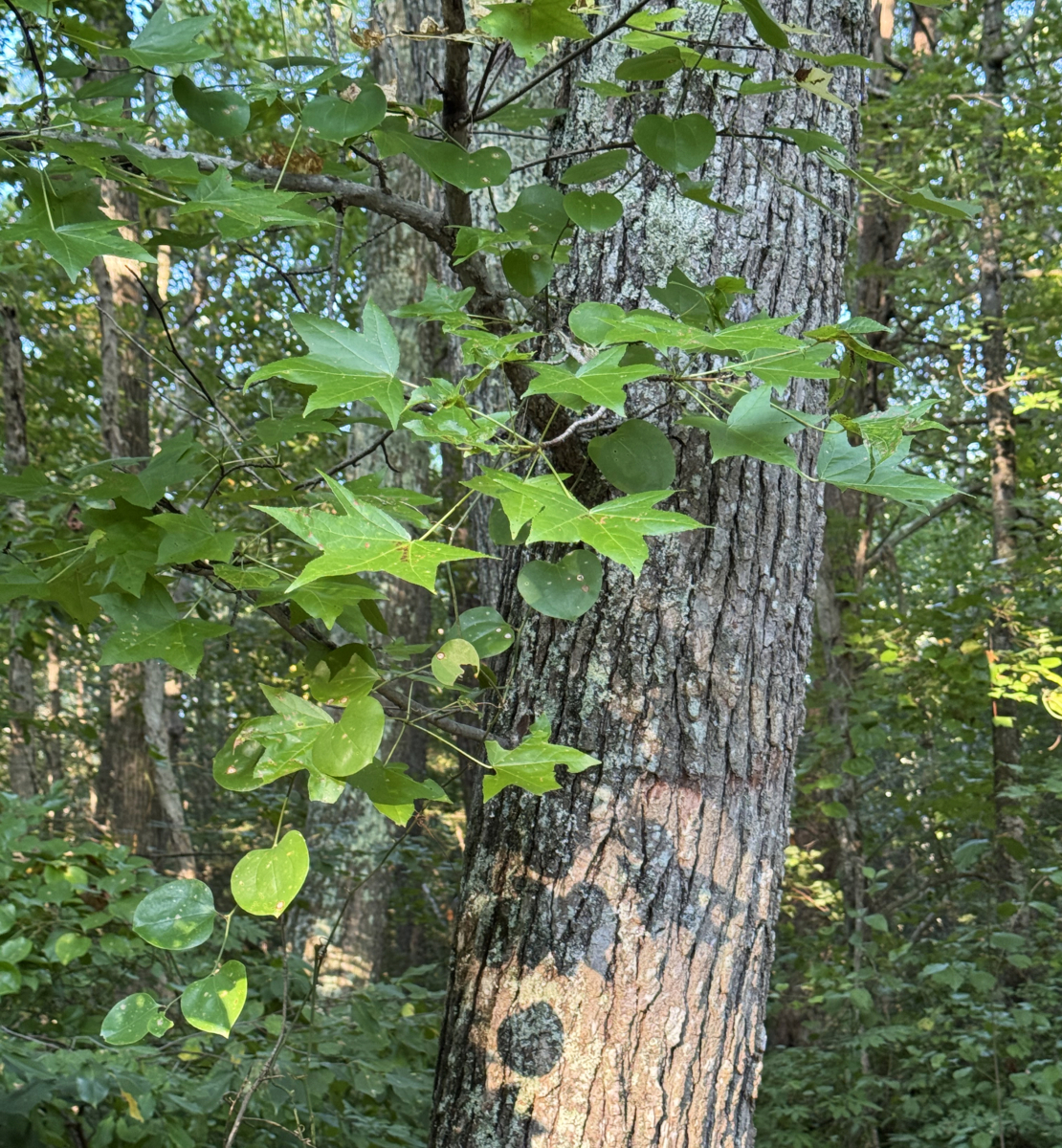
The bark of the sweetgum tree is brownish and deeply furrowed by narrow fissures. That’s greenbrier growing on the trunk. Typically, leaves have five pointed lobes.
The common name, star-leafed gum, derives from the five pointy lobes that give the leaf a star-shaped appearance. In the warmer months it is one of the easiest trees in the forest to identify.
In addition to animals, many moths’ larva use sweetgum as a food plant. These include Luna, imperial, regal, purplish-brown looper, small phigalia, double-lined gray, promethea, red-humped, yellow-haired dagger moth, and large paectes.
The sweetgum is often a pioneer in deforested patches of ground along the Delaware Bayshore, which is often previously farmed land. This is true of other coastal areas, especially if they are sheltered from the wind and direct sunlight is accessible. These trees can also tolerate an occasional wash of brackish water, making coastal habitats suitable. Young saplings will often sprout densely within only a few feet of one another. Ultimately the trees can’t support this density because they are a large deciduous hardwood that can exceed 100 feet in height, with a diameter of three to five feet. To raise the tree as a forestry resource—as with many species—one must give attention to spacing..
Their young branches often show a corky winged surface on the bark, theorized to afford greater air exchange. Sweetgums do not produce seeds until they are 20 to 30 years old, and they may continue production until 150 years of age.
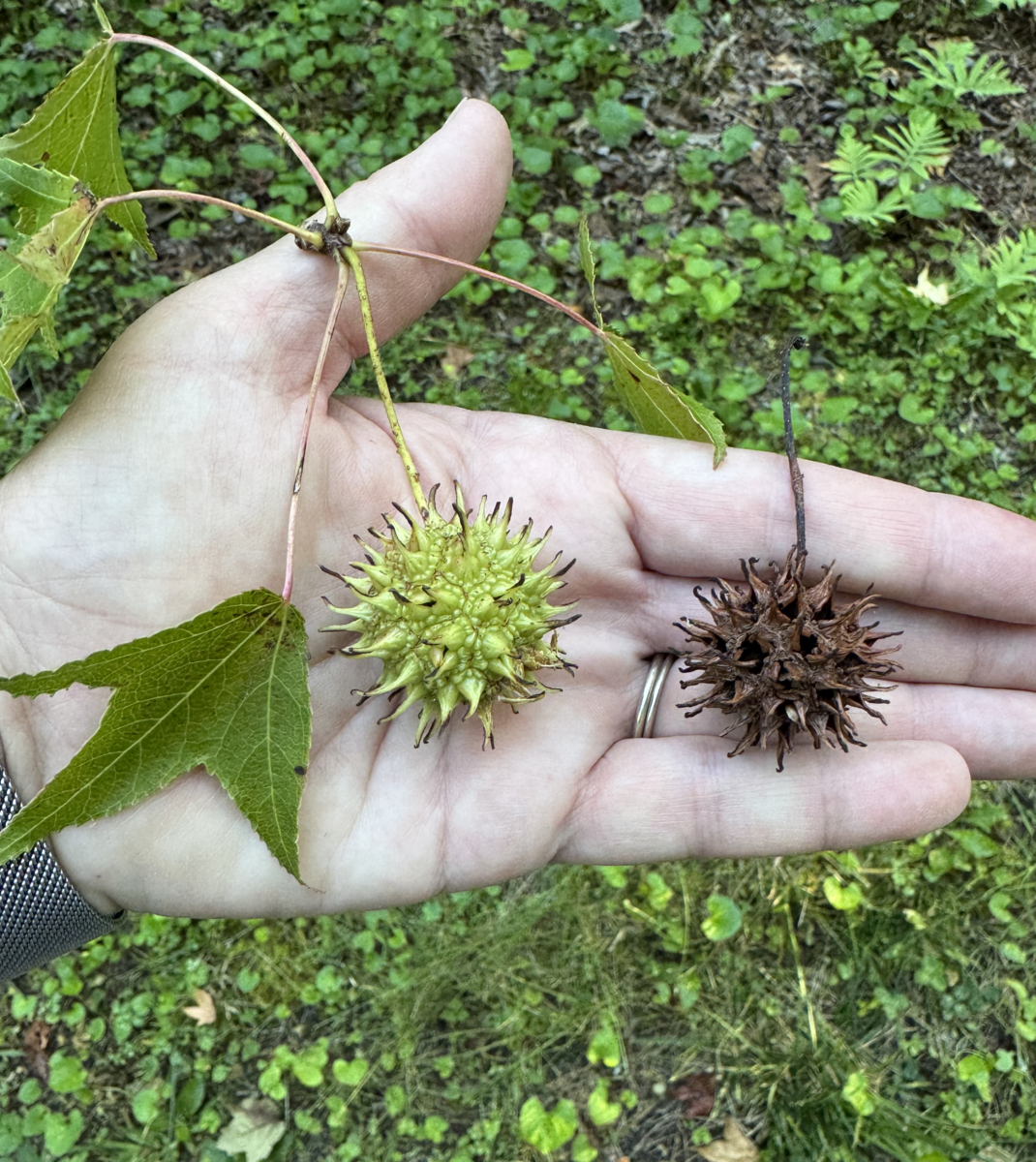
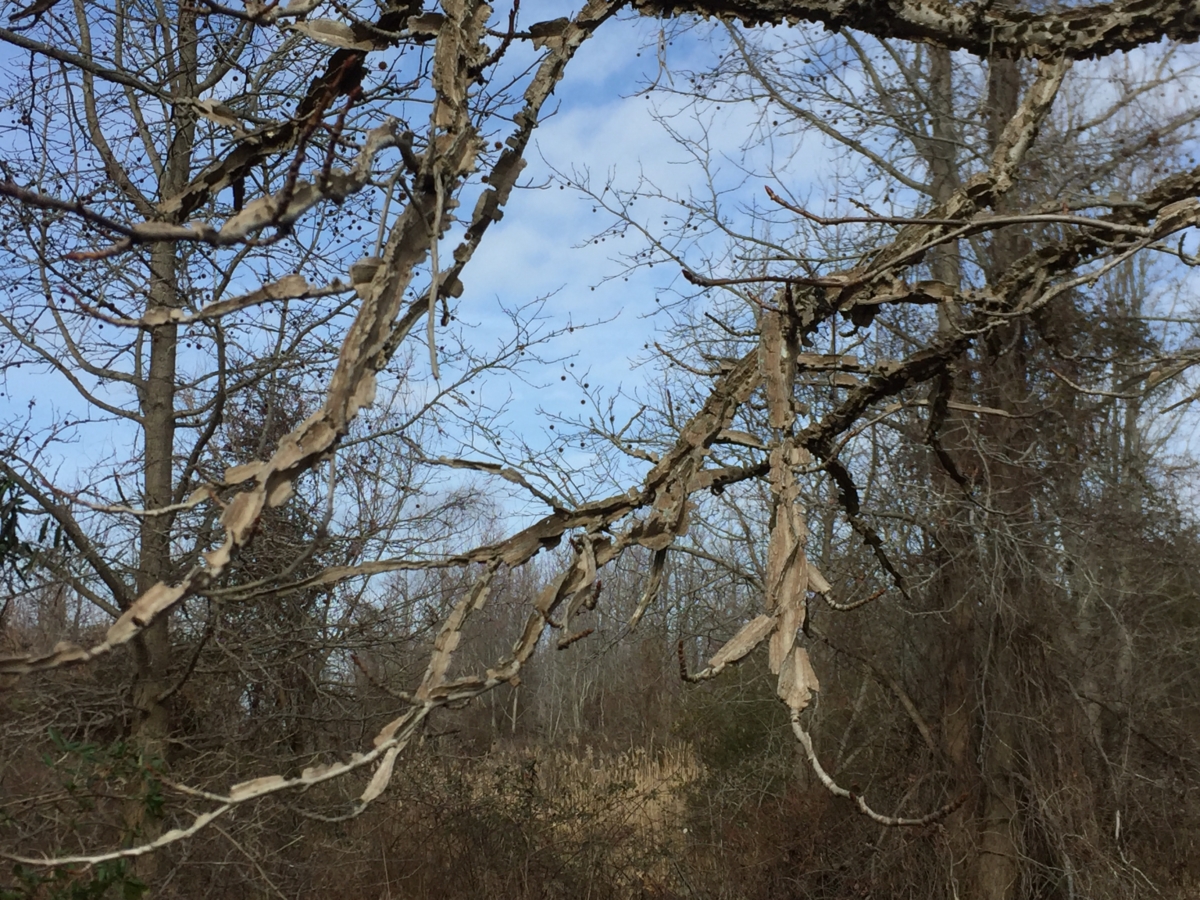
Young tree branches often have corky bark wings. ABOVE: Spikey spherical fruits of a sweetgum tree contain seeds. Some common names for this fruit include gumballs, monkey balls, sticker balls, space bugs and witch balls. The fruit changes from green to brown as the fruit matures.
Sweetgum trees prefer bottomland areas with rich, slightly acid soils having a pH of 6.1-6.5. Some of the largest sweetgums I have seen in our area border the Maurice River Bicycle and Walking Trail in Millville, just downstream from Union Lake Dam. There is a park entrance near the Jacob Law Group office on Main Street in Millville. If you continue from that entrance to the main trail you will see a stand of large sweetgum. I admit to mourning the collapse of the largest and likely oldest of the group. You can still see its large hulk lying on the forest floor, where it replenishes the soil.
Sweetgums range from the southeastern United States west to Texas, south to Florida and north to New Jersey. They occur in limited numbers as far north as Connecticut. There is a scattered occurrence into Central America.
The tree’s handsome fast-growing hardwood has a great many uses—pulp, furniture-grade lumber, pallets, and paneling. Sweetgum is commonly used as a plywood veneer. Gene Wengert, a contributor to Woodworking Network, comparing blackgum (tupelo) to sweetgum, notes that the latter has a white to light pink sapwood and is sometimes sold as “sap gum,” while the reddish-brown to brown heartwood is marketed as “red gum” and in European markets it was once offered as “satin walnut.” The heartwood can be mistaken for cherry. Conversely, blackgum has a light gray-brown sapwood and a heartwood that is darker gray brown. Sometimes the woods’ color is difficult to differentiate and magnification is employed. So clearly sweetgum and blackgum can be similar.
Sweetgum has been employed for medicinal purposes by Native Americans, colonists, and in modern-day medicine. The Cherokee tribe used the inner bark as an anti-diarrheal and for dermatological salves. Along with sheep or cow tallow, a mixture was applied to itchy skin, sores, and ulcers. An infusion of inner bark was used as a sedative for “nervous patients.” The Houma tribe applied a decoction of root to lesions thought to be caused by worms. Koasati used bark decoctions for night sickness. These are but a few examples.
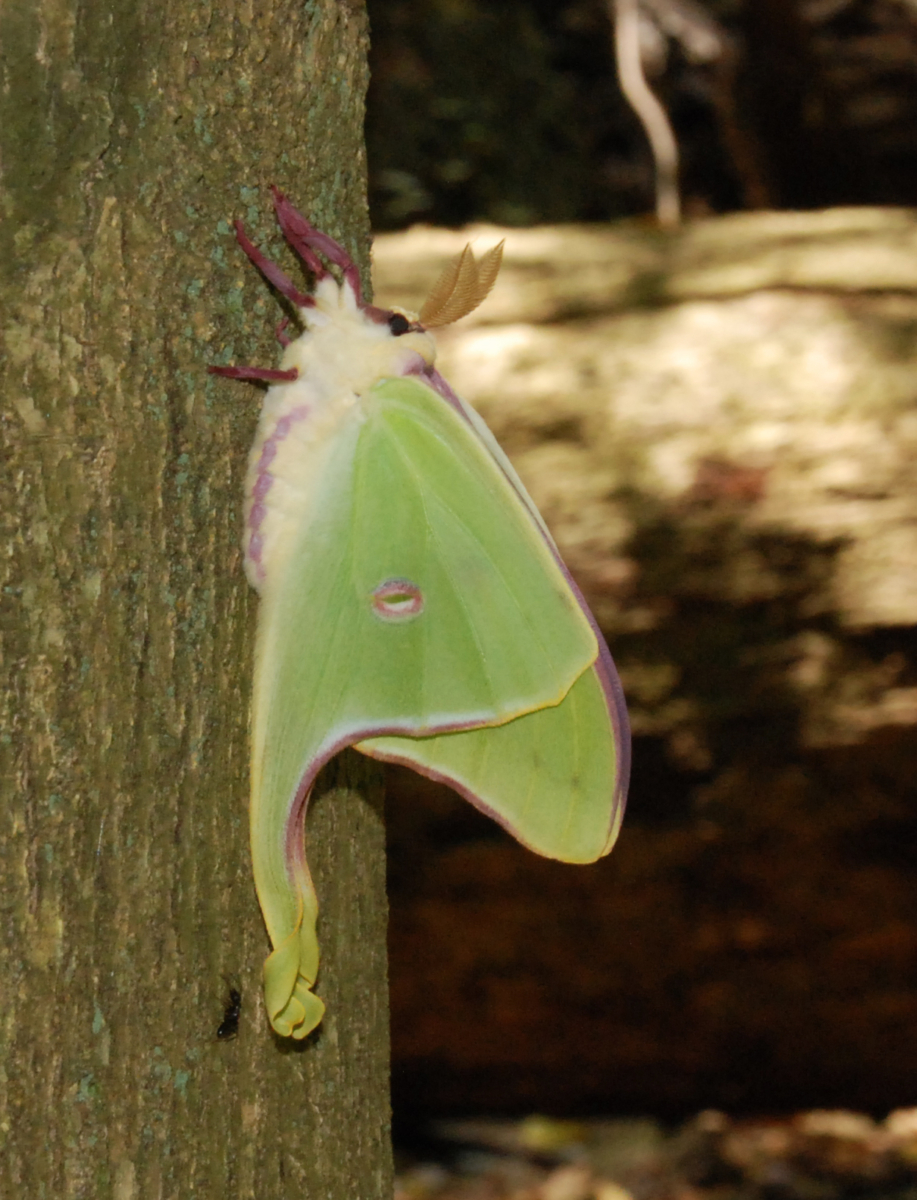
Sweetgum leaves attract at least 10 species of caterpillars. The Luna moth’s larva relies on sweetgum leaves as one of its food sources. Sweetgum is not this moth’s only host plant, they also will eat walnut, hickory, birch, persimmon, sumac, maple, and willow.
The Cherokee also made a tea beverage from the bark and grapes that colonists translated as being called “Hearts-a-bustin’-with-love.” They also used solidified sap as a chewing gum.
A Confederate field guide for medical officers during the Civil War mentions sweetgum numerous times as a medicine. It suggests boiling equal parts of red oak and sweetgum into a syrup to alleviate diarrhea and dysentery.
Today, similar to a tea suggested in the Confederate medical guide, shikimic acid is extracted from sweetgum bark as a precursor to Tamiflu.
Setting aside the many uses and properties of sweetgum, we can simply enjoy its shade and splendor. And currently we are approaching the tree’s signature glory days of autumn. When the chlorophyll drains to the ground it reveals the leaves’ true colors of deep yellows, purples, fuchsias, and reds, dominating the forest scene in a rich display. Don’t miss the show!
Sources:
iForests – Biogeosciences and Forestry, Journal of the Italian Society of Silviculture and Forest Ecology (SISEF)
Native American Ethnobotany, D. Moerman, Timber Press, Oregon, 1998
Caterpillars of Eastern North America, David L. Wagner, 2005
Black vs. sweet gum, by Gene Wengert, August 12, 2010, Woodworking Network
Trees of New Jersey and the Mid-Atlantic States, New Jersey Department of Environmental Protection, Division of Parks and Forestry