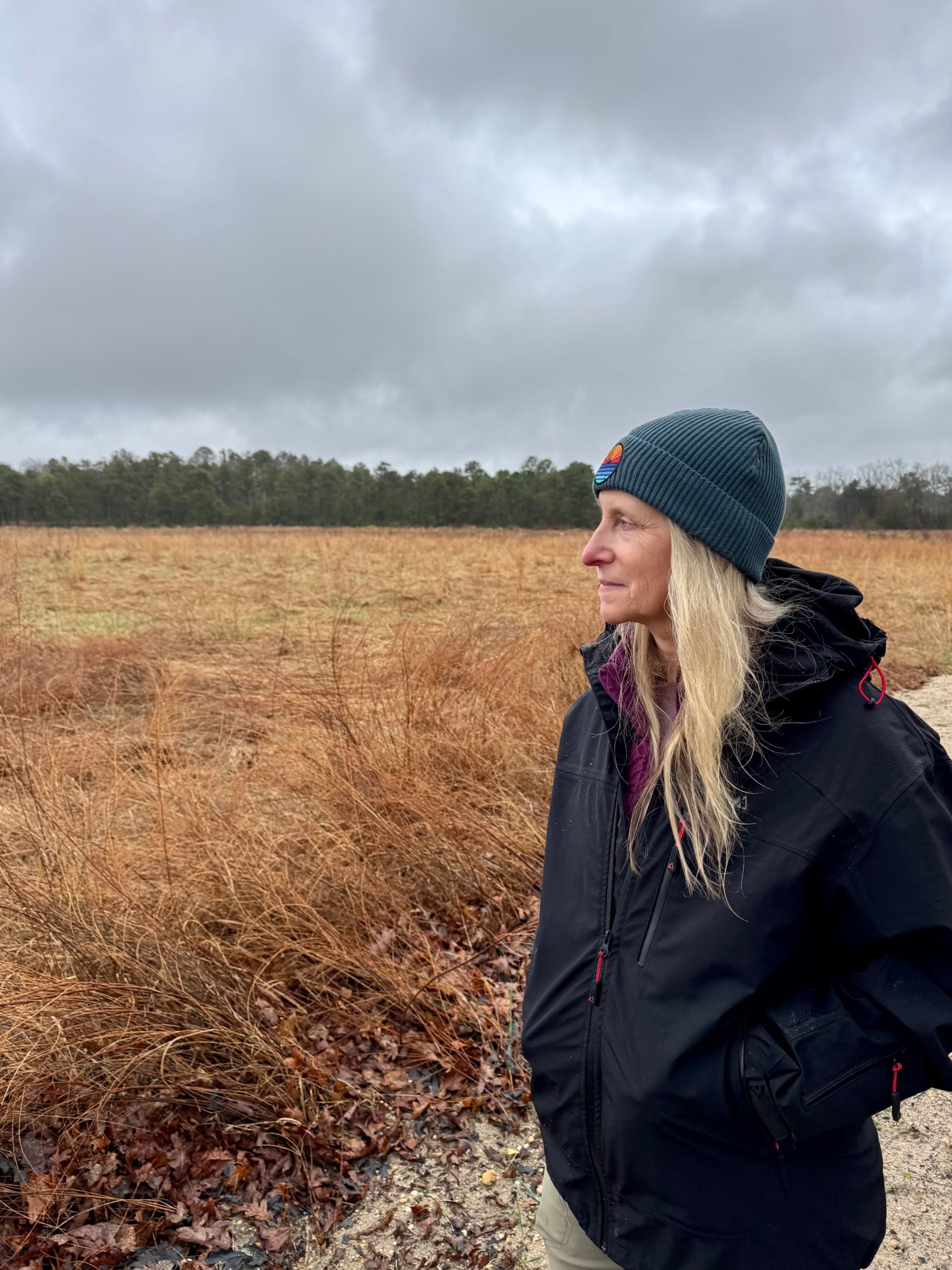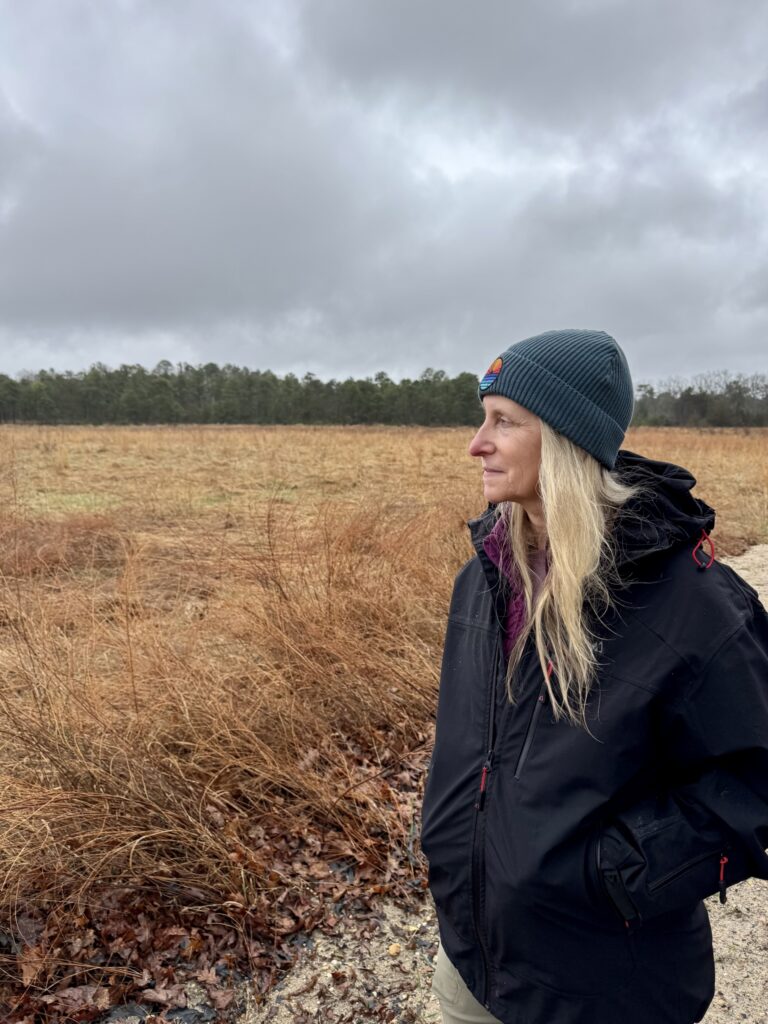
When Dede Manera looks at protected space like the former Holly Orchard, now a New Jersey Wildlife Management Area, she contemplates how future generations will protect flora and fauna. She knows that wildlife trafficking is everywhere and that it takes many vigilant eyes to protect wildlife from poachers. PHOTO: J. MORTON GALETTO
A retired wildlife criminal investigator, who worked on both regional and global cases, encourages people to act locally to protect wildlife.
Fellow nature enthusiasts and I had the pleasure of spending the morning on a hike with Dorothy Dianna “Dede” Manera, a recently retired criminal investigator for the United States Fish and Wildlife Service (USFW). She worked in the Office of Law Enforcement and Special Investigations Unit from 1992 until November of 2024. When she began her career about 250 such agents were in our country. These agents network with other wildlife criminal investigators, such as conservation officers, across the nation, and with an international network of individuals whose job it is to protect species. Only four such agents are women.
During my most active years in conservation both of us knew of the other. This was the first time I had a chance to talk to her about her career in general terms as opposed to involving a specific case. Her blond hair and steely blue eyes relayed interest and resolve as she spoke to CU Maurice River hikers. The passion she had for her life’s work is evident in each thought she shared.
I’m aware of some of the work that wildlife criminal investigators do as a result of my serving on the New Jersey Endangered and Nongame Species Advisory Committee (ENSAC) from 1988 until 2023, and I also served on the Fish and Game Council for 13 years. On these boards we would often hear about individual cases of poaching animals for profit; it’s illegal to possess wild animal parts or sell wild animals in New Jersey.
On our walk a number of people said they didn’t know that selling wild venison is not permitted. The reasoning behind this is that hunting is established as a non-profit activity. If it were profitable people would be likely to exploit animals for gain, and this would constitute a serious threat to local populations of animals.
On Fish and Game Council we would review cases of sportsmen who committed wildlife violations, whereas on ENSAC we would learn of everything from hobbyists who illegally possessed poisonous snakes, box turtles, salamanders, alligators, and the like to organized criminal trafficking of large numbers of animals that involved millions of dollars.
There exists an international agreement between 184 parties, signed in 1973 and enforced since 1975, that seeks to ensure that international trade does not threaten species survival. This agreement is called the Convention on International Trade in Endangered Species of Wild Fauna and Flora (CITES). People who get involved at the international level, such as Dede during her career, investigate these international crime networks.
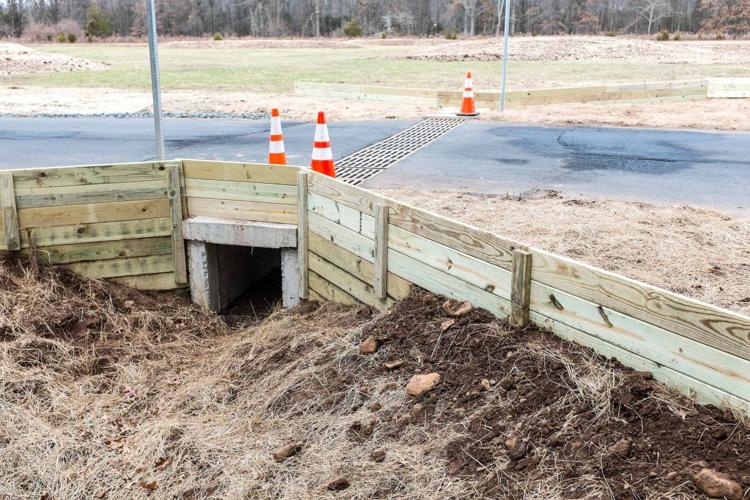
Wildlife traffickers threaten wildlife populations. Conversely, municipalities collaborate with New Jersey Fish and Wildlife to install turtle tunnels to help protect turtles from being killed on the road. A number of small mammals also use these connective passages. This is part of the Connecting Habitat Across New Jersey (CHANJ) program that actively seeks to reduce wildlife road fatalities. Photo: Brian Zarate, NJ Fish and Wildlife, Endangered and Nongame Species.
Manera explained to me and fellow hikers that the trafficking networks are focusing on more than just wildlife. She said, “They are true criminal networks that operate opportunistically; they will deal in whatever makes them money.” As a result, enforcement agencies frequently become involved in a case that includes a diverse number of criminal activities.
Dede was the recipient of the 2022 National Fish and Wildlife Foundations Guy Bradley Award, a lifetime achievement award given to one state and one federal officer each year whose dedication to protecting natural resources has advanced the cause of wildlife conservation. Dede’s most famous case has as many twists and turns as a multifaceted Dan Brown novel. Involving the illegal trade in rhinoceros (rhino) body parts, it was called Operation Crash, “crash” being the term for a group of rhinos.
Like most people who are seeking large sums of money, criminals of this type are generally enmeshed in many other illegal activities. What Dede relayed was many layers of criminal behavior surrounding the sale of rhino horn cups and other horn material. Rhino cups are displayed in museums as cultural Chinese artifacts, much like carved ivory, which is also illegal today. Even the shavings from these carvings have great value on the black market.
Many of you may be aware that ancient Chinese medicine practices have created a demand for the illegal trade of rhino horn and the products made from it. Rhino horn is culturally tied to male virility in ancient medicine theories still practiced today. Aspects of the case involved a well-known auction house selling a rhino horn cup at auction. When it went for half a million dollars it set a market value, even though the seller, through many complexities, was also the end buyer.
At another level an informant in the case was actually borrowing cups from a woman who had a collection of antique libation vessels. These he cast to make resin forgeries to sell on the black market, so that the pre-established value was benefiting him. Many people with illegal intentions were involved in this scheme throughout Dede and her associate’s investigation.
While this description is vastly oversimplified, Dede explained the many layers of involvement both dependent and independent of one another. And what she shared was clearly only scratching the surface of four years of this fascinating and convoluted investigation.
Operation Crash ultimately uncovered the criminal network, leading to the conviction of more than 40 individuals and resulting in 516 months of prison time, $2.1 million in fines, $5.7 million in restitution, and the extradition of five individuals to the United States.
Dede was involved in many smaller cases that can have just as great an impact on wildlife populations. In New Jersey a property owner destroyed known bog turtle habitat, thus eradicating their food source and breeding territory. Under federal law this is considered a “take.” The individual was indicted by a federal grand jury and pleaded guilty to this violation of the Endangered Species Act.
It is important to note that removing just one turtle from the wild can have vast repercussions on the species as a whole. Biologists maintain that turtles, because of their life history, are very sensitive to any loss of individuals. Poaching, collecting, and illegal harvest can mean the eradication of an entire population. This is especially heartbreaking when the species is endangered or threatened. Dede stressed the scale of wildlife trafficking, and the fact that it is happening everywhere.
To be clear: It is illegal to kill, harass, or collect native, non-game wildlife. Dede emphasized that reporting any suspicious activity to wildlife enforcement is important and that it often allows officers to connect the dots. Public input frequently results in cases being solved or criminals being prosecuted. She stressed, “Don’t give up; be persistent if you think something isn’t right. Law enforcement is often short-handed, but your tips help solve crimes.”
In the beginning of Dede’s employment she found that getting the help of prosecution agencies was difficult. But in the last 10 years of her service the support greatly improved. However, she continues to be frustrated by the amounts of the fines imposed because they are not meeting the gravity or magnitude of crimes committed and don’t act as a sufficient deterrent.
When I asked her where she found joy or pleasure in her work she stressed that it was satisfying to work with the many agencies that cooperate to bring a case to prosecution. She also spoke of the respect she had for her team of wildlife criminal investigators and their resolute dedication to solve cases.
In her three decades of work Dede, a resident of Cumberland County, was originally assigned to Newark, then Philadelphia, Pleasantville, Millville, and finally Vineland. Though her office was local she and her team often worked internationally to solve wildlife trafficking cases.
In our region reptile and amphibian collection is a common crime. If you suspect poaching, illegal hunting, fishing, trapping, and/or wildlife violations, you can call NJ Fish and Wildlife Law Enforcement’s Operation Game Thief Hotline at 1-855-648-8477. If you ever see someone handling animals and taking them from the wild, they are likely acting illegally. Anyone collecting or studying animals legally needs to have a permit, so when you call in a suspect to New Jersey’s team of conservation professionals, they will likely know if the activity is suspicious or not. Remember that when you call it in, you may be protecting the existence of a whole colony of endangered creatures, not just that one individual!
Source:
“Resident Agent in Charge Dorothy ‘Dede’ Manera is the first female federal law enforcement professional to earn the Guy Bradley Award for lifetime achievements,” U. S. Fish and Wildlife Service, March 2022 (https://www.fws.gov/story/2022-03/change-agent)