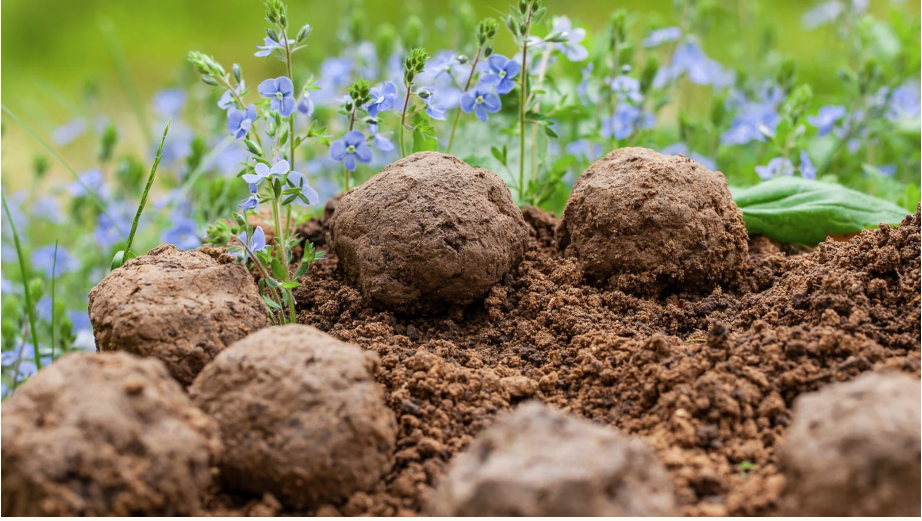
Epicgardening.com gives instructions on how to make seed bombs; “How to make seed bombs: 3 Different methods,” including the Fukuoka Method.
Plant seeds, not bombs! The seed-balls are used for ease of broadcast
and to protect the seed until conditions are right for germination.
In watching the news of late, it seems that dropping bombs has once again become all the rage. So I have decided to introduce an ancient concept, one involving green benevolence.
The idea occurred to me when seeding flats of herbs and flowers this month—that a more benign warfare was popularized in the 1970s, called “seed bombs.” No drones or napalm were involved, in fact it is quite nonthreatening. So what is a “seed bomb”? It is the use of clay, compost, dirt, and seeds rolled into a ball to grow plants. The clay protects the seed from pests as it germinates, and holds in moisture.
In the 1930s, Japanese farmer, microbiologist, and philosopher Masanobu Fukuoka (1913-2008), popularized seed balls/bombs as a “do-nothing” farming method—shizen noho. He is said to have been inspired by ancient Japanese tsuchi dango (earth dumplings). In today’s terms one might say his idea “went viral” in Asia, and planting using seed balls became very popular.
The concept isn’t that new, and in fact we can even look at ancient uses of seed balls. Seed Balls. Inc., a company whose product is—well—obvious, speaks of early records of Egyptians using such methods to cultivate land along the Nile River. The balls were used for many reasons—for ease of broadcast and also because such seeds could be protected until conditions were right for germination. The Nile, like most rivers, was prone to erosion and the balls helped to keep the seed in place, as did the plant roots that subsequently grew.
In the 1700s, West African slaves were ordered to use seed balls in the Carolinas for the cultivation of rice. The balls contained rice seed, red clay, and a mixture of soils. The plantation owners’ intent was to protect the seed from flooding, insects, and birds, and it was reported that this ancient technique was successful in producing a healthy rice crop.
In the 1970s, Green Guerrilla groups gave new life to Fukuoka’s practice of seed bombs. These garden guerrillas were madeup of horticulturalists, botanists, gardeners, and planners who sought to transform abandoned lots and empty parcels in New York City into green spaces. Some of the more militant participants tossed what became known as “seed grenades” onto property to which they had no legal rights.
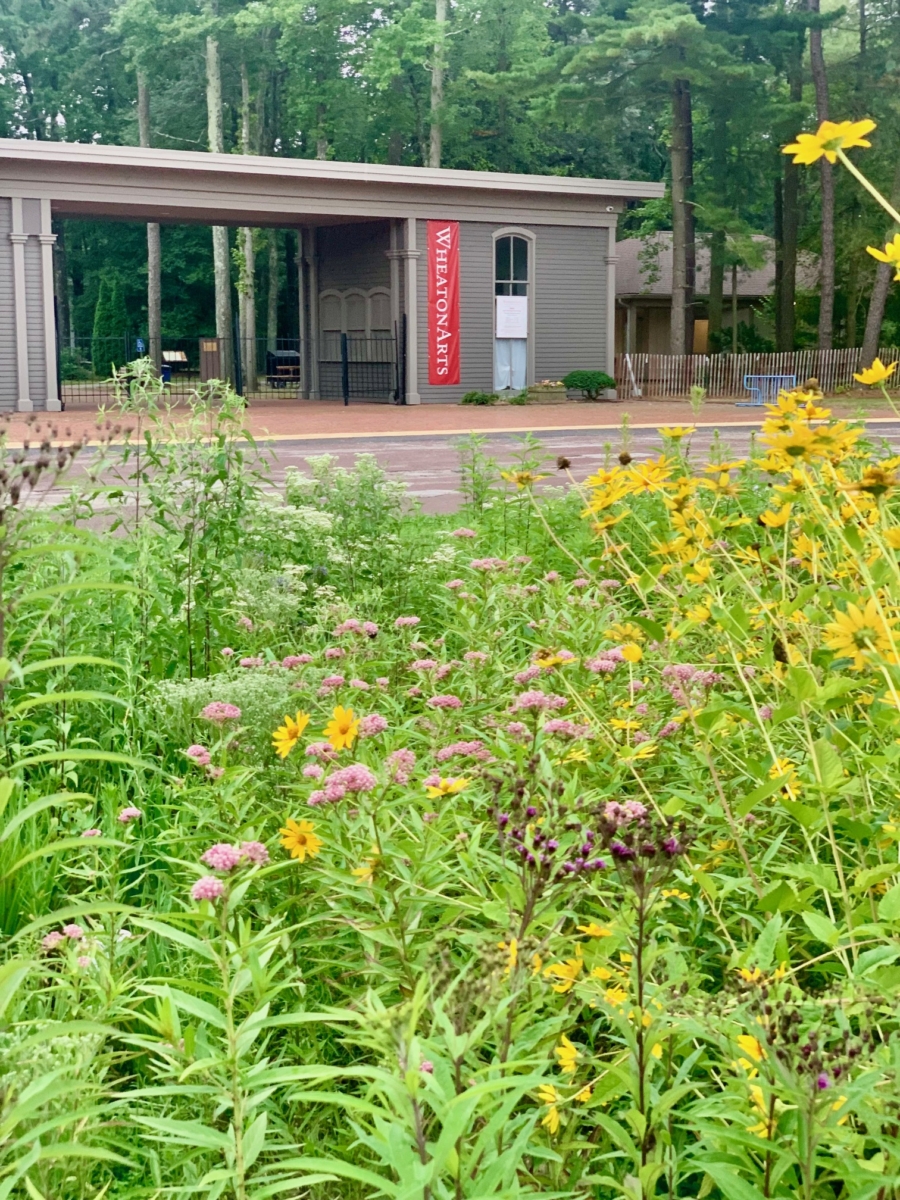
The internet is rich with international examples of guerrilla gardeners who sought to make former railroad rights-of-way green by employing seed bombs. Some were sanctioned activities while others were more militant.
The whole idea of guerilla gardening is clearly not new. In the 1600s, the English Diggers advocated communal land ownership for agrarian purposes in a clearly anti-establishment approach. And in the 1790s and early 1800s, America’s Johnny Appleseed (John Chapman) wandered through parts of Pennsylvania, Ohio, Indiana, and Illinois planting orchards. Johnny was prone to evangelism as part of his messaging.
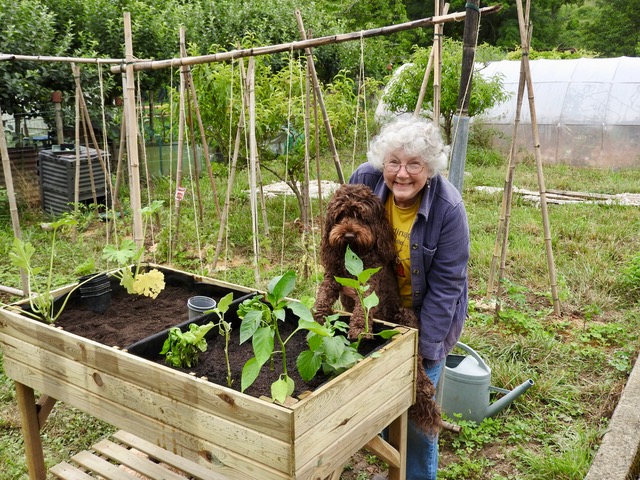
Numerous U.S. cities have created community gardens for planting vegetables by repurposing abandoned lots and forming green spaces. Many organizations have adopted these spaces, transforming them into small, sustainable farming plots.
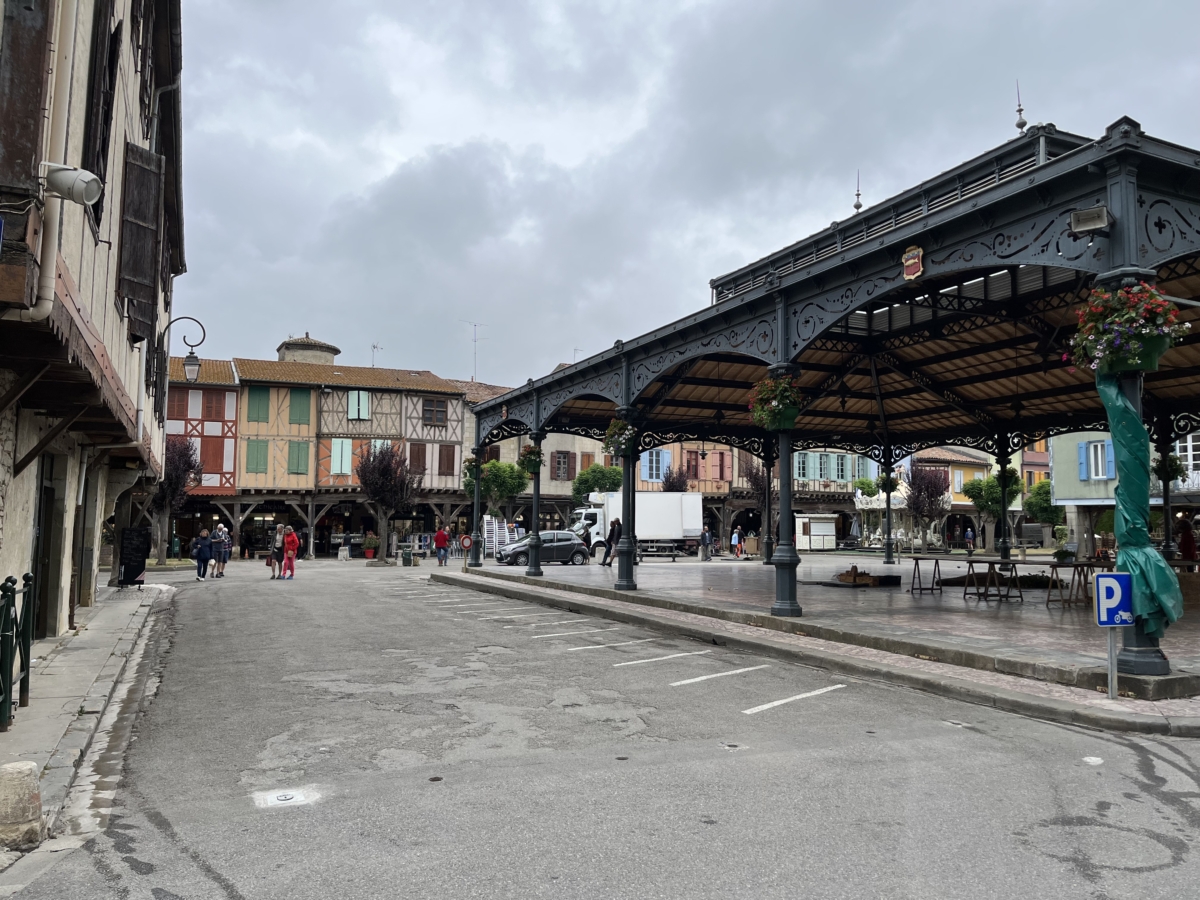
The idea of common green spaces or assigned lots on the outskirts of small towns is not unheard of in Europe; this commune concept dates back to the 1100s. Rowhomes in a town sometimes have a small deeded farmette outside the village itself as part of property ownership. In fact the formation of bastides, a social-engineering idea developed in France in the 14th century, mandated such agricultural parcels, called “casals,” around the perimeter of the village square and its encircling houses so that the homeowners could grow their own food and sell the excess under the halle to pay their taxes. Today these areas, called Cazals, are seen outside many former and current bastide villages in the French southwest. Mirepoix and Carcassonne are two famous bastides that still remain.
Currently the trend, when not agriculturally driven, is to introduce native plants in flower gardens. Natives take less care, promote pollination, and support local natural communities of plants and animals.
I’m not sure when the statute of limitations runs out for mischief but I once employed seed as revenge. I was in my early teens when a property owner in my neighborhood, who had the most perfect of lawns, took a pot shot at my dog.
The homeowner’s lawn was zoysia, an incredibly tough turf that he manicured with everything but tweezers. If you dared to set foot on the grass its strength held you aloft. And if you walked on it he hollered to get off his property. He used to burn it annually. There was not one weed.
Back in the ’60s it was common for dogs to go unleashed in neighborhoods. And my dog dared to wander onto this man’s precious grass one day when I went over to a neighbor’s for a snack. As I exited I saw the homeowner inside his open garage holding a gun aimed at my dog; this was long before he could have been influenced by the actions of homeland security.
I yelled, “Stop, mister, that’s my dog!” but he shot anyway. He must have missed because my dog had no reaction, although he was clearly baffled by the noise.
We left, my dog and I. But we hatched a plan. My dog was my best friend and we discussed everything together, good and bad, so together it was decided that I would swing a bag of bird seed all over his lawn. Unfortunately, when I carried out the plan, he caught me and the chase was on. I ran for two and a half blocks and into the backyard of a property where I jumped a fence. I heard his pants get torn as he tried to hurtle after me, then a number of utterances not worthy of repeating here spewed from his mouth.
I made it one block further into a wooded lot where I lay down with my dog for what felt like hours before I ventured home.
I learned a few things—that when you are scared you can run much faster than you ever thought possible, and that a Kerry Blue Terrier behind you can really trip up a would-be-assailant. I also learned that revenge generally backfires.
So if you want to toss seed bombs my advice is to think out your plan and wear stretch pants and P.F. Flyers. Whatever the outcome, it won’t be as nasty as what our nations do with armaments.
May your garden grow!
Sources
“Guerrilla Gardening,” Silvana Vukadin-Hoitt (2015). The SAGE Encyclopedia of Food Issues.
“On Guerrilla Gardening: A handbook for Gardening without Boundaries,” Richard Reynolds, (2014).
Seed Balls, Inc. website.
“The Real Johnny Appleseed,” Heinz History Center.com
La Bastide by Jacques Dubourg Pilote 24 édition novembre 2000
Notes