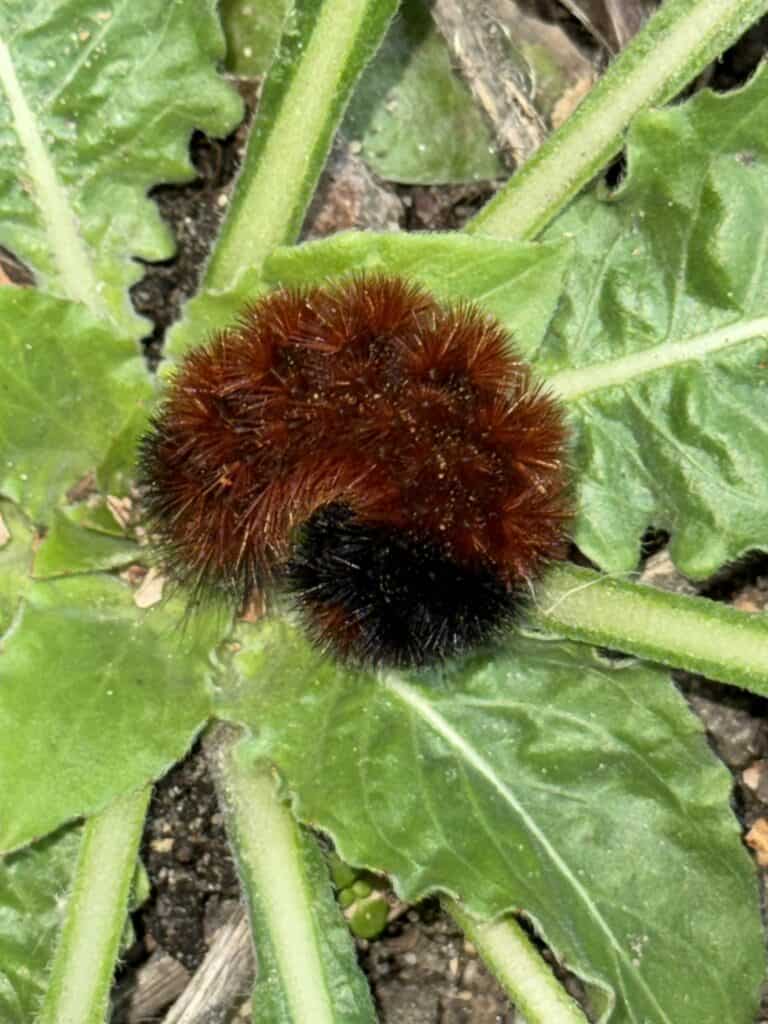
This woolly bear caterpillar assumes a defensive posture; by rolling into a ball it protects its soft underside against predators like wasps. Photo J. Morton Galetto
…for Halloween? Yes, but a wide band of orange hairs on the woolly bear caterpillar does not predict a cold winter.
As we approach Halloween a number of our critters are suitably dressed in holiday attire. The monarch butterfly, milkweed tussock moth caterpillar, false milkweed beetle, and large milkweed beetle all don orange and black. Many naturalists assert that these colors are intended to scare off predators, in many cases indicating that the potential prey feeds on noxious plants.
The larval stages of these insects eat milkweed, which contains toxic chemicals called cardiac glycosides. While they have evolved to tolerate the poisons, their predators have an adverse reaction to them. If a bird or mammal eats one it may feel unwell, so while the individual bug dies the predator avoids its comrades that display similar colors. Some are sacrificed to save the many.
Predators have learned to assume that orange and black denotes “If you dare to eat me, you’re going to be ill.” Not only is the monarch’s yellow, black, and white caterpillar stomach-turning, but the adult butterfly carries the same cardiac glycosides from milkweed as its larval form. Even a bite from a wing can make a songbird vomit.
Milkweed has some of its own defenses, gumming up the jaws of its diners with a sticky sap. The longhorned beetle uses its own strategy to avoid this fate. It snips the major veins of the leaf, allowing the sap to drain out before it munches on it.
One caterpillar in particular is crawling about in proper orange and black attire for Halloween. These have been plentiful in our yard this fall and I’m compelled to write about them. As a child we knew them as “woolly bears,” which transform into the adult Isabella tiger moth, Pyrrharctia isabella. In fact the common name among experts is the same—woolly bears.
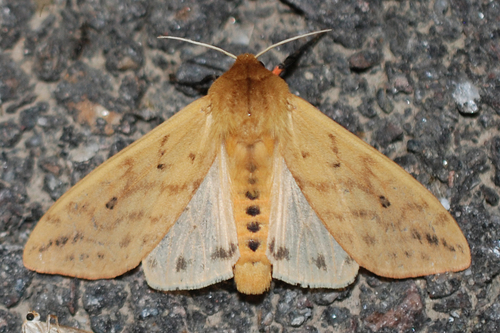
The woolly bear metamorphizes into an Isabella tiger moth. Photo: Larry Clarfeld, iNaturalist
As children we were always warned not to pick them up because “they sting.” That’s not exactly what is happening, but the result of handling one could feel as though you’ve been stung. While their bristles do not inject any venom, they can penetrate the skin and cause discomfort.
Caterpillar expert David Wagner explains that both hairy and spiny caterpillars should be handled with care. The hairs are called setae and they can be dislodged. For some people both the woolly bear and the hickory tussock can produce an allergic reaction, but this is rare. Nonetheless, if the skin it contacts is in a sensitive area like the eyes or mucosal membranes, it can prove very uncomfortable. Wagner says he can pick them up gently without issue but suggests not handling them around children who may not heed the warnings. I generally let one climb aboard a stick or leaf if I wish to inspect it.
As a child I would of course pick them up, especially since I was told not to touch them. Yes, I was that kid, and honestly their name and surface evoke the impression of a cuddly creature—or is that just me? I was also amused by their propensity to roll into a ball to defend their soft underside.
Wasps are known to attack caterpillars, and in some instances even use the caterpillars’ bodies as hosts for their larvae. By rolling in a ball only the setae are exposed and the soft underside is protected. The Minnesota Conservation Volunteer says that some birds such as cuckoos, catbirds, and towhees can eat hairy caterpillars, although most species are deterred by the prickly hairs and bad taste. This animal is most vulnerable in the adult/moth stage, when bats and spiders may dine upon it.
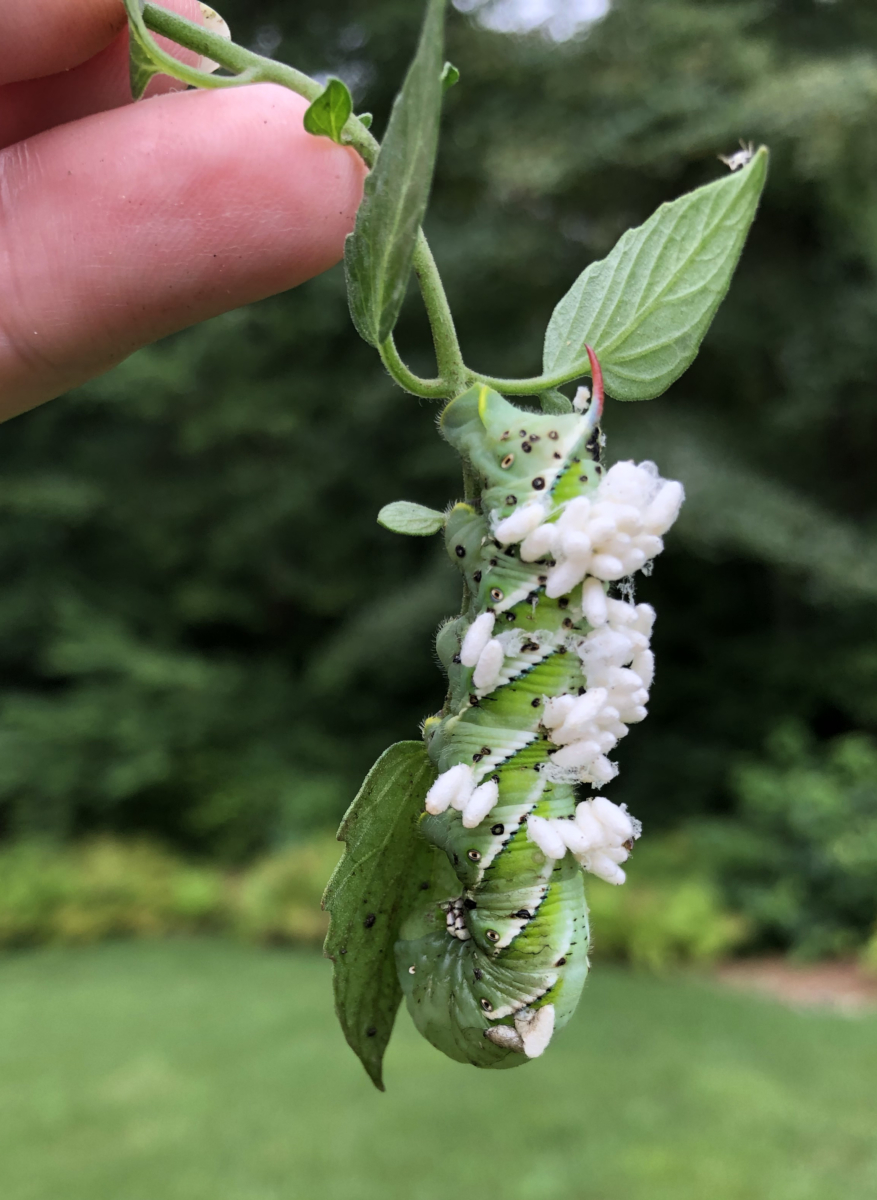
Hornworm caterpillar that has been infested by a braconid wasp that laid its eggs on the caterpillar as a host. Photo:
J. Morton Galetto
Speaking of hairy and spiny caterpillars, some actually can sting you. Know this: Flannel moth caterpillars are fuzzy, looking innocent enough, but beneath their hairy surface they have warts that pack a poisonous charge. Wagner worked in Costa Rica and identified some 15 species of flannel caterpillars, but in our region there are only two. Buck moth larvae also have poison-filled spines. My advice is not to handle hairy caterpillars without some expertise in such matters. There is no need to be afraid of them as they are not about to attack; however, just as many parents advise I’d say, “Look with your eyes.” You and the caterpillar will both be much happier.
Back to our subject species: Woolly bear caterpillars are literally on parade prior to the first frost. In the fall they begin their search for shelter and as such they are often seen crossing hardscape. The individual hatches from an egg laid by a female Isabella moth (its adult stage) and the caterpillar will eat throughout spring, summer, and fall; then it looks for a shelter to overwinter. These creatures have an uncanny ability to withstand freezing temperatures.
Their plump tubular shape, capped by black on each end with a rusty orange middle, is easily recognized. And although I would like to think of them as Halloween-ready, they are probably best camouflaged by their black and orange cloak when crawling through fall leaves.
Legend has it that their orange middle is a predictor of the severity of the coming winter—the narrower the band the more brutal the weather will be. In fact, each time they molt their black ends become narrower, replaced by a wider middle band, so that in their final instar or molt they are mostly orange. The narrower the orange band the younger the individual.
Their lifecycle: In spring the caterpillar will spin a cocoon from its own hairs to prepare for metamorphosis into the adult butterfly. A male will find a female by chemical scents called pheromones and they will mate, after which the female will lay her eggs on a suitable host plant. When the eggs hatch the larvae will begin to eat their way throughout the warmer months and the cycle has thus begun again.
Their food plants are low-growing herbaceous plants such as dandelion, sunflowers, clovers, grass, lettuce, meadowsweet, and nettle. Trees that provide sustenance include maple and elm.
If you are a child I suspect that these furry critters will fascinate you, and if you are an adult I hope they remind you of a childhood filled with outdoor memories. Trick or treat!
Sources
Michael J. Raupp, Ph.D., Professor of Entomology Extension Specialist, University of Maryland, Bug of the Week Series.
Caterpillars of Eastern North America, David Wagner.
Buckeye Yard & Garden onLine, Ohio State University, Woolly Bears and Winter’s Tale, Joe Boggs
Missouri Department of Conservation, Isabella Tiger Moth (Woolly Bear; Woolly Worm), online field guide.
Minnesota Conservation Volunteer, Banded Woolly Bear, by Mary Hoff. September – October 2024.